This is a project shelf, not a single AI framework
AI Engineering Hub collects more than 90 examples grouped as beginner, intermediate, and advanced. The menu covers OCR, local chat interfaces, RAG, voice agents, model comparisons, fine-tuning, MCP servers, and multi-agent workflows. That breadth is useful when you want working shapes to inspect. It also means there is no one installation, architecture, or reliability claim that applies to the repository.
Each directory is effectively its own small project. Some use local models, others depend on hosted search, model, vector, voice, or browser services. The root README offers a roadmap through 22 beginner, 48 intermediate, and 23 advanced entries, but it cannot replace the instructions and code review required for each one. Treat the difficulty labels as navigation, not certification that an example is safe or complete.
The measured researcher is a 3-step CrewAI pipeline
Our selected directory, Multi-Agent-deep-researcher-mcp-windows-linux, creates 3 agents. A web searcher calls Linkup, a research analyst turns results into structured findings, and a technical writer produces Markdown with source links. CrewAI runs the tasks sequentially. The researcher can be opened as a Streamlit chat app or called through one stdio MCP tool named crew_research.
agents.py defines the tool, agents, tasks, and crew. app.py stores a Linkup key in Streamlit session state and displays the conversation. server.py wraps run_research with FastMCP. The package metadata asks for Python 3.11 or newer and lists CrewAI, Linkup, MCP, OpenAI, dotenv, and Streamlit dependencies.
The model path is less flexible than the root description suggests. get_llm_client() hardcodes ollama/deepseek-r1:7b and http://localhost:11434. Running the example therefore needs Ollama reachable on that address with the named model available, plus a Linkup API key for web search. The README explains uv sync, the Streamlit command, and an MCP client block, but it does not document changing the model or operating the service remotely.
What happened when we ran it
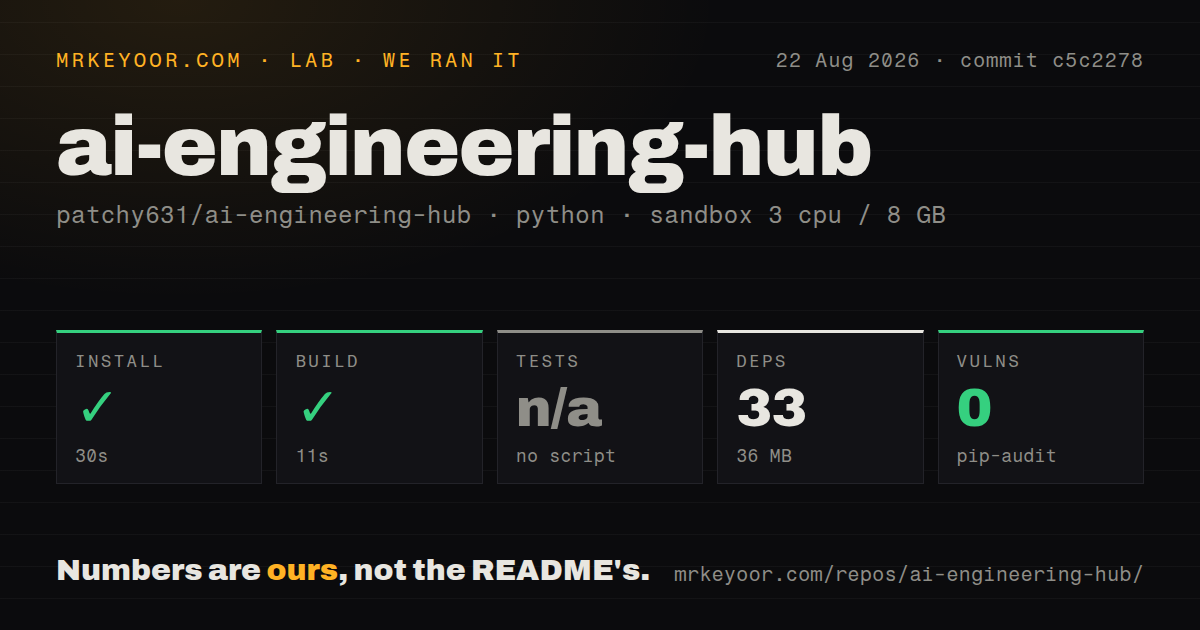
Our sandbox checked commit c5c2278 and worked inside the measured subdirectory rather than treating all 93-plus examples as one Python package. uv installed 33 packages in 30 seconds, consuming 36 MB. The measured build succeeded in 11 seconds, and pip-audit reported 0 known vulnerabilities. The container had 3 CPUs, 8 GB of RAM, and no secrets.
There was no test script or target, so we skipped tests. The repository has no tests directory for this measured path, no Dockerfile, and 0 GitHub CI workflow files. A successful 11-second build tells us the locked dependency set resolved in our fresh Debian container. It does not verify a Linkup search, the local DeepSeek model, a 3-agent handoff, Streamlit, or the MCP call. No credentials were available in the sandbox.
The whole checkout was 349.5 MB across 1,444 files and roughly 104,367 source lines. That size belongs to the collection, while the 33-package result belongs only to the deep-researcher directory. Mixing those scopes would make the install look more representative than it is. Another example may use notebooks, Node, a hosted database, GPU libraries, or several paid APIs and have a completely different setup cost.
Error handling is tutorial-grade
The Linkup tool catches a broad exception and returns its text as a string. run_research does the same around CrewAI. That keeps some failures visible in chat, but it does not distinguish authentication, quota, timeout, model, or malformed-result errors. There is no retry policy, structured failure response, health check for Ollama, or test around partial agent output. They are unacceptable defaults in an unattended research service.
Open issue 250 is specifically about Multi-Agent-deep-researcher-mcp-windows-linux. It reports that a GitHub API rate-limit exception is not handled and terminates the workflow. The current source we read does not expose a GitHub tool directly, so the report may concern a path or revision not obvious from the small files. It still identifies quota handling as something a prospective user must reproduce before deployment rather than assuming a general catch covers it.
Security review must happen per directory too. Open issue 229 concerns the separate Pixeltable MCP example and reports MCP tools that build Python functions from raw strings passed to eval() and exec(). That finding does not apply to the measured CrewAI server. It does show why a large tutorial collection cannot carry one blanket safety verdict. Never expose copied MCP tools to a privileged agent until you have traced every input to its side effects.
Activity is healthy, release discipline is absent
The last repository push was July 27, 2026. Pull requests were still being updated in August, including new examples and model-pin changes. GitHub listed 124 open issues and pull requests, with reports about notebook rendering, dependency conflicts, incorrect RAG branching, hardcoded paths, and the MCP code-execution concern. That is real activity around a large teaching collection, though the queue mixes contributions with defects.
There is no latest GitHub release. Users must pin a commit rather than a versioned artifact, and independent examples can age at different rates even when the root README receives updates. The lack of root CI makes that drift harder to spot. A dependency lock in the measured directory is helpful, but without an executable test it only preserves a set of packages, not known behavior.
Pick one lesson and take ownership of it
AI Engineering Hub is good browsing material for a developer who wants several concrete starting points in one place. The 3-agent researcher is readable, installs quickly, and demonstrates both Streamlit and MCP around the same function. It is a sketch you can extend after adding model configuration, typed errors, retries, tests, and safer credential handling.
For a research service you intend to operate, GPT Researcher or Open Deep Research offers a more focused starting point. For a course, Microsoft's AI Agents for Beginners gives lessons an explicit order. Use this hub when breadth and experimentation are the goal. The moment one example becomes production code, move it into its own repository and give it the controls the collection does not provide.