Eighteen lessons move from tools to deployed agents
The curriculum starts with agent definitions, framework choices, design patterns, and tool use. It then covers agentic RAG, trust, planning, multi-agent work, metacognition, production, MCP plus A2A and NLWeb, context engineering, memory, Microsoft Agent Framework, browser control, scalable deployment, local agents, and security. That sequence is more serious than a collection of chat notebooks.
Each lesson has written material, Python samples, and usually a video or further-reading link. The README expects generative AI familiarity and directs true newcomers to Microsoft's separate 21-lesson course. That prerequisite is sensible. Agents combine model calls with tools, state, external data, and side effects; a learner who is still sorting out tokens and prompts will struggle to judge the additional failure modes.
Microsoft Foundry is the default, not an optional sidebar
The current notebooks use Microsoft Agent Framework with FoundryChatClient, connecting to Foundry Agent Service V2 through a Foundry project. Standard setup needs Python 3.12 or newer, Azure CLI, an Azure subscription, a deployed model, and an authenticated az login. The project endpoint and deployment name go into .env, while most notebooks use the CLI identity instead of copied API keys.
Optional paths make setup wider. Some samples require .NET 10 or newer. Lessons 5 and 16 can use Azure AI Search, though the setup guide says Lesson 16 still needs an admin key for a real index. Lessons 6 and 8 can call Azure OpenAI directly. A Bing grounding workflow adds another resource, and alternative OpenAI-compatible providers have varying levels of automatic configuration.
What happened when we ran it
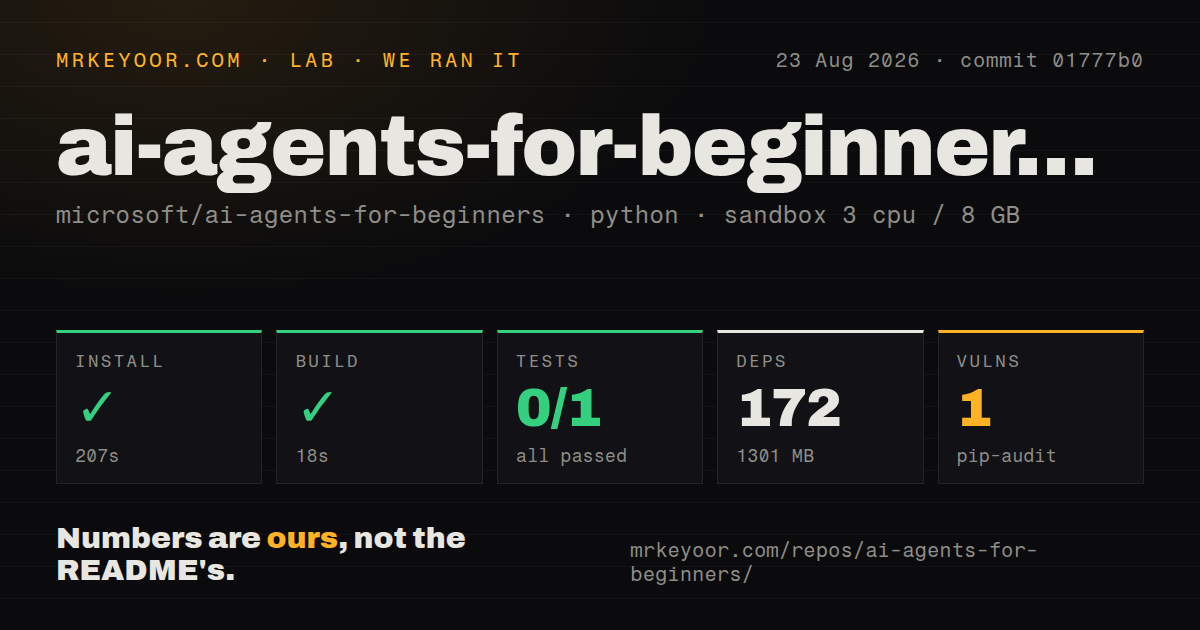
Our sandbox installed 172 Python packages in 207 seconds and used 1,301 MB on disk. The build completed successfully in 18 seconds. We ran commit 01777b0 in an unprivileged Debian container with 3 CPUs and 8 GB of RAM. The checkout contained 10,224 files, about 4,358 lines classified as source, and occupied 539.7 MB before dependencies.
Pytest failed with exit code 1 after 54 seconds. It ran 0 tests and reported 1 collection or setup error. While importing 04-tool-use/code_samples/test_demo_plugins.py, Python raised ModuleNotFoundError: No module named 'demo_tool_agent'. The supplied log does not show whether the module is absent, misnamed, or outside the import path, so we will not assign a cause beyond the failed import.
Pip-audit reported 1 known vulnerability, with no package or severity in the measurement block. Three CI workflow files and a tests directory were present; no Dockerfile was found. The successful 18-second build does not cancel the collection failure. A learner should fix the import context and rerun the test before using that tool lesson as a reference implementation.
Local models cover chat examples, not every cloud feature
Foundry Local is the documented on-device option. It downloads and serves a model behind an OpenAI-compatible Chat Completions endpoint, then Microsoft Agent Framework can wrap it as an agent. That is useful for offline study and for separating agent logic from cloud provisioning. It also keeps eligible prompts and code on the learner's machine.
The setup guide states the limit clearly: Foundry Local does not provide the full Responses API feature set used by the cloud path. A local model may also behave differently on tool selection, long context, planning, and structured output. Run the same small exercise on the intended production provider before treating a local success as compatibility proof. Provider portability is an experiment here, not a guaranteed course-wide property.
The clone is larger than the lesson code
Our checkout was 539.7 MB and held 10,224 files despite only about 4,358 lines being classified as source. The README explains that more than 50 language translations increase the download size. The setup guide goes further, noting that a full history clone can be around 3 GB and showing both shallow and sparse commands for workshops and Codespaces.
Use sparse checkout for 00-course-setup plus the lesson folders you plan to run. This reduces download and search noise without changing the learning content. Translation availability is valuable, but automated text can lag a code or credential change. When a translated setup step disagrees with the English notebook, verify the environment variable and SDK call in the current source.
Protocol and security lessons belong before production
Dedicated material on MCP, A2A, NLWeb, context, memory, deployment, and security gives the course a better stopping point than many beginner series. Tool-capable agents can read data and cause external changes, so authentication, authorization, budgets, logging, and human approval need to be designed with the workflow. A notebook that returns the right prose is not enough evidence for safe automation.
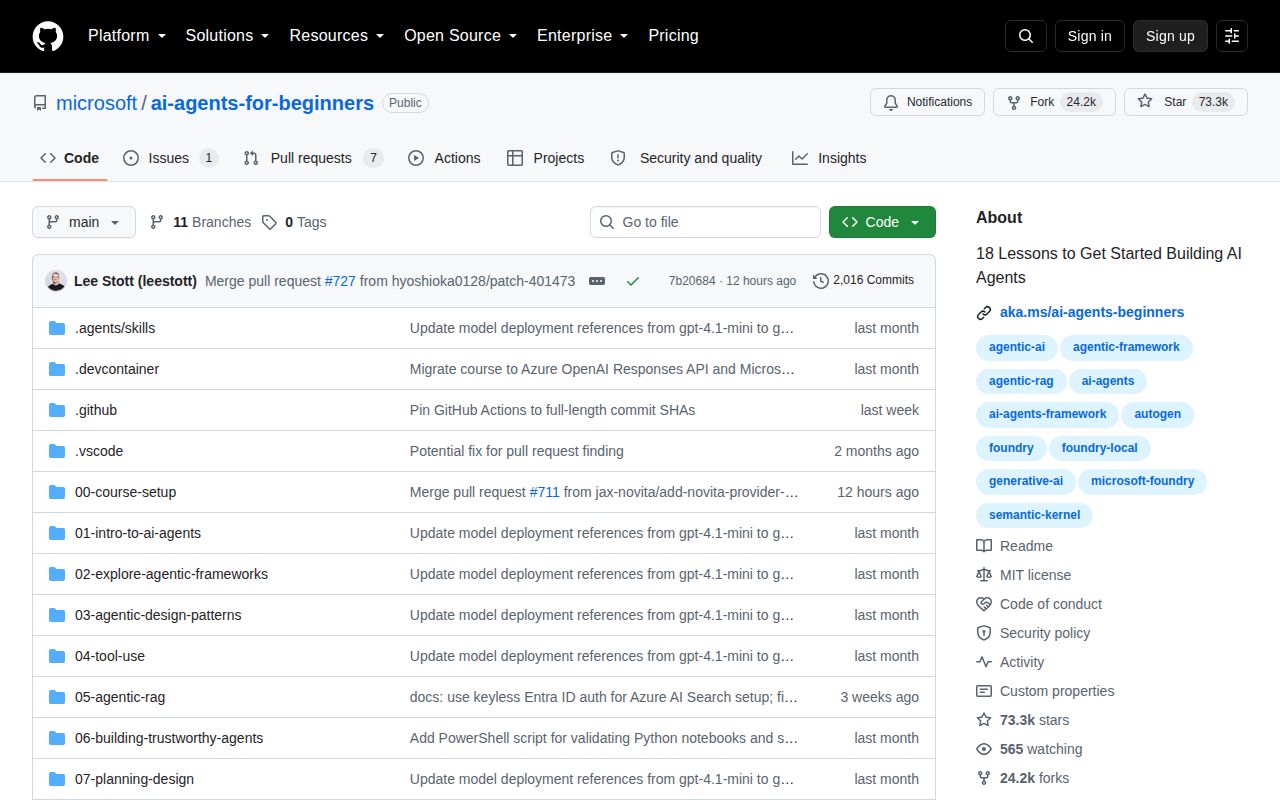
The repository had 73,292 stars and 8 combined issues and pull requests when fetched, and the last push was August 27, 2026. GitHub's latest-release endpoint returned no release object, but same-day source activity argues against calling the course stale. Its main weakness is execution consistency: 1,301 MB of dependencies installed and the build passed, yet the available test never reached its first assertion. Learn the patterns, then rebuild the chosen one in a smaller, tested service.