The skill turns a premise into a Traditional Chinese shooting draft
AI-drama-pound packages a writing method for short, vertical drama as a standalone Codex skill. The fetched README is entirely in Traditional Chinese and does not offer an English translation. A prompt can ask for a creative brief, cast relationships, episode beats, scene divisions, dialogue, conflict, reversals, hooks, a draft, or revision. The useful part is scope control: if you request only dialogue changes, the instructions say the skill should avoid rebuilding the characters and full outline.
The README's worked example starts with a delivery rider who suspects that a customer with memory loss is his missing grandfather. It turns that premise into an 8-episode structure with 90-second episodes and no more than 3 main locations. The sample then supplies character motives, selected episode beats, and a formatted opening scene. That gives a buyer a concrete view of the intended output instead of asking them to infer the workflow from a folder name.
It preserves production limits but stops before storyboards
The skill is strict about requested constraints. Its feature list says it retains episode count, duration, audience, genre, platform, budget, locations, and delivery format. Scene formatting covers interior or exterior, place, time, action, character names, dialogue, and on-screen text. Revision guidance is supposed to identify the problem, point to the relevant passage, explain the effect, and propose a usable correction. Those rules address common script-generation failures such as unexplained character turns and dialogue that only recites background.
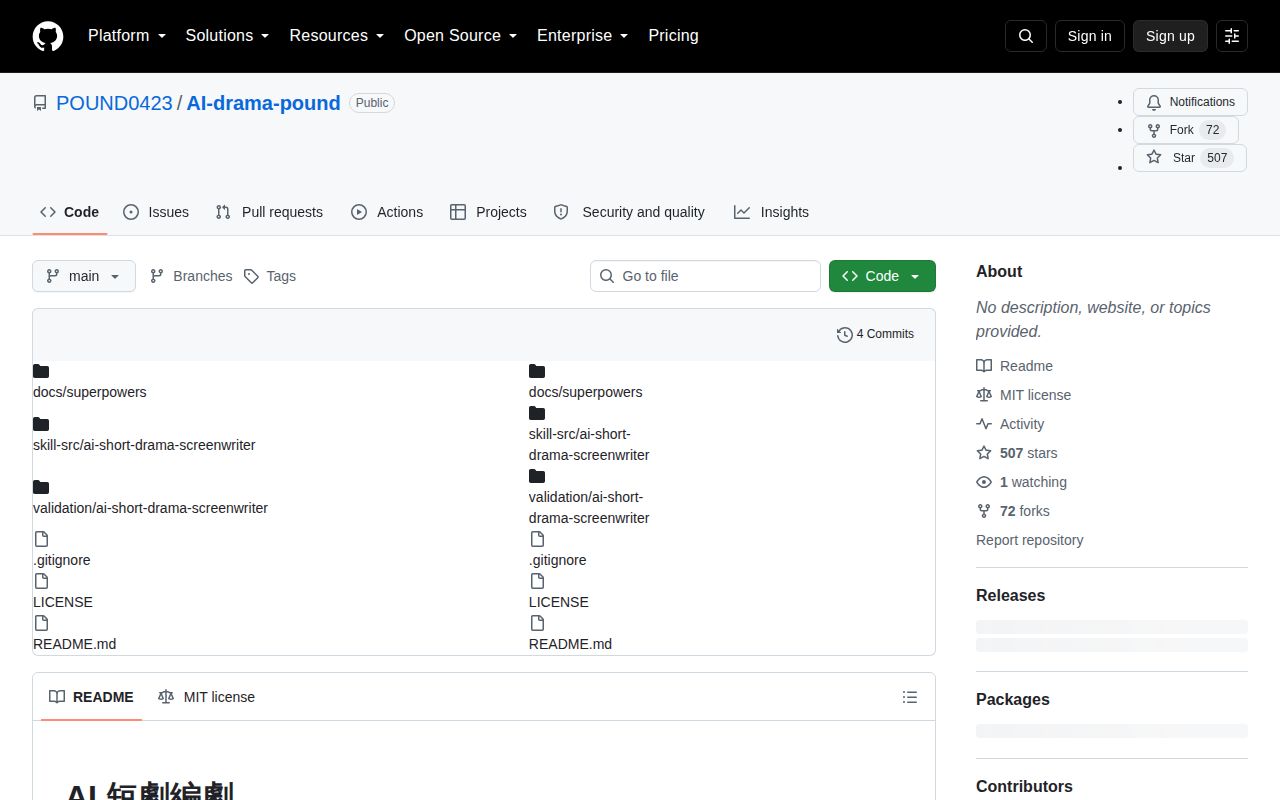
Its boundary is equally useful. A script request does not automatically produce shots, camera movement, framing, or parameters for an AI video model. Mixed requests finish the script first and then hand off only when another suitable skill is installed. That makes AI-drama-pound a writing component, not a complete production line. Teams still need separate decisions about visual continuity, asset generation, voice, editing, and delivery. The repository's own project tree shows one writing skill with references for workflow, format, and checklists.
What happened when we ran it
Our lab did not run AI-drama-pound at commit d3724f7. The checkout exposed no language ecosystem supported by the harness, and it had no Dockerfile. In a fresh unprivileged Debian container with 3 CPUs, 8 GB of RAM, and no secrets, there was therefore no defensible install, build, or test target to execute. We have no package count, timing, test total, or disk result to report.
That finding fits the artifact: users install it by copying files rather than compiling an application. It still limits what we can verify. Repository-supplied validation records are useful documentation, but they are not a substitute for our own execution. A trial should invoke the skill on representative premises, check that constraints survive across revisions, and compare the generated script with the requested delivery scope. We did not perform those behavior checks in this sandbox run.
Installation is a file copy into a Codex skills directory
The documented prerequisites are Git and a ChatGPT desktop Codex, Codex CLI, or IDE extension that supports standalone skills. On macOS and Linux, users clone the repository, create $HOME/.agents/skills/ai-short-drama-screenwriter, and copy the contents of the source skill folder there. Windows receives equivalent PowerShell instructions. The README says Codex normally detects the skill automatically and recommends restarting the client if it does not appear.
No hosted account, API key, database, or background service appears in that setup. The operational dependency is the Codex host itself. Explicit use names $ai-short-drama-screenwriter; an ordinary request that falls inside its scope may trigger it implicitly. That automatic route deserves a quick check in a shared skills collection, especially if another writing or video skill can answer the same prompt. The README resolves mixed work by completing the screenplay and then seeking another installed skill.
Traditional Chinese is the default, while current market claims need research
The repository says the default output language is Traditional Chinese and allows another language to be requested in the prompt. That is different from providing English documentation or showing English output quality. An English-language newsroom would have to translate the operating instructions, create its own evaluation prompts, and inspect whether terms such as scene headings, subtext, and episode hooks transfer cleanly. Nothing in our lab result proves that cross-language behavior.
One safeguard is worth keeping if you adapt the files. Requests about present platform preferences, algorithms, or market trends must be researched rather than answered from old knowledge. That rule separates stable craft guidance from claims that can expire. It also means the skill needs browsing or another current source when a writer asks what a platform rewards today. Without that access, the correct result is a narrower script response, not confident market advice.
A fresh v0.1.0 release makes this an early adoption
GitHub showed 507 stars, 0 combined open issues and pull requests, and a last push on August 26, 2026. Release v0.1.0 was published the same day. Those facts show immediate attention around the first public version, though a zero-item queue says little about how the workflow behaves across varied productions. The repository is MIT licensed and was not archived when fetched.
For Traditional Chinese short-drama writers already using Codex, the cost of inspection is low because the package is plain text and the README exposes its limits. The case for adoption rests on whether its constraint handling improves your scripts, something our harness could not measure. English-only teams, storyboard-first creators, and buyers wanting a runnable service should choose a different tool. This repository is best treated as an editable editorial method whose output must still earn a place in production.