Most entries are links, while bundled skills contain code
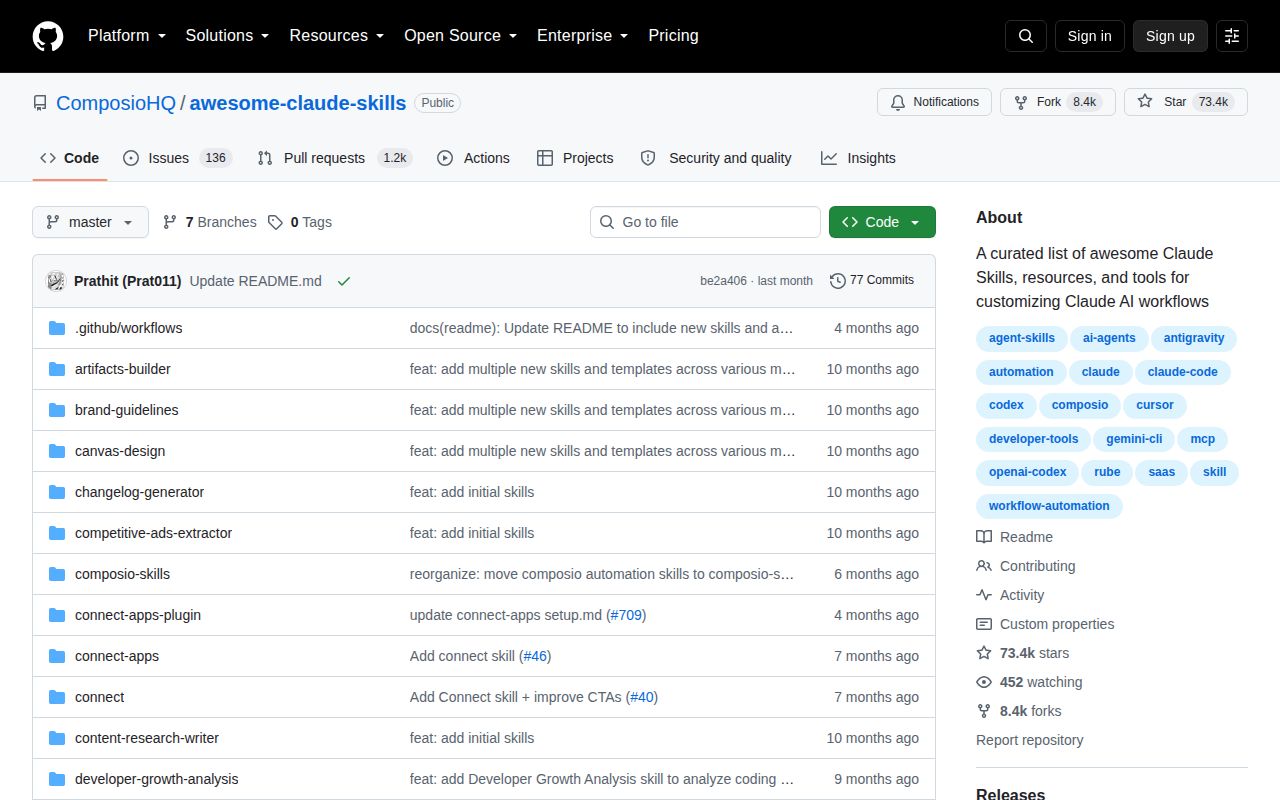
Awesome Claude Skills collects instruction folders that tell an agent how to perform a recurring job. The root README spans document work, development, research, marketing, media, organization, and app automation. Some entries live in this repository. Many point to another owner's repository, website, or plugin. That distinction matters because selecting a link from the list does not give you a common runtime, support policy, or security review.
The checkout we measured had 1,142 files, about 17,437 lines of source, and an 11.6 MB repository footprint. Its dominant language is Python because several bundled skills contain helper code, but much of the product is Markdown. Calling it a Python application misses the point. It is closer to a shelf of agent procedures, with a few working toolkits placed beside the index.
Claude Code gets patterns, not one common runtime
A skill is a folder centered on SKILL.md, with metadata that says when the agent should load it. Instructions can be joined by scripts, templates, references, and assets. The README explains manual placement for Claude Code and also discusses Claude.ai, API use, Codex, Cursor, and other agents. Portability still depends on what each entry asks the host to do.
The breadth is the reason to visit. A developer can compare several approaches to testing, research, screenshots, spreadsheets, or project management without discovering every author separately. The repository also includes app automation skills built around Composio services. Those entries may require a Composio API key, an MCP connection, and permission to act in an outside account. A readable instruction file is not a harmless instruction file by default.
What happened when we ran it
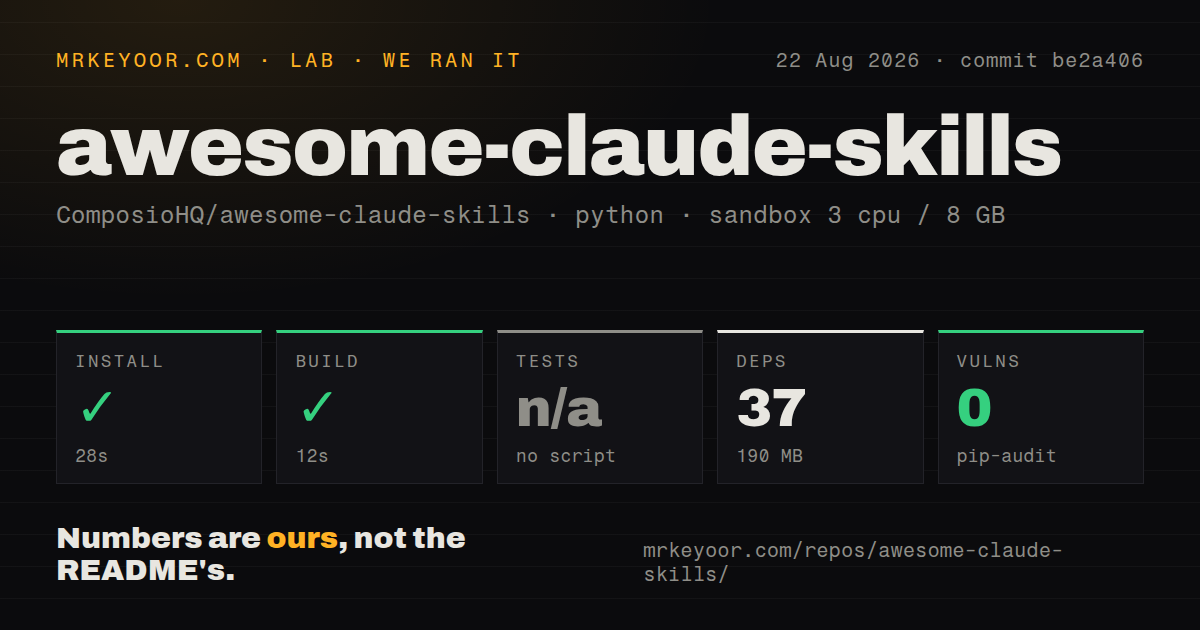
Our sandbox ran slack-gif-creator, the Python project inside the collection. Installation succeeded in 28 seconds, pulled 37 packages, and occupied 190 MB. The build completed in 12 seconds. Pip-audit reported 0 known vulnerabilities in that installed environment. These results apply to commit be2a406 in the stated 3-CPU, 8 GB Debian container, not to every external project linked from the README.
There was no tests script or target, so the lab skipped tests. The repository scan likewise found no tests directory, one CI workflow file, and no Dockerfile. None of those facts proves the GIF code is broken. They mean the successful build is the end of the automated evidence we have, and users should validate actual GIF output before placing the skill in a shared agent setup.
Slack GIF Creator builds, but it has no test target
The bundled GIF skill is more substantial than a prompt. Its Python modules cover frame composition, typography, color palettes, easing, validation, and effects. Template files implement bounce, fade, flip, morph, movement, pulse, shake, slide, spin, wiggle, zoom, and other animation patterns. The skill tells the agent to check dimensions and output size for Slack messages and emoji.
Four direct requirements, Pillow, imageio, imageio-ffmpeg, and NumPy, sit behind that workflow. The instructions provide Python examples for assembling frames, quantizing colors, removing duplicates, and warning when a file exceeds its target. Our 37-package install says the local cost is modest compared with many AI tools. The missing test target says you still own regression checks for frame counts, file headers, visual quality, and Slack acceptance.
Submission rules do not prove every skill was rerun
The contribution guide asks authors to solve a real problem, document examples, test across a Claude surface, and confirm before destructive operations. Those are sensible submission rules. They are statements to contributors, not proof that maintainers reran every submitted skill against every supported agent. Outside links can also change after inclusion without a commit in this repository.
GitHub listed 1,332 combined issues and pull requests when fetched, and recent activity included several new skill submissions on August 26, 2026. The repository's last push was August 10, 2026, so issue activity is newer than the default branch. There is no latest GitHub release. This looks active, but the queue is large enough that readers should not mistake presence in the list for current maintainer approval.
Licensing also needs item-by-item attention. GitHub returned no detected license for the repository root, although the README displays an Apache 2.0 badge and the Slack GIF folder contains its own Apache 2.0 license text. Linked projects keep their own terms. A company copying several skills into an internal agent should record the source and license for each folder instead of assigning one license to the whole catalog.
Review one skill before granting it credentials
Start with the job you want the agent to perform, then open the selected SKILL.md, scripts, and linked dependencies. Look for shell commands, network calls, credential requests, write operations, and instructions that send data to another service. Pin the source revision once a skill passes review. For a workflow that can delete files, send messages, or change cloud resources, test it with limited credentials in an isolated environment.
Awesome Claude Skills saves discovery time and shows many concrete ways to package agent instructions. It does not remove the engineering work between finding a skill and trusting it. The 28-second Slack GIF install makes that one bundled tool easy to try, while the absent test target and mixed ownership keep the collection out of the install-everything category.