This is a textbook repository, not one agent product
AI Agent Book organizes agent engineering into 10 chapters. It starts with the basic model of an agent, then covers context, memory and knowledge bases, tools and MCP, coding agents, multimodal interaction, evaluation, model post-training, continuous improvement, and multi-agent cooperation. Each chapter links theory to experiments. That makes the repository useful for structured study, but the examples do not form one deployable service with a shared runtime contract.
Chinese is the primary language. The repository provides an English community translation along with Spanish, Indonesian, Arabic, Traditional Chinese, Russian, Tamil, Vietnamese, Japanese, Turkish, Korean, Hungarian, and Hebrew editions. The README explicitly says translated versions may lag behind the Chinese original. English readers have substantial material, including downloadable PDF and EPUB files, but should check the source chapter when an experiment or dependency no longer matches the translated instructions.
Chapter extras are the intended installation boundary
The documented setup supports Python 3.11 through 3.13 and recommends uv sync --locked --extra ch1, replacing ch1 with the chapter being studied. That boundary matters because the repository spans simple API examples, browser automation, local inference, evaluation systems, and training stacks. Installing one chapter keeps unrelated tools out of the environment and makes failures easier to trace. The all extra is described as CPU-friendly and still does not include every experiment.
Many exercises require configuration beyond Python. The README names provider API keys, local Ollama where explicitly supported, browsers, CUDA, FFmpeg, Playwright browsers, and external repositories. It also supplies pinned checkout commands for external reproduction tracks. A learner should pick an experiment, read its own README, list paid services and hardware, then create a disposable environment. Cloning the root repository is only the first step.
What happened when we ran it
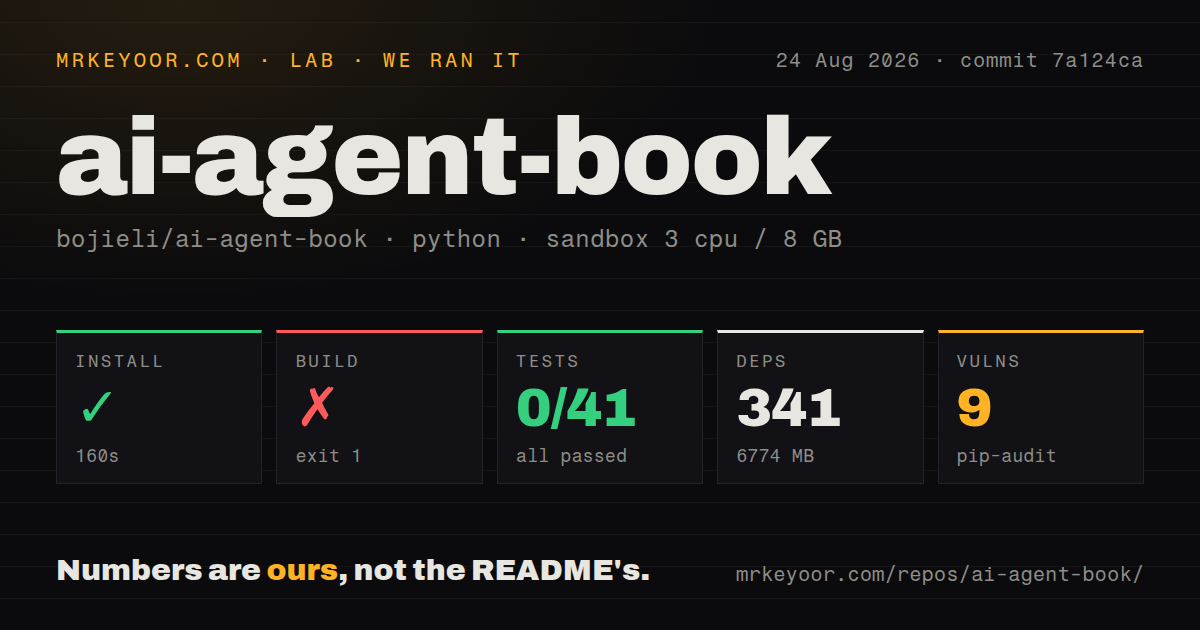
Our root Python 3.12 install at commit 7a124ca succeeded in 160 seconds. It added 341 packages and used 6,774 MB on disk. The checkout was already 1,290.7 MB, containing 11,635 files and about 511,440 lines of source. Those figures explain why a whole-repository setup is a poor default for casual reading: code, book sources, translations, assets, and many independent experiments share one tree.
The build failed after 10 seconds. Its final lines contained repeated SyntaxWarning messages in an AWorld Redis storage module because string literals were compared with is not rather than !=. The excerpt does not show the build command's final error, so we cannot say those warnings caused the exit. We can only report that the build ended with status 1 and that the warning pattern was visible at the tail.
Tests ran for 43 seconds and exited 3 with 0 passes, 0 failures, and 41 collection or setup errors. The final traceback shows chapter3/agentic-rag-for-user-memory/test_enhanced_logging.py calling sys.exit(1) while pytest imported the module, producing an internal error. Pip-audit also found 9 known vulnerabilities in our installed environment. These are reasons to isolate experiments and review dependencies before running them with credentials.
Experiment labels matter more than the headline count
The README distinguishes runnable projects, reproduction tracks, and designs in chapter-specific indexes. That is a useful admission because educational repositories often blur code presence with completed verification. An external checkout pinned to a commit gives a stable source point, yet it says nothing about model access, hardware, datasets, browser setup, or whether the experiment finishes. The project also keeps a separate experiment-status document for execution evidence and unfinished checks.
Readers should preserve that distinction in their notes. Record which commit, chapter extra, provider, model, dataset, and command produced a result. Avoid installing every chapter into one long-lived environment, especially after our audit found 9 known vulnerabilities. Disposable environments reduce dependency conflicts and keep experimental packages away from development credentials used elsewhere.
Activity is strong, while translations remain moving targets
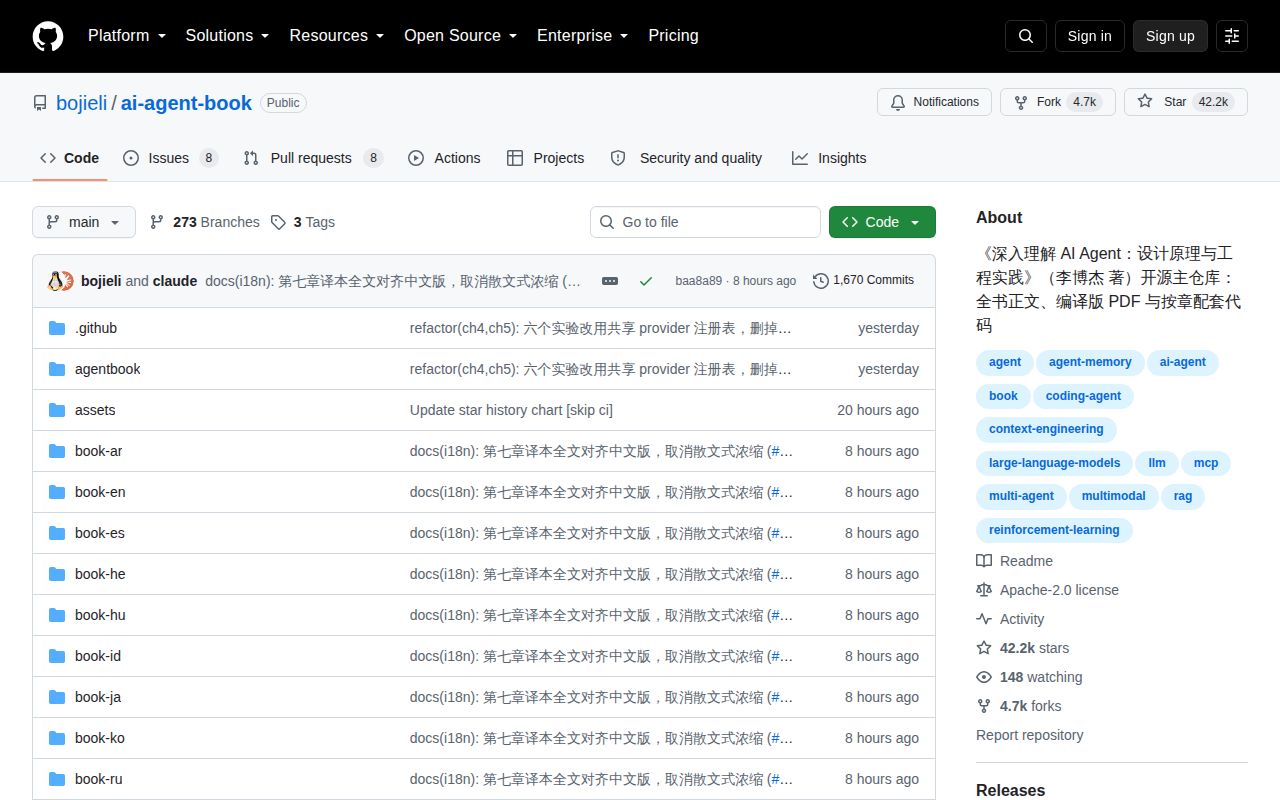
The repository was pushed on August 25, 2026. GitHub showed 16 open issues and pull requests, and the most recently updated items included several same-day translation-alignment pull requests plus learner questions about prerequisites and study strategy. That combination indicates active maintenance and real reader engagement. The small combined queue should not be read as a defect count, and same-day translation work also confirms that non-Chinese editions need continuing alignment.
There was no conventional latest release returned by GitHub's latest-release endpoint during this review, despite the README linking downloadable book artifacts through a latest path. Health should therefore be judged from current commits and issue activity, not a missing release object. Readers who need a fixed citation should record the commit or download a specifically identified artifact rather than assuming a moving link will remain identical.
Read widely, run narrowly
AI Agent Book is useful because it connects architecture concepts with concrete experiments across much more than one framework. The Chinese original is the best-supported reading path, and the English edition makes most of that structure accessible. Apache 2.0 licensing also permits reuse of the repository's own material, subject to licenses inside individual subprojects.
Its weakness is the same breadth. A 6,774 MB root environment that fails build and collection is not a dependable course appliance. Microsoft’s AI Agents for Beginners and the Hugging Face Agents Course offer narrower English-first paths. LangChain is a better comparison when the goal is shipping an application. Use this repository as a map and laboratory shelf: select one chapter, verify one experiment, and keep its environment isolated.