Put your recurring review procedure in a folder, give it a name and a useful description, and let a compatible agent load the detailed instructions when needed. That is the practical promise of Agent Skills. The repository defines the shared packaging convention behind SKILL.md files, so a workflow can travel with its references and scripts instead of being reconstructed in each conversation.
The decision is whether you need to author or support that format. Someone looking for a ready-made document workflow should start with an actual skill collection. A team moving its own procedures between agent tools should read this specification, especially the parts that leave behavior to the host. A shared file structure gets you only part of the way to a repeatable result.
What happened when we ran it
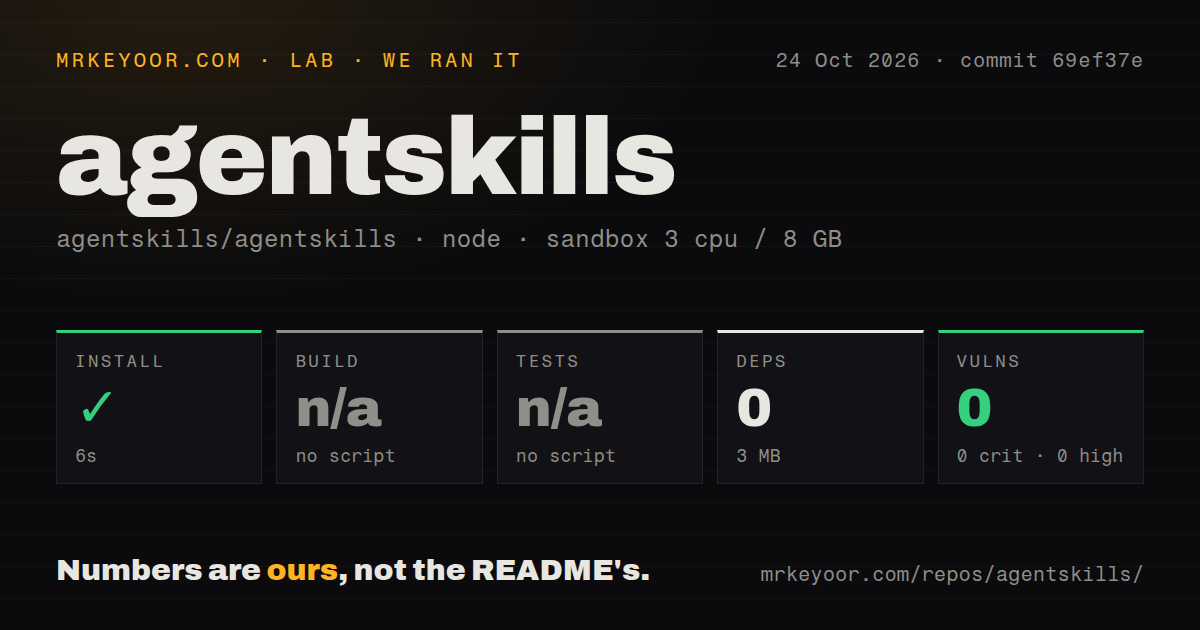
Our sandbox installed Agent Skills commit 69ef37e in 6 seconds, recording 0 dependencies and 3 MB on disk on October 24, 2026. The checkout contained 138 files and occupied 1.7 MB before installation. The selected npm path had no build script or target and no test script or target, so both steps were skipped. There is no passing suite behind this result.
Npm audit reported 0 known vulnerabilities. With 0 dependencies recorded on that path, the audit offers little evidence about scripts somebody might later add to a skill or software used by an agent host. Those components were outside the run. A clean repository audit cannot establish that an imported workflow handles private files or external services safely.
The recorded configuration was 3 CPUs, 8 GB RAM and image lab-node:22. Actual runtime and operating-system versions require the raw toolchain logs. This was a repository-mechanics run through npm, with no observation of skill discovery, agent compliance or host permission checks. The small installed footprint makes inspection inexpensive, while leaving those adoption questions open.
Name and description determine how a skill is discovered
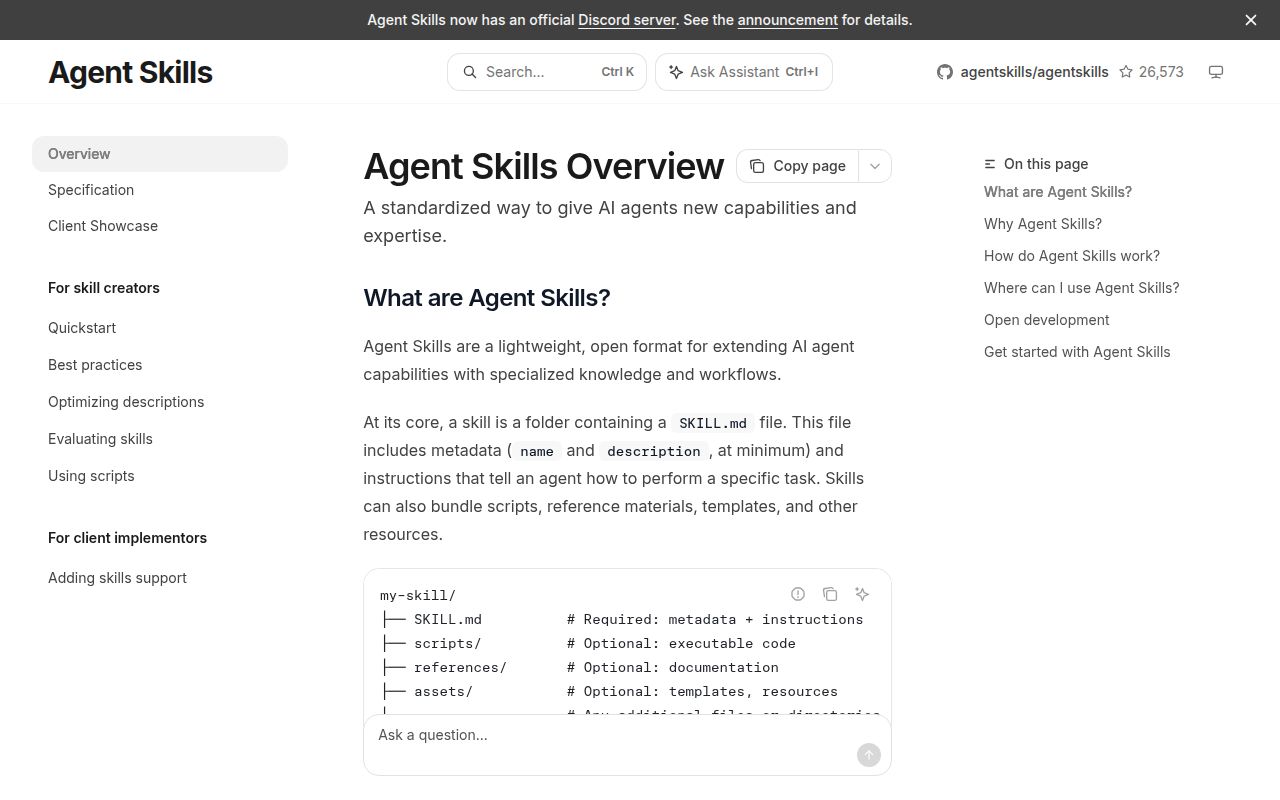
The specification requires SKILL.md to contain YAML frontmatter followed by Markdown instructions. Name and description are required. The name must follow the documented lowercase naming rules and match the parent directory. The description should explain both what the skill does and when to use it. That second part matters because the agent uses metadata to decide whether the full instructions belong in its current task.
The README describes discovery, activation and execution as separate stages. At discovery, an agent loads names and descriptions. It reads the full instructions when a task matches, then loads resources or runs bundled code as needed. That suggests a practical editing priority: make the description specific enough to distinguish your workflow from neighboring skills before adding more procedural detail.
Optional scripts, references and assets can sit beside the main file. The specification recommends relative paths and shallow reference chains, with detailed material separated from the main instructions. A release checklist can therefore point to its supporting files without forcing all of them into the initial discovery text. We did not measure context savings, activation accuracy or completion quality from that arrangement.
Allowed tools and script languages depend on the host
The allowed-tools field is experimental, and the specification says support may vary between agent implementations. Treating that field as a universal permission control would exceed what the format promises. If a workflow can write files or call external services, check what the intended host actually permits and how it obtains approval. A metadata declaration alone doesn't demonstrate enforcement.
Script portability has a similar boundary: supported languages depend on the agent implementation. The optional compatibility field can describe a required product, system packages or network access. Use it when a workflow has those requirements, then inspect the scripts themselves. A folder that parses correctly may still require an executable, credential or network route unavailable in the destination environment.
The specification points to skills-ref for checking frontmatter and naming conventions. That is useful for catching structural mistakes before distribution. It doesn't establish that the agent selects the skill for the right request or produces the intended answer. For adoption, choose a representative task with an expected result and check it in each host you intend to support. That exercise remains separate from our skipped repository test step.
Recent tracker submissions continue after the August push
GitHub records the last push as August 9, 2026, with 104 open issues and PRs combined. The recent tracker feed includes client-list submissions from October 16, 17 and 21. Those observations show continuing contributions around the format, while leaving the pace of merged implementation work and quality of support unknown. Counting client-list submissions would not establish working interoperability.
The README also distinguishes licenses: repository code uses Apache 2.0, while documentation uses CC-BY-4.0. Keep that distinction when reusing material. The format's openness does not assign a license to every skill written in it; each imported folder still needs its own review.
Anthropic and Vercel provide task skills to inspect
Anthropic Skills supplies examples for Claude and explicitly describes them as demonstration and educational material. Its document skills have separate source-available terms, so inspect the relevant folder's license before reuse. Choose that repository when you want to see a complete workflow rather than decide how to implement the common format.
Vercel Agent Skills includes React and Next.js guidance packaged for coding agents. It is a more direct starting point for those tasks, while agentskills/agentskills answers the underlying format question. For your first authored skill, keep the instructions narrow, document the host requirements, and retain the expected output alongside the task you use to check it.