A 7B model generates picture and sound in one pass
DreamX-Creator starts with 1 image and a text prompt, then generates video and audio together instead of adding a soundtrack afterward. The 7B base model has separate video and audio streams joined by cross-modal attention. commit 215d4cd packages the inference path in a 69-file repository with about 19,077 source lines. That is a focused research release, not an editing interface or a general media application.
The default job produces 5 seconds at 24 FPS with 50 denoising steps. Six image-and-prompt examples from Verse-Bench are included, covering speech, weather, an animal, typing, and music. You can replace the first frame, prompt, model paths, step count, duration, seed, and output path. The model still chooses the generated motion and sound; there is no timeline for trimming a beat or moving an effect by hand.
The 5B refiner is a separate second pipeline
DreamX-Creator's 2K story uses another model. The SR-DiT 5B refiner takes a generated or external video and applies 2x super-resolution in chunks. It copies the input audio track into the output by default rather than regenerating it. That separation is useful because the refiner can process outside clips, but it also means another requirements file, checkpoint set, launch script, and set of memory decisions.
The refiner exposes a long list of controls, including a 9-frame latent cache, window attention, low-resolution anchoring, FP8 matrix operations, and an optional distilled decoder. Some choices trade image quality for speed. Output paths encode pixel-changing settings so a run does not quietly reuse a file made with different knobs. This is careful research tooling, though each option expands the validation matrix for anyone building a repeatable pipeline.
What happened when we ran it
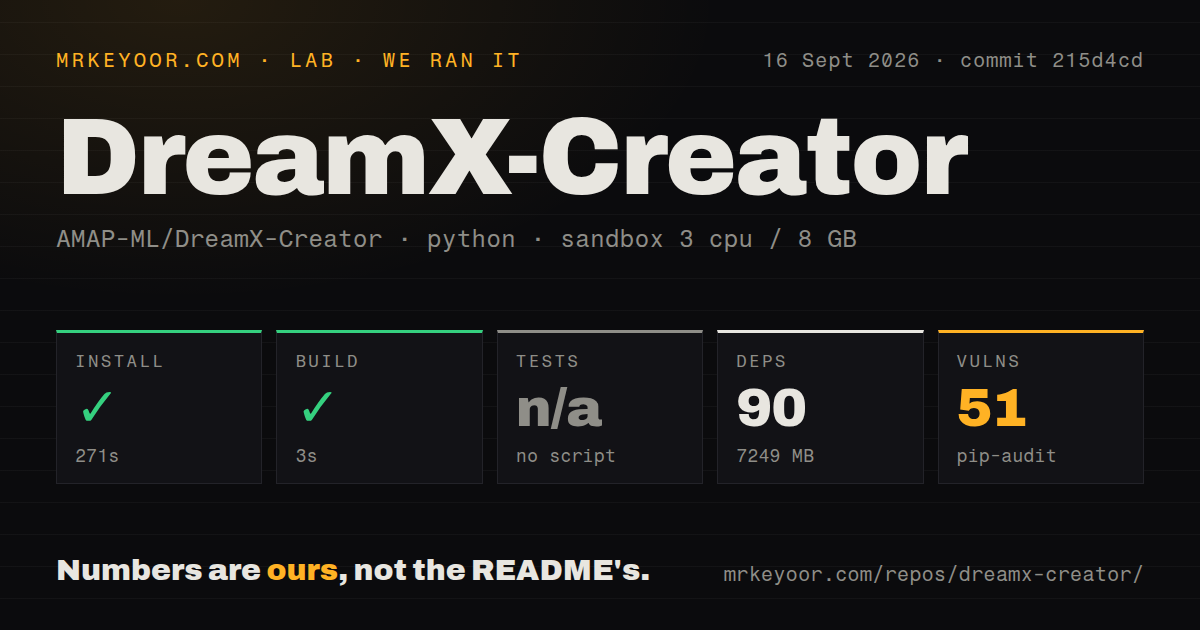
Our fresh Debian sandbox installed commit 215d4cd in 271 seconds with 3 CPUs and 8 GB of RAM. The audio-video environment added 90 packages and consumed 7,249 MB on disk. The build then succeeded in 3 seconds. The repository checkout itself was 4.4 MB, so nearly all measured storage came from the Python and ML dependency environment before any DreamX or Wan model weights were downloaded.
There was no test script or target, so our run skipped tests rather than recording a pass or failure. The repository scan found no tests directory, no GitHub Actions workflow, and no Dockerfile. Pip-audit reported 51 known vulnerabilities in the installed packages. Those findings do not measure generated video quality, audio alignment, inference speed, or GPU memory use; our sandbox had no secrets and did not run model inference.
Model weights sit outside the 7,249 MB environment
The measured 7,249 MB environment is only the starting point. Joint generation needs the Creator video and audio models, cross-attention weights, an audio VAE, and 3 named Wan2.2 assets for video decoding and text encoding. Refinement adds the SR-DiT 5B checkpoint and upsampler weights, with another optional decoder. The files come from Hugging Face or ModelScope and must follow the documented directory layout under checkpoints/.
FFmpeg is a separate system requirement for final MP4 muxing. The 7B generator can move its text encoder and both VAEs between CPU and GPU to reduce device memory use. The README does not give a minimum VRAM or host-RAM figure, and our 8 GB container did not load the checkpoints. A successful package install therefore says nothing about whether a given GPU can complete the default clip.
Sequence parallelism supports five GPU counts
The multi-GPU launcher accepts 2, 3, 4, 6, or 12 GPUs because the device count must divide the video and audio attention-head counts. Every rank keeps a full copy of the weights while attention work is split, so this reduces activation pressure rather than sharding the entire model. Rank 0 decodes and writes the final files. Teams should read that distinction before assuming several small cards can collectively hold a model that fits none of them.
Single-GPU use is still the main documented route. The default generator uses an 880 spatial-token budget and preserves the first frame's aspect ratio within that budget. CPU offload can lower GPU pressure at the cost of transfers and host memory. Since the project publishes no minimum card, test the exact 5-second job, output shape, and offload combination you intend to use before planning capacity.
Training and evaluation are intentionally absent
The audio-video README explicitly excludes training, datasets, and evaluation. You receive inference code, 6 evaluation inputs, released weights, and an Apache-2.0 code license. You do not receive a path for adapting the 7B generator to a private dataset or reproducing the project's training procedure. The top-level roadmap mentions distilled models with fewer sampling steps as an unchecked item, which is an aspiration rather than something available in commit 215d4cd.
There is also no documented Web UI, HTTP service, queue, authentication layer, or container image. Shell scripts call the 2 Python pipelines directly. That is enough for a researcher who owns the machine and watches the process. A shared service would still need request handling, resource limits, checkpoint caching, output storage, moderation choices, and isolation from untrusted media. None of those product concerns are solved by a 3-second build.
September activity is too young to show maintenance depth
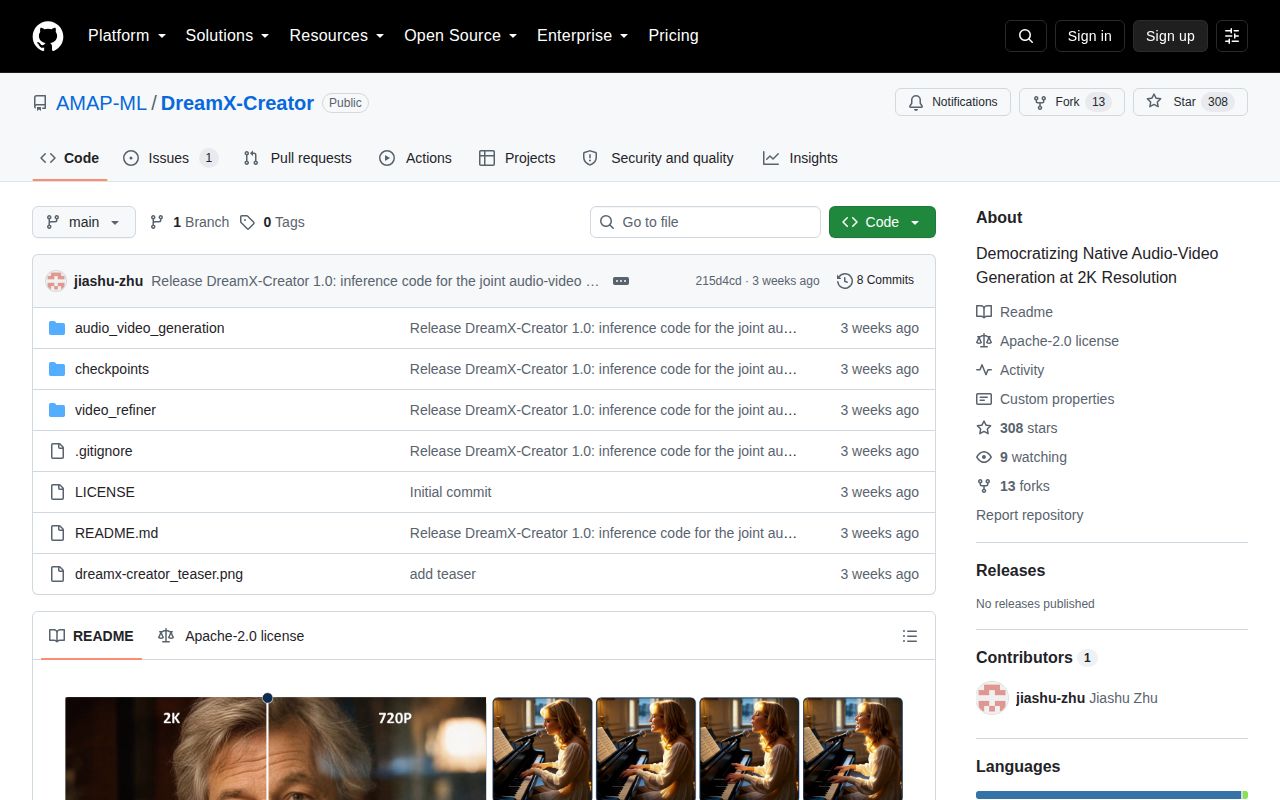
The repository was created on September 1, 2026 and last pushed on September 3, when commit 215d4cd added the inference code and weights announcement. GitHub showed 308 stars, 1 open issue, and no tagged release when fetched. The lone issue is a user-pasted video prompt, not a defect report or support exchange, so it offers no evidence about response time or bug handling.
Two days of source history cannot establish upgrade habits or compatibility discipline. The detailed READMEs are a good start, and the code is available under Apache-2.0, but the 51 audit findings and missing automated tests are present facts today. Pin commit 215d4cd, isolate its 90-package environment, and evaluate the generated files before deciding whether the joint audio-video result justifies the operating cost.