Linux 6.8 and KVM are the entry ticket
AgentENV turns OCI images into Firecracker sandboxes that agents can start, pause, resume, snapshot, and fork. The server requires Linux kernel 6.8 or newer plus access to /dev/kvm. That immediately separates it from a library or desktop sandbox: you are installing a host runtime with authority over virtual machines and block devices. The CLI can run on Linux or macOS, but the machine doing the isolation work is a suitably configured Linux server.
The quickest route still carries host consequences. The native script installs a systemd service with sudo. The Docker command runs a published server image as privileged, mounts /dev, and exposes port 8000. First startup downloads Firecracker, a guest kernel, and a root filesystem, then generates an API key. AgentENV authenticates that key but does not encrypt the connection. A remote deployment needs a trusted network, VPN, or reverse proxy that terminates TLS.
Snapshots and forks make this an RL platform, not a shell wrapper
Version 0.2.2 can build templates from OCI-compatible images, preserve filesystem and memory state, and resume or branch environments for parallel work. Overlaybd supplies image data on demand, while ublk participates in the block-device path. Cluster deployments can persist snapshots to S3-compatible object storage or a shared filesystem. These pieces fit reinforcement-learning runs where many agent attempts begin from a common state and idle environments should release host resources.
The same design raises the operator bar. Snapshot storage needs retention and failure policy. Image caches need capacity limits. Forked machines need identity handling, and schedulers need a consistent view of node resources. Open issue 33 says forked children are restored without reseeding guest entropy or rotating inherited session state. The report does not claim a measured exploit, but it gives security-sensitive users a concrete reason to avoid treating forked siblings as cryptographically independent until that boundary is addressed.
What happened when we ran it
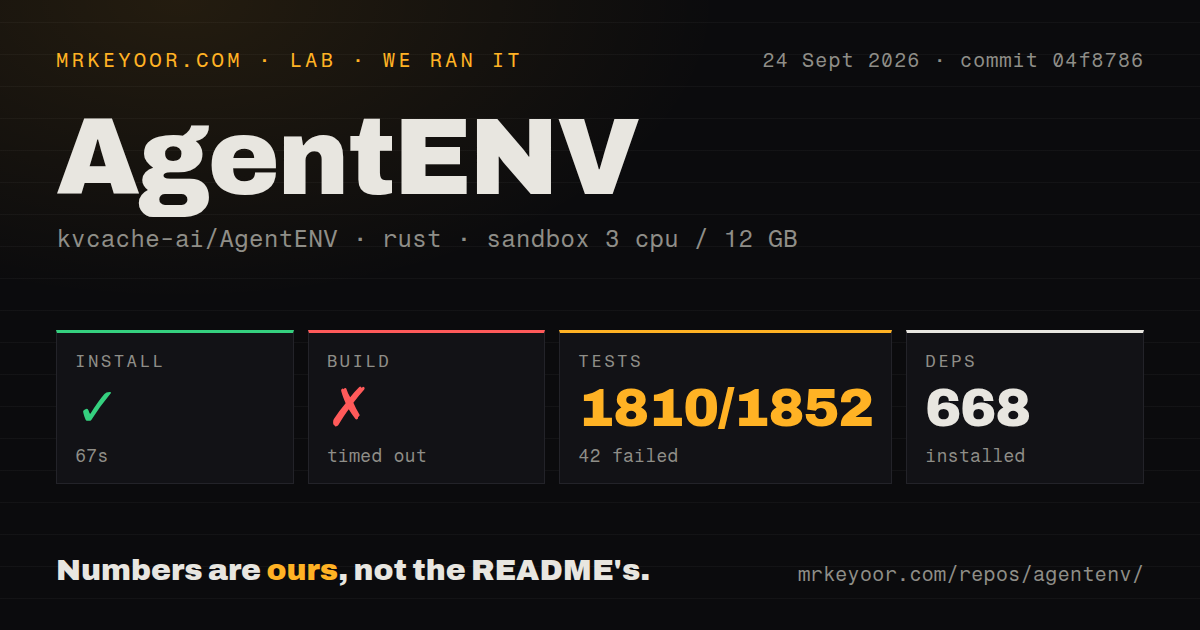
Our sandbox installed 668 Rust packages in 67 seconds. The build did not finish before the 900-second cap. We tested commit 04f8786 in an unprivileged Debian container with 3 CPUs and 12 GB of RAM. The checkout contained 798 files, about 214,060 lines of source, and 9.5 MB before dependencies. It included a tests directory and 13 CI workflow files, but no Dockerfile. The README's Docker route uses a separately published image.
The test command ran for 894 seconds and reported 1,810 passed with 42 failed out of 1,852. The final log section showed an integration target with 21 failures and no passes. Named failures involved snapshot-attached drives, frozen volumes, writable overlaybd mounts, and the ublk lifecycle. The tail does not include the error messages that caused those cases to fail, so we cannot attribute them to missing host devices, permissions, or product defects. The safe conclusion is that the supplied commit did not pass in our container.
Most tests passing is meaningful for a codebase this broad, but it cannot cancel the integration result. Storage and microVM behavior are the product. A pilot should rerun the failing targets on the exact Linux 6.8 or newer host, KVM configuration, filesystem, and object-store path planned for production. Our 12 GB container result is a screening test, not evidence about sandbox launch speed, density, or snapshot durability. We did not measure those runtime properties.
E2B compatibility is useful and incomplete
Open issue 5 tracks the E2B surface endpoint by endpoint. Basic health, sandbox listing, deletion, pause, fork, timeout, and parts of templates and snapshots are covered. The same matrix marks teams, multi-tenant API-key management, sandbox logs, template file caching, template tags, and several admin operations as missing. Other areas are partial because AgentENV uses different status codes or simplified namespace, visibility, and build behavior.
Pointing an E2B Python or TypeScript SDK at AgentENV can therefore save client work, but it is not proof that an existing E2B application will behave identically. Test every endpoint the application calls, including error paths and authorization assumptions. The current authentication model is a generated API key for a single installation. Organizations that need tenant isolation, per-team quotas, or independent key lifecycle should treat those as missing platform work rather than deployment settings they have not found yet.
September activity is high, while open issues reach core boundaries
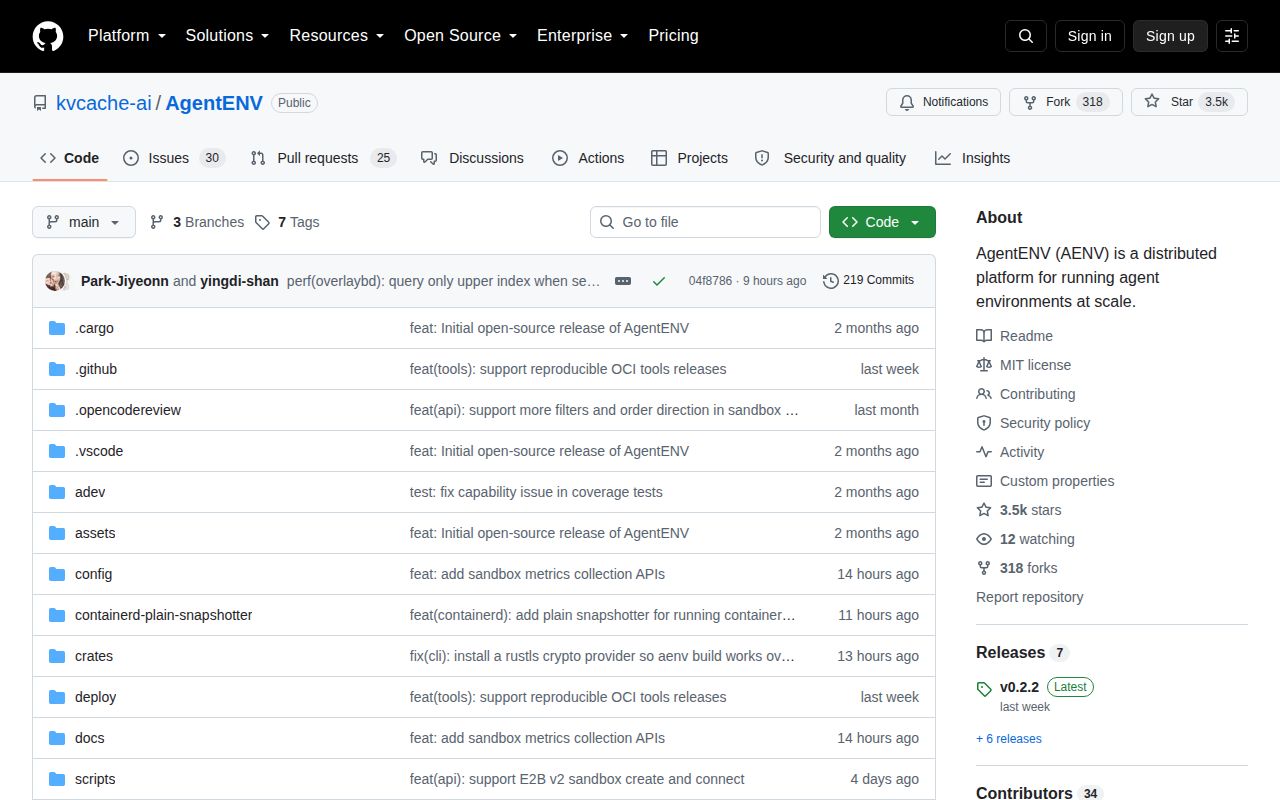
GitHub recorded the last push on September 24, 2026, 6 days after v0.2.2. The repository had 3,534 stars and 55 open issues and pull requests when fetched. Pull requests for snapshot prefetch and Firecracker memory work were receiving updates that day. Release v0.2.2 also included fixes for MinIO-backed tests, minimal images, shell fallback, ublk device limits, and reproducible tool releases. The project is moving quickly; the combined open count is not a bug count.
Some open reports still belong in an adoption decision. Issue 191 describes per-node resource limits failing across multiple scheduler replicas because each replica sees only part of the heartbeat state. Issue 302 reproduces stale placeholder pages after a pooled ublk device changes images, while carefully stopping short of claiming a full upstream VM-panic reproduction. AgentENV is credible enough to test and consequential enough to test on real hardware. The 42 failed cases make that hardware-matched gate mandatory.