Omakade is one shelf above your existing launchers
Omakade 1.12.0 collects installed games from Steam, Lutris, Heroic, Faugus, GOG, Wine prefixes, RetroArch, and several standalone emulators. It presents them as one cover-focused library with search, favorites, collections, tags, completion states, and saved filters. Pressing Play still delegates to the source that installed the game. Omakade does not replace a store account, a compatibility layer, or an emulator configuration.
That boundary is the project's best decision. Core discovery, browsing, organization, local achievements, and launching can work offline. Omakade reads launcher data without modifying it and stores its own library in a local SQLite database. Optional network calls add Steam library sync, IGDB details, RetroAchievements, artwork, and ProtonDB badges. If an external service disappears, the local game shelf still has a useful job.
Omarchy gets packages; source builds carry the dependency list
Omarchy users can install Omakade from its package repository, and v1.12.0 also publishes Arch packages for x86_64 and ARM64 with checksums, software bills of materials, and signed provenance. The Omarchy package may trail the newest GitHub release, which the README states plainly. Omakade itself is Linux-only, though ARM64 use has been reported on Apple Silicon running Asahi Linux.
Building is a different proposition. The documented floor is CMake 3.24, Qt 6.8 with several modules, SDL 3, libsecret, libzip, Ninja, a C++20 compiler, and Python 3 for the repository's test command. There is no Dockerfile in the measured checkout. A source builder on a distribution older than the project's target must supply those development packages before CMake can produce a build graph.
What happened when we ran it
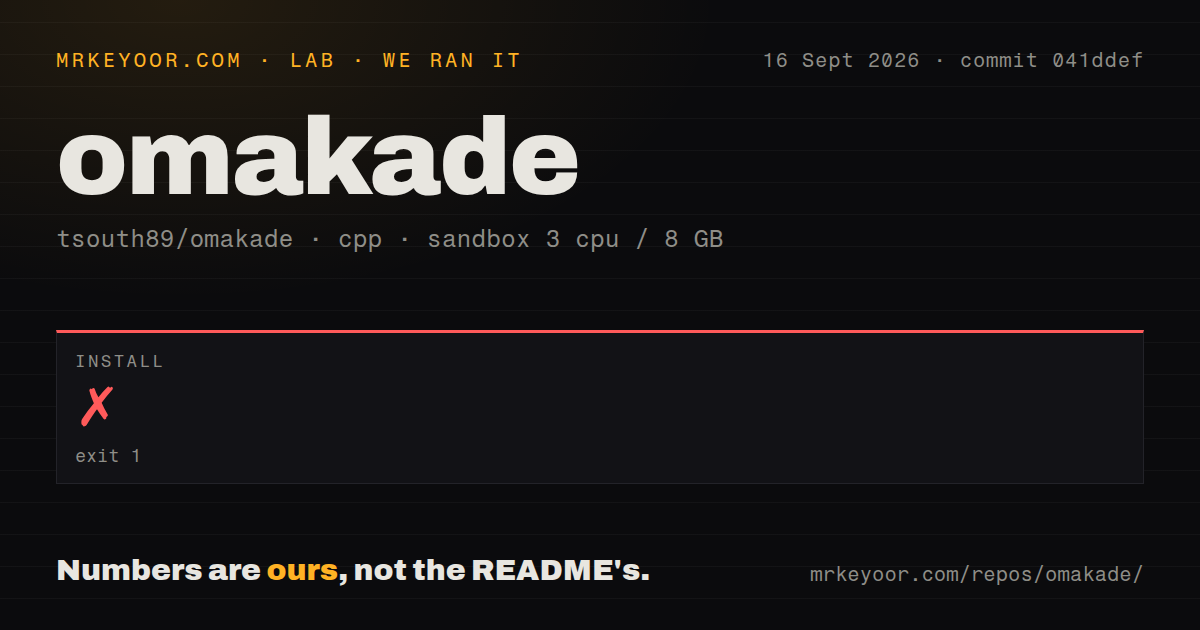
Our sandbox cloned commit 041ddef into an unprivileged C++ container with 3 CPUs and 8 GB of RAM. The checkout held 380 files, about 54,572 lines of source, and occupied 100.9 MB. The install or configuration step failed after 2 seconds with exit code 1, before compilation began.
CMake called pkg-config for sdl3 and reported that the required package was not found. The tail ends with configuration incomplete and points to build/CMakeFiles/CMakeOutput.log. It does not show a compiler failure, a wrong SDL version, or an application crash. The narrow finding is that the fresh environment did not contain a discoverable SDL 3 development package required by the project.
No later build or test step ran after configuration failed. Our scan found 4 CI workflow files and a tests directory, with no Dockerfile. Those repository signals are useful, but they cannot convert our interrupted run into a pass. For a source evaluation, install the documented native dependencies first and keep the absent lab result distinct from Omakade's published package checks.
Couch Mode and local records are more than decoration
The controller interface has grid and detail views, on-screen search, and an option to keep controller input with the launched game. Omakade can export Sunshine entries so Moonlight opens the library or a selected title. Version 1.12.0 adds local Stats, running-session visibility, history deletion, and a Year in Review image whose coverage period is labelled. These are sensible features for a library meant to sit on a TV.
Save protection is scoped per supported emulator rather than pretending all saves look alike. The documentation names specific folders and identifiers for systems such as Nintendo DS, PlayStation 3, and PSP, while keeping save states separate where appropriate. Personal-library backups exclude game files, launcher databases, account credentials, and downloaded caches. That makes a backup portable as organization data, not a surprise archive of an entire collection.
Play history depends on evidence each emulator exposes
Session recording is optional and runs through a user service after it is enabled. Attribution can come from process arguments and, on Hyprland, a confident known-game window match. Some adapters also inspect emulator-specific records or logs. The README warns that a supported profile is not the same as runtime acceptance, and issue 9 still asks users for sanitized reports from real native and Flatpak launcher libraries.
That caution is appropriate because stopping or recording the wrong process is worse than missing a statistic. Omakade 1.12.0 adds previews for shared Wine and Flatpak scopes and refuses ambiguous evidence in several emulator paths. Imported lifetime totals remain separate from dated recordings. Players who care about exact history should check the source diagnostics and compare a few sessions with the emulator's own records before trusting long-term totals.
Version 1.12.0 arrived with the September 23 push
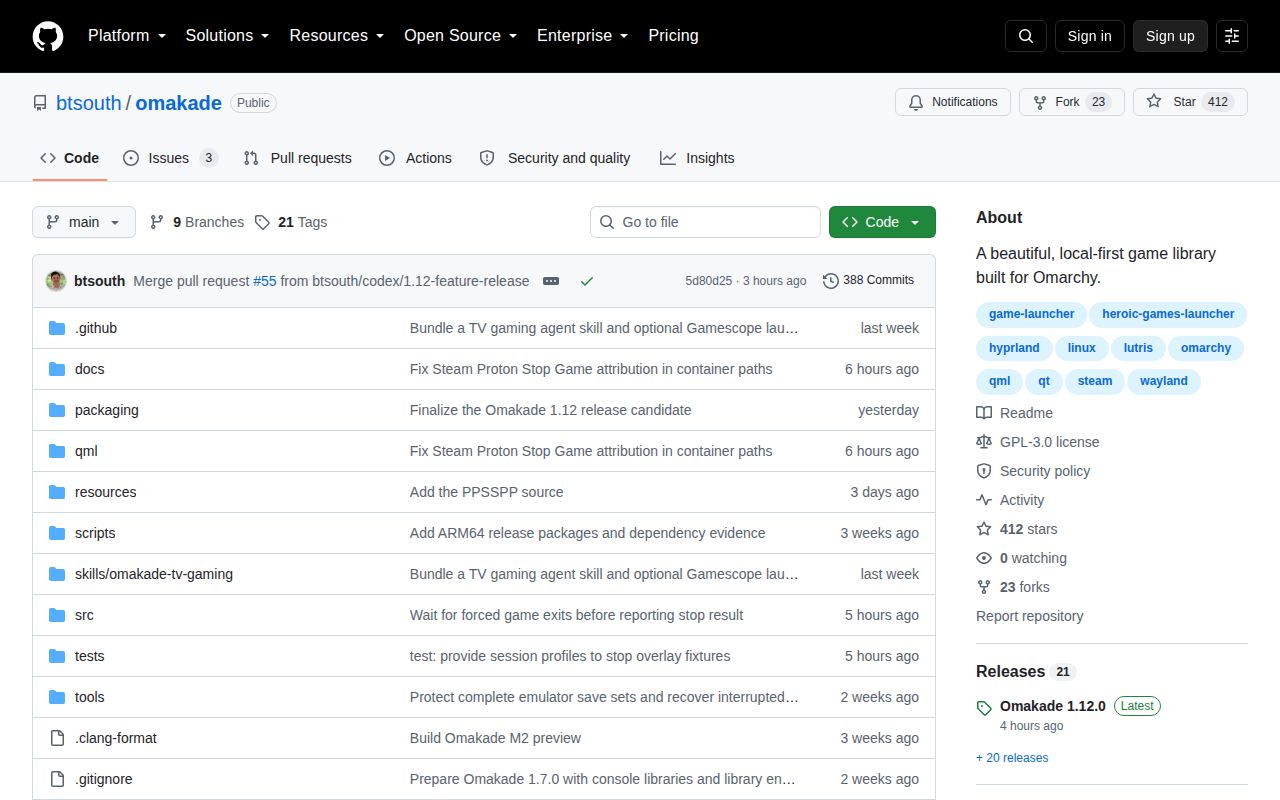
GitHub recorded the latest push and v1.12.0 release on September 23, 2026. The repository had 412 stars and 3 open issues and pull requests when fetched. That is current activity in a project created on September 1, not long operating history. The release work is detailed, while the remaining real-library validation request shows where fixture coverage still needs user evidence.
Omakade is a good fit when Omarchy is already your desktop and the actual launchers are already configured. The failed 2-second setup on our box is a source-build warning, not a verdict on the signed Arch package. Its local-first design keeps the blast radius small: Omakade can organize, record, and decorate the library, while ownership and execution stay with tools you can test separately.