IRC announcements trade polling delay for immediate decisions
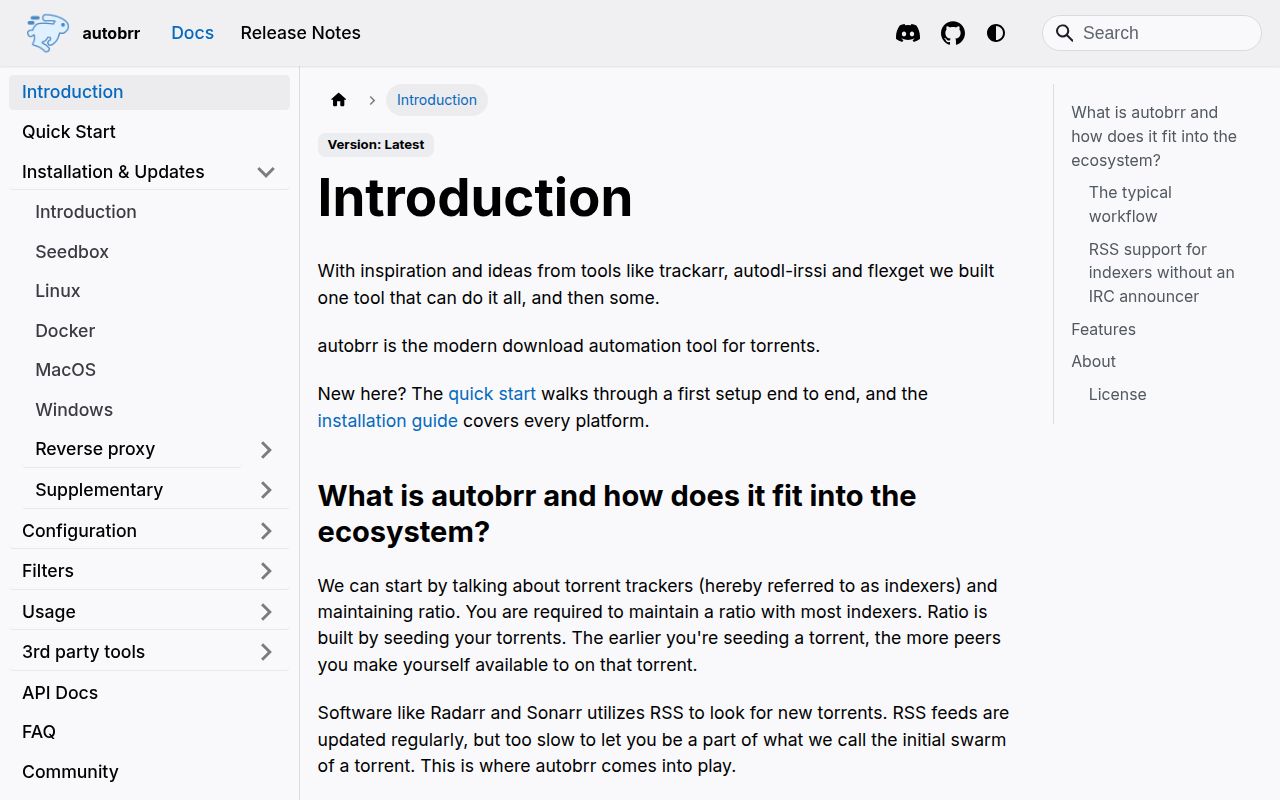
Version 1.86.0 listens to tracker IRC announce channels, then runs each release through filters and actions. That differs from Sonarr and Radarr's usual RSS loop, which checks feeds periodically. Getting into the initial swarm sooner can help a private-indexer user seed back more effectively. The server can also send a match to Sonarr or Radarr for a second decision, so autobrr does not have to replace the library manager already choosing formats and upgrades.
The README claims support for more than 100 trackers with IRC announcements, plus Newznab, Torznab, regular RSS, magnet links, and Usenet. Actions cover qBittorrent, Deluge, rTorrent, Transmission, SABnzbd, NZBGet, the *arr applications, watch folders, webhooks, and custom scripts. One instance can address clients on remote servers. That breadth is useful, but each indexer definition and client API becomes another boundary where names, sizes, categories, or credentials can be wrong.
Versions 1.85.0 and 1.86.0 expose parser edge cases
Open reports against versions 1.85.0 and 1.86.0 show parser edge cases that can reach a downloader. A filter can inspect release names and parsed fields, apply regular expressions, enforce limits, and choose an action. That is the reason to run autobrr instead of forwarding every announce straight to a client. Start with one tracker and a narrow match, send it through a library manager where possible, then read the activity log before adding broad wildcard rules. Speed has little value when a permissive filter grabs the wrong release first.
Two open reports show the kind of indexer-specific checks worth making. Issue 2702 describes version 1.85.0 missing a duplicate when the parsed title differed only by a colon, which led to the same episode being sent twice. Issue 2686 reports version 1.86.0 interpreting one tracker's GB labels as decimal even though the tracker appeared to mean binary units, causing valid cross-seed candidates to miss a size gate. Neither report means every filter is unreliable. Both show why sample announcements from your own trackers are better than a generic checklist.
What happened when we ran it
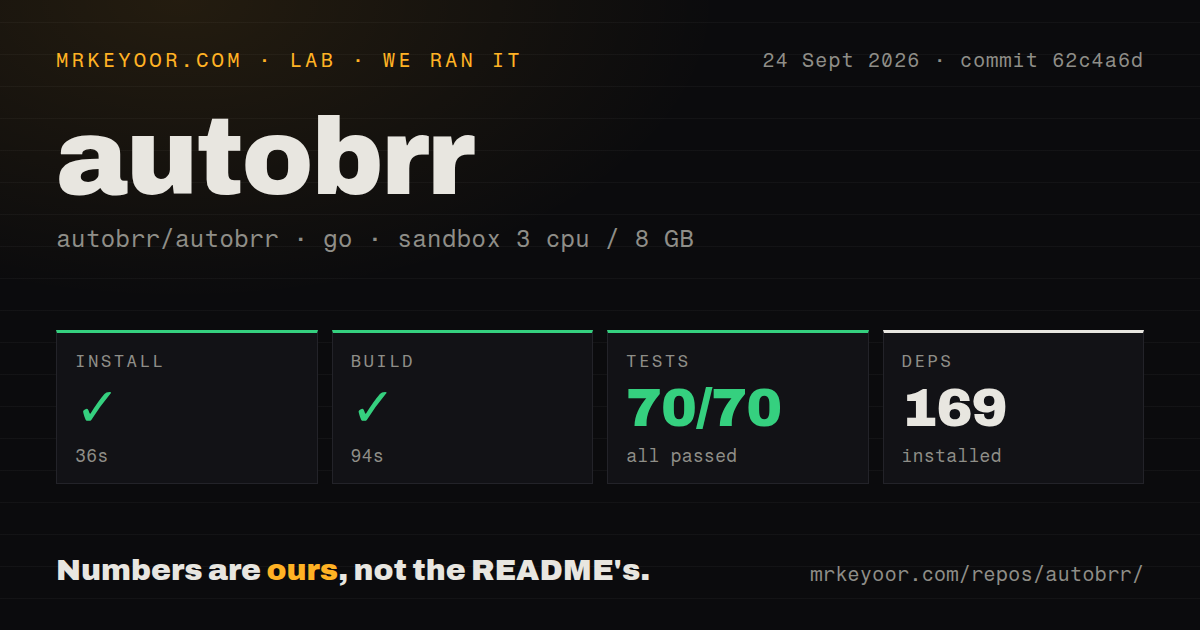
Our measurement setup was an unprivileged Debian container with 3 CPUs, 8 GB of RAM, Go 1.24, and no secrets. In our run, dependency installation took 36 seconds and added 169 packages. The project built successfully in 94 seconds. Its Go test step completed in 40 seconds with 70 passed and 0 failed out of 70.
The checkout at commit 62c4a6d was 7 MB and contained 1,017 files with about 125,907 source lines. We found 9 CI workflow files, a Dockerfile, a Compose file, and a tests directory. Those are good source-maintenance signals, and the passing commands make local modification less risky. We did not connect a live IRC network, indexer, downloader, or Usenet provider, so the run does not measure announce latency, parser accuracy, or action delivery.
Version 1.86.0 keeps port 7474 local by default
Autobrr 1.86.0 listens on 127.0.0.1:7474 by default. That is a sensible local starting point. Docker examples publish port 7474, while the Linux instructions recommend a reverse proxy for internet exposure. Built-in authentication and OpenID Connect are available, and base-path support helps when the interface lives below an existing domain. Do not change the bind address or publish the container port until login, TLS, proxy headers, and backup access have been tested.
SQLite is the default database, which keeps a single-user installation simple. PostgreSQL is available for operators who prefer a separate database, and environment variables can read secrets from files. Metrics listen on 127.0.0.1:9074 when enabled, while profiling uses port 6060. Indexer passwords, IRC credentials, API keys, and downloader endpoints deserve the same secret-handling care as any other automation service because a compromised instance can submit real jobs.
The 7 MB checkout includes Docker, but distroless drops the shell
The 7 MB checkout includes a Compose example that needs a config volume, timezone, port mapping, and the published image. Native packages or release binaries cover Linux, macOS, Windows, FreeBSD, and several seedbox platforms. External filters and actions add more runtime assumptions. In particular, the optional distroless image has no shell, and the README says Bash and sh scripts will not work there unless the action is replaced with a compiled static binary.
That choice affects 2 different operating styles. A standard container supports existing scripts but contains more userland tools. The distroless build cuts those tools and narrows what an attacker or accidental action can invoke, while also removing common debugging commands. Decide based on the actions you actually run. A setup that depends only on client APIs and webhooks is a better distroless candidate than one built around several inherited shell scripts.
Version 1.86.0 is active, with a small open queue
GitHub recorded the latest push on September 24, 2026. Release v1.86.0 arrived 14 days earlier with filter controls, downloader changes, an external-filter test button, dependency updates, and a session-cookie fix. The repository had 3,083 stars and 14 open issues and pull requests when fetched. The combined count is not a bug total, but it is small enough that an adopter can search the queue for a specific tracker or client before upgrading.
Autobrr earns its place when delayed RSS is the constraint and tracker announcements are already part of your routine. The measured build and 70 passing tests make the codebase easier to trust than a source checkout that only ships binaries. The remaining work is operational: protect the web interface, back up the database, scope credentials, and prove each filter against real announce strings before letting it act unattended.