mrkeyoor.com_
Thu 24 Sept 07:40 UTC
Self-Hostedevaluationupdated 24 Sept 2026

LibreChat review

LibreChat is a self-hosted web app that puts hosted and local AI models behind one shared chat interface. It adds user accounts, agents, file chat, search, MCP tools, code execution, and admin controls for people who want to run their own alternative to a hosted AI chat product.

Verdict

Our LibreChat run installed 2,741 packages and used 2,491 MB, then the @librechat/api build failed after 48 seconds, so source deployment needs more investigation than the polished feature list suggests. Use it when several users, model providers, and agent tools justify a six-service chat platform. A solo user who mainly talks to one local model should choose a smaller interface.

We ran it

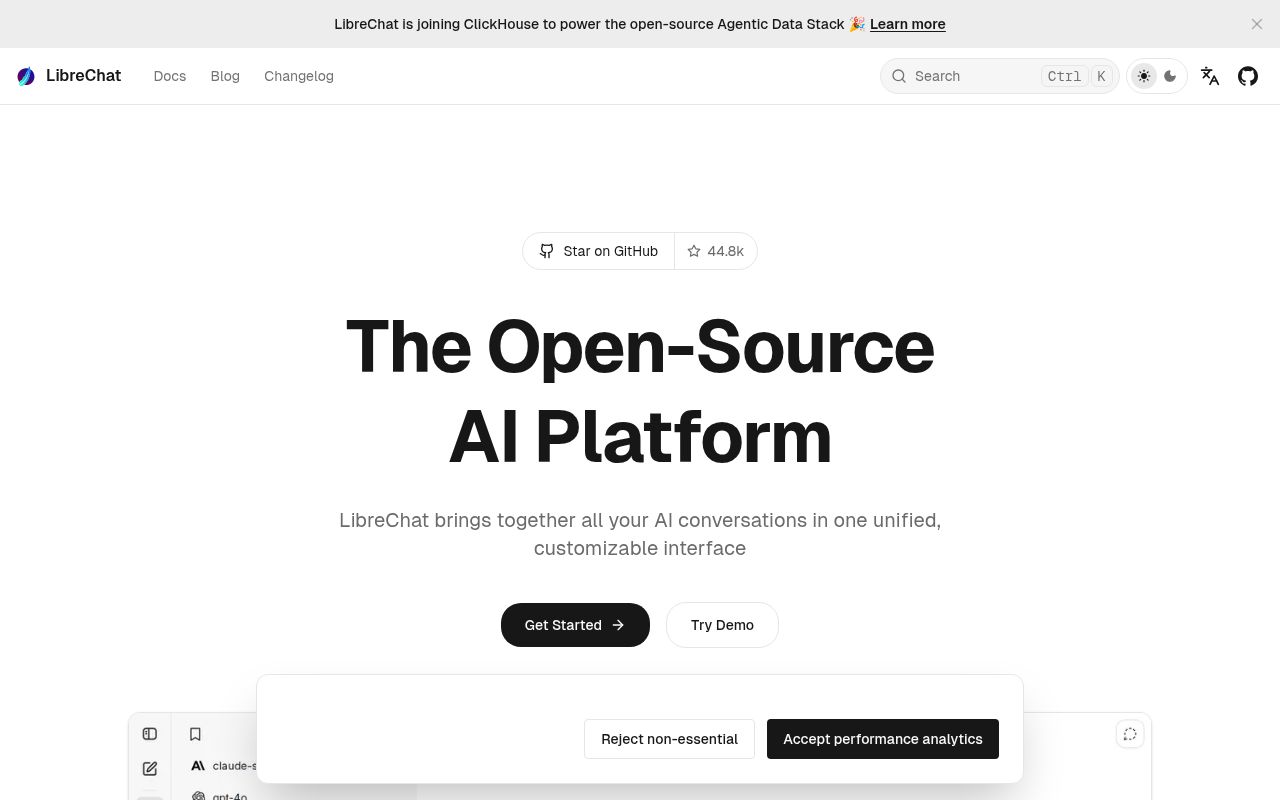
Lab card: what happened when we ran LibreChatScreenshot of LibreChat (librechat.ai)
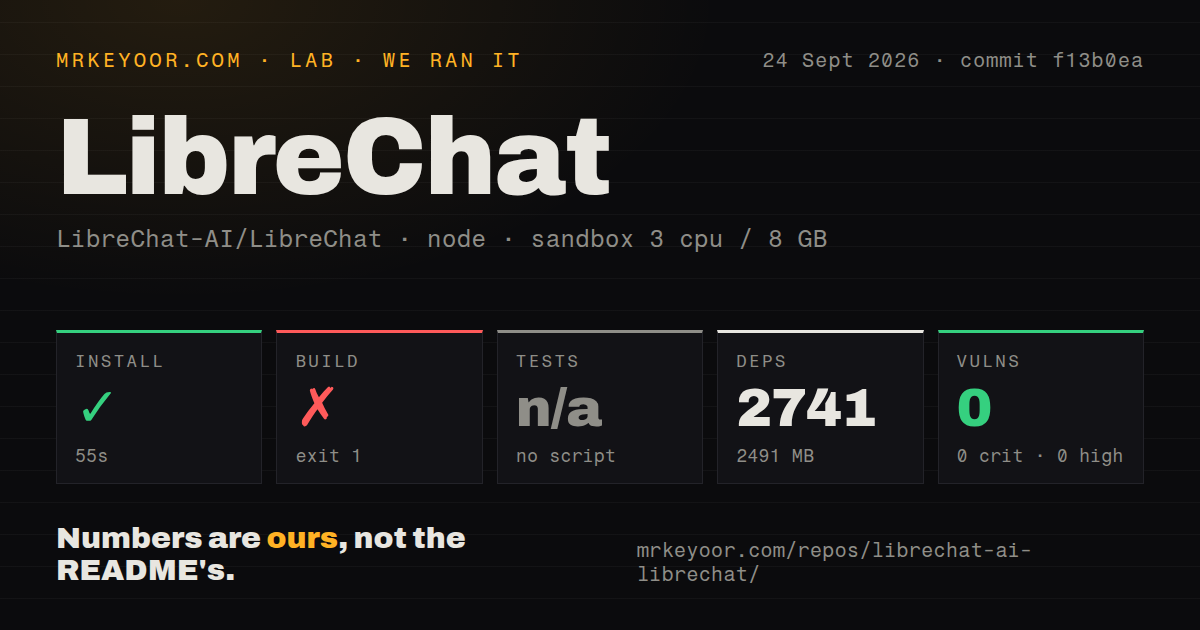
Install✓ · 55s2741 packages · 2491 MB
Build✗ · 48s
Testsn/ano test script
Known vulns00 critical · 0 high · 0 moderate · 0 low (npm audit)
Repo5502 files~1,517,950 lines of source · 65 MB · 28 CI workflows · Dockerfile

Answers from our run

Does LibreChat build from source?

Dependencies installed in 55 seconds (2741 packages), and the build failed. We cloned commit f13b0ea into a clean Debian container with 3 CPUs and no project-specific setup.

Does LibreChat have tests you can run?

Not through a standard command: the project exposes no test script or target that our harness could run.

Does LibreChat have known vulnerabilities in its dependencies?

npm audit found none in the dependency tree at the time of our run.

Who should not use LibreChat?

Teams that require a clean source build before adoption: our commit f13b0ea build failed in @librechat/api after 48 seconds, and the log tail gave no deeper cause.

What are the alternatives to LibreChat?

Open WebUI, LobeHub, NextChat. Our LibreChat run installed 2,741 packages and used 2,491 MB, then the @librechat/api build failed after 48 seconds, so source deployment needs more investigation than the polished feature list suggests.

Setup2/555-second install, failed build, and a six-service compose stack
Docs4/5Extensive feature and configuration guidance; setup spans many files
Community5/544,812 stars with push, issue, and PR activity on September 24
Maturity4/5Broad admin and deployment controls, but our source build failed

Who it’s for

Teams that want one managed chat front end for several AI providers and local model endpoints.
Self-hosters who need multiple user accounts, roles, shared agents, and conversation search.
Developers building agent workflows with MCP tools, skills, file search, or code execution.
Organizations prepared to own authentication, secrets, storage, model billing, and updates.

Who it’s NOT for

Teams that require a clean source build before adoption: our commit f13b0ea build failed in @librechat/api after 48 seconds, and the log tail gave no deeper cause.
Operators looking for a single small container: the checked compose file defines six services, including MongoDB, Meilisearch, PostgreSQL with pgvector, and a RAG API.
Admins who will expose the defaults without a security review: the example environment enables registration and unverified email login, while production JWT and admin-panel secrets need deliberate configuration.
Anyone expecting the download to include an AI model: LibreChat connects to hosted providers or separately operated local endpoints, and its code interpreter is another service.
Small hosts where a 2,491 MB dependency install is already too costly, before databases, images, uploads, logs, or model services are counted.

Setup reality

Our commit f13b0ea sandbox install succeeded in 55 seconds, adding 2,741 packages and using 2,491 MB. The build failed after 48 seconds with exit 1 in @librechat/api; 3 of 5 tasks had succeeded. Our runner found no test script or target, so tests were skipped. Npm audit reported 0 known vulnerabilities.

The checked compose file defines six services: LibreChat, its admin panel, MongoDB, Meilisearch, PostgreSQL with pgvector, and the RAG API. You also need at least one model provider key or local endpoint, plus persistent JWT, credential-encryption, admin-session, and search secrets for the features you enable.

Docker avoids the failed local compilation path, but it does not make this a one-container install. The example config enables registration and unverified email login, search is off until configured, and code execution needs a separate Code Interpreter deployment. Plan a reverse proxy, backups, secret rotation, storage, and update checks before public access.

The compose file starts six services before a model answers

LibreChat's compose file at commit f13b0ea defines 6 services: the web application, an admin panel, MongoDB, Meilisearch, PostgreSQL with pgvector, and a separate RAG API. That is the clearest description of the product. LibreChat is a chat control plane with accounts, storage, retrieval, search, and administration around the models you choose. It can replace several provider-specific chat tabs, but the operator inherits several moving parts in return.

The v0.8.8-rc4 README lists OpenAI, Anthropic, Google, Azure, AWS Bedrock, custom OpenAI-compatible endpoints, and local options such as Ollama. Users can switch models, branch conversations, search old messages, share prompts, and work with uploaded files. Multi-user authentication covers email, OAuth2, and LDAP. These features make sense for a household, lab, or company that wants one governed interface instead of separate accounts scattered across provider websites.

A 55-second install still ended in a failed build

Our sandbox installed 2,741 packages in 55 seconds and consumed 2,491 MB on disk. That is a heavy developer checkout before any database volumes, uploaded files, container images, or model weights enter the picture. The dependency audit reported 0 known vulnerabilities, which is a useful result for commit f13b0ea, though it says nothing about the security of external model services or a future dependency tree.

The checkout contained 5,502 files and about 1,517,950 lines of source in 65 MB. It is a workspace monorepo with 28 CI workflow files, a Dockerfile, and a compose file. Those signals explain why LibreChat can cover a wide set of providers and deployment shapes. They also explain why changing it is closer to working on a platform than reskinning a small chat client.

What happened when we ran it

Our run used an unprivileged Debian container with 3 CPUs, 8 GB of RAM, Node 22, and no secrets. Installation succeeded, but the build exited with code 1 after 48 seconds. The final log named the failing task as @librechat/api#build, after its command ran the package clean step, tsdown, and the OpenAPI copy step. The tail did not identify which earlier compiler message triggered the failure, so assigning a cause would be guesswork.

The build summary showed 3 successful tasks out of 5, with no cache hits. Our runner found no test script or target and skipped tests, so this run provides no passing test count. Npm audit found 0 known vulnerabilities across the installed tree. Taken together, the result is mixed: dependency installation worked, the package audit was clean, and the repository build did not finish.

Three provider keys show why setup does not end at Docker

The v0.8.8-rc4 environment example has user-provided key slots for OpenAI, Anthropic, and Google, alongside many optional provider and tool credentials. You can point LibreChat at a local endpoint instead, but the compose stack does not include an Ollama server or a language model. Calling the interface self-hosted is accurate. Calling the whole AI system local would depend on the endpoints you configure.

Production authentication takes its own pass through the configuration. The example leaves JWT and refresh secrets blank so temporary values can be generated, and it tells operators to set persistent values before production. The bundled admin panel needs a session secret of at least 32 characters. Registration and unverified email login are enabled in the example, while password reset is disabled. Those defaults are editable, but they are decisions, not details to leave untouched on an internet-facing host.

MCP tools and code execution widen the trust boundary

The v0.8.8-rc4 README includes MCP tools, reusable skills, subagents, file search, agent actions, and a public Agents API. Attached code workspaces are labeled highly experimental. This is considerably broader than sending a prompt to one model. An administrator must decide which users can create agents, which tools may receive conversation data, and which internal or public addresses those tools may contact.

Code execution is also a separate deployment, powered by the ClickHouse code-interpreter project rather than one of the 6 default compose services. The configuration includes keys and JWT settings for that connection. Web search can involve a search provider, scraper, and reranker, each with its own credentials or endpoint. LibreChat puts these capabilities in one interface, while service isolation, egress rules, logs, and spending limits remain the operator's job.

September 24 activity is strong, but the failed build still counts

GitHub showed 44,812 stars and 775 open issues and pull requests on September 24, 2026. The repository was pushed that same day, and the recently updated queue contained both merged work and open pull requests. GitHub's latest-release endpoint returned no published release object, while the README identified its current feature set as v0.8.8-rc4. The activity supports calling the project maintained; the combined open count should not be read as 775 bugs.

LibreChat earns consideration when one installation will serve several people and connect several model or tool providers. The 6-service compose design matches that job better than the failed source build does. If your requirement is one local model for one person, 2,741 packages and 2,491 MB are hard to justify. If you need shared accounts, agent permissions, MCP, retrieval, and provider choice in one place, the operating cost has a clear reason to exist.

Alternatives

ProjectWhat it isPick it when
Open WebUI gh↗A self-hosted AI interface with direct support for Ollama and OpenAI-compatible APIs.pick this instead when local Ollama use is the center of the deployment and LibreChat's broader provider and agent configuration feels excessive.
LobeHub gh↗An agent-oriented workspace focused on organizing and operating persistent AI workers.pick this instead when scheduled agent operations matter more than reproducing a multi-provider chat product.
NextChat gh↗A lighter multi-platform AI chat client with hosted and downloadable options.pick this instead when you want a simpler personal chat client and do not need LibreChat's server-side user, RAG, and admin stack.

What people are saying

  1. [github-trending] LibreChat-AI/LibreChat
  2. [github-trending] danny-avila/LibreChat

Sources

  1. LibreChat repository and README
  2. Measured LibreChat commit f13b0ea
  3. Docker Compose stack at the measured commit
  4. Environment configuration at the measured commit
  5. LibreChat configuration example
  6. LibreChat issue and pull request activity

More self-hosted reviews

hosts · Atomic-Chat · omakade · Mobile-Security-Framework-MobSF · radar · sftpgo · the whole board →