One container starts static scans, not the whole MobSF lab
MobSF's documented static path needs Docker 20.10.0 or newer and exposes its web interface on port 8000. You can upload APK, IPA, APPX, or source code and get a report covering application code, binaries, resources, permissions, and other security signals. REST APIs and a separate CLI make the same scanner usable in CI. For that job, MobSF behaves like a team appliance: one place to submit builds and retain reports that colleagues can inspect.
Dynamic analysis changes the shape of the deployment. Supported Android targets must be rooted and fall between Android 4.1 and 11, no higher than API 30. The emulator has to be running before MobSF, ADB has to reach it, and HTTPS interception uses port 1337. On iOS, the choices are a Corellium VM or a jailbroken device. The two-command Docker example accurately represents static setup. It leaves the runtime lab out of the picture.
What happened when we ran it
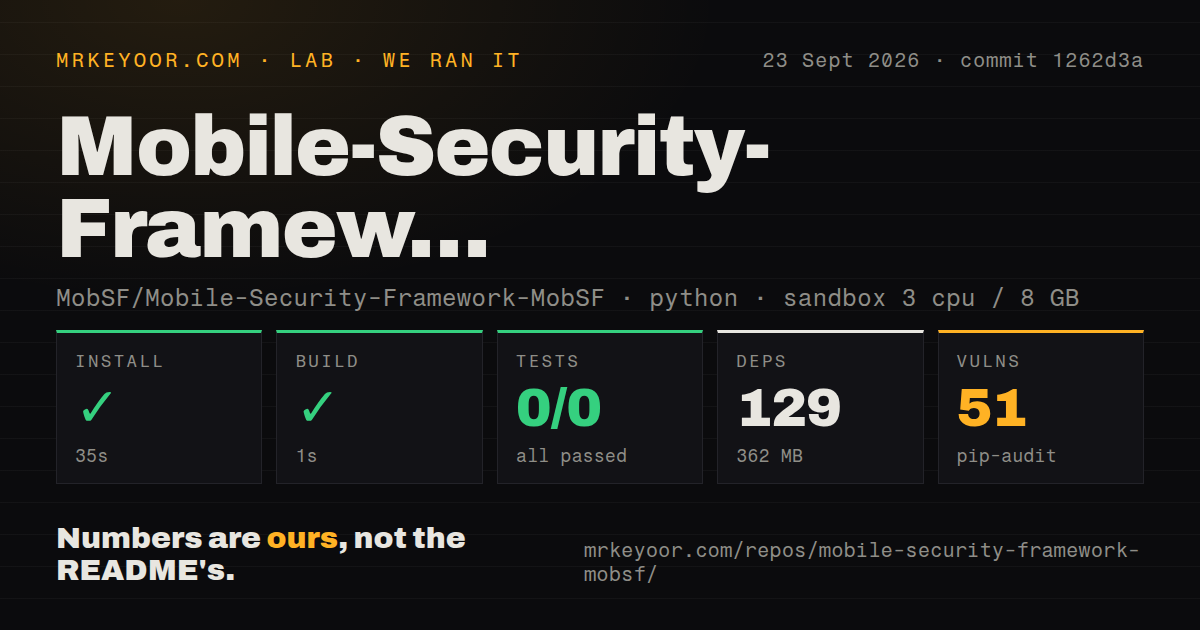
Our MobSF install at commit 1262d3a succeeded in 35 seconds, pulled 129 packages, and occupied 362 MB. The build finished successfully in 1 second. This was a fresh unprivileged Debian container with 3 CPUs and 8 GB of RAM. Before dependencies, the checkout contained 546 files, about 112,383 lines of source, and used 366 MB. That measurement setup is useful for judging repository friction, not scan speed or finding accuracy.
The test step failed with exit code 5 after 1 second. Pytest reported 0 passed and 0 failed because it discovered 0 tests, and the log ended with no tests ran in 0.07s. The checkout also had no tests directory, although it contained 7 CI workflow files. We cannot turn that output into a theory about the cause. It says only that the test command used by our sandbox did not execute a test suite at this commit.
The 51 audit findings raise the isolation bar
Pip-audit reported 51 known vulnerabilities in the Python environment we installed. That count does not tell us which findings are reachable through MobSF, and our run did not establish severity or exploitability. It still matters because this server accepts mobile packages that may be hostile by design. Pin the image or release, keep the scanner away from unrelated internal services, control outbound access, and treat dependency review as adoption work rather than cleanup for some later date.
Release v4.5.3 reinforces that point. Published on September 21, 2026, it fixed DNS-rebinding SSRF, several path-traversal cases, bounded ZIP decompression, and required token-bearing POST requests for dynamic actions. The default web login is mobsf/mobsf, while the REST API keeps key authentication even when web authentication is disabled. Its documented API limit defaults to 7 requests per minute. Change the credentials and Django secret before exposing the service beyond a local evaluation network.
Android 12 and ordinary phones fall outside dynamic support
MobSF's Android dynamic analyzer stops at Android 11 and API 30. Android Studio images with Google Play are unsuitable because they lack the required root access, and the guide says newer AVDs do not provide the writable system MobSF expects. A Linux container also needs a route back to the host emulator. The supplied helper can forward host port 5556 to emulator port 5555, after which MOBSF_ANALYZER_IDENTIFIER tells MobSF where ADB lives.
The iOS path has an equally specific boundary. Corellium requires an API key, and MobSF v4.4.0 or newer expects Frida Server above version 17.0.0 in that VM. The physical-device route is beta, requires a jailbreak plus SSH, and the documentation names testing on iPhone 6s and iPhone 8 hardware. A team whose device policy allows only current stock phones cannot use MobSF's dynamic half, regardless of how easily the static container starts.
Source installs need Python 3.12 and Java 21
The host installation asks for Python 3.12 or newer and OpenJDK 21 or newer. Linux also needs build tools, development headers, and wkhtmltopdf. Windows substitutes Visual C++ Build Tools and OpenSSL for part of that system stack. iOS IPA static analysis has its own platform boundary: it works on macOS, Linux, or Docker, not a native Windows host.
Once those pieces exist, Linux and macOS use setup.sh, then run.sh can bind the server to 127.0.0.1:8000. Calling the run script without an address listens on 0.0.0.0:8000, a detail worth catching before testing on a shared network. The container packages this stack into a simpler trial. Build from source when you need to change MobSF or pin its bundled tools, not because the static scanner requires it.
Async scanning adds another process rather than making the single server magically concurrent. The documented Docker arrangement shares the MobSF data volume with a DjangoQ2 cluster, and its default configuration allows 3 workers. The fuller Compose stack adds PostgreSQL and Nginx. Those pieces suit a shared internal service, provided someone owns migrations, stored scan data, keys, queue timeouts, and the device lab. A developer who wants only source findings should start with mobsfscan instead.
v4.5.3 shows active maintenance, with a small live queue
GitHub showed 21,816 stars and 12 open issues and pull requests when we fetched the repository. The last push was September 23, 2026, two days after v4.5.3, and an Android split-APK analysis issue was closed on September 22 alongside its fixes. The star total alone says little about maintenance. The dated activity shows maintainers shipping code and closing a reported problem in the same week.
The 35-second install makes MobSF cheap to trial for static scans. The 51 audit findings, Android 11 ceiling, and device requirements make the operating decision less casual. Choose it when one repeatable report is worth maintaining an isolated scanner and, for dynamic work, a supported mobile lab. If your target fleet begins at Android 12 or forbids rooted and jailbroken devices, MobSF cannot close that testing gap.