mrkeyoor.com_
Tue 11 Aug 17:04 UTC
Dev Toolsevaluationupdated 11 Aug 2026

microsandbox

Microsandbox runs untrusted code inside local micro virtual machines while presenting a container-like command line and application API. It is meant for AI agents, user-submitted code, plugins, CI jobs, and other workloads that need a stronger boundary than an ordinary process or container without requiring a permanent sandbox server.

Verdict

Microsandbox is one of the most approachable ways to put generated or user code behind a microVM boundary on a developer machine. Its daemon-free SDK, OCI image support, cross-platform ambition, and language coverage make it more practical than assembling a VMM stack yourself. Adopt it as beta infrastructure: pin versions, test the exact host and guest combination, restrict networking and mounts, and keep a containment failure plan outside the sandbox itself.

Setup4/5One-command start when host virtualization is ready
Docs4/5Clear SDK, CLI, platform, build, and lifecycle guidance
Community4/5Busy issue queue with frequent maintainer work
Maturity3/5Useful beta with active cross-platform edge cases

Who it’s for

Agent builders who need to execute generated code locally with hardware-backed isolation.
Developer-tool teams embedding short-lived or detached sandboxes in Rust, Python, TypeScript, Go, or Ruby applications.
CI, plugin, scraper, and code-runner developers who already understand OCI images and want a Docker-like workflow.
Teams that need host-controlled network rules and API secrets that are not placed directly inside the guest.
Claude Code and MCP users who want structured sandbox lifecycle, filesystem, execution, and monitoring tools.

Who it’s NOT for

Teams that require a production-stable compatibility promise: the README labels Microsandbox beta software and explicitly warns about breaking changes, missing features, and rough edges.
Intel Mac users or Linux hosts without KVM: the documented local requirements support Apple Silicon on macOS and require KVM on Linux.
Windows teams relying heavily on shared host directories: an open v0.6.7 report shows Linux guest statx calls receiving incorrect Windows error numbers, breaking some tools on virtiofs mounts.
IPv4-only hosts that cannot alter guest images: an open networking report says dual-stack destinations can hang because the guest's apparent IPv6 connection prevents fallback to IPv4.
Node workloads that must use secret injection without qualification: an active report describes intercepted HTTPS failing certificate validation on Linux hosts.
Operators seeking a cluster scheduler or multi-host control plane: the primary local SDK model starts microVMs as child processes, with no long-running daemon.

Setup reality

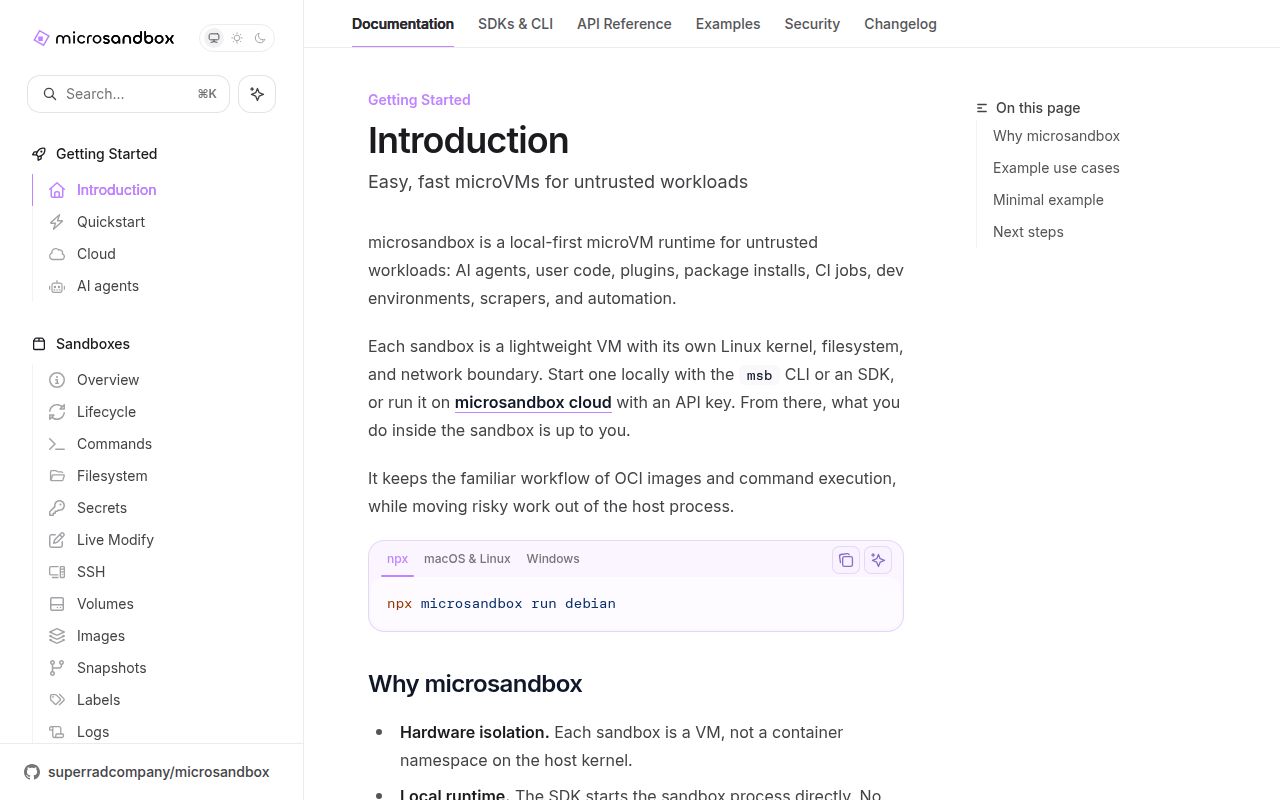
The happy path is excellent if the machine meets the virtualization requirements: npx microsandbox run debian can pull an OCI image and boot it, while package managers cover the CLI and five SDK languages. The first sandbox pays for runtime and image downloads, and Windows Hypervisor Platform or Linux KVM must already work. Building from source is substantially more involved, including Rust, submodules, guest binaries, firmware, a Linux build backend on macOS or Windows, and possibly kernel configuration prompts. Production use also means designing network allowlists, secret scopes, image caching, volume policy, cleanup, and limits around hostile workloads.

A microVM that feels like a library call

Microsandbox solves an increasingly common problem: an application needs to execute code it should not trust. AI agents write shell commands and programs, coding products run user submissions, and plugin systems load third-party work. Running that code as a normal child process gives it the host user's authority. A container improves packaging and isolation, but it still shares the host kernel.

Microsandbox puts each workload in a micro virtual machine and wraps that boundary in a familiar interface. The CLI can run an OCI image, create a named sandbox, execute commands, open a shell, attach volumes, inspect state, and report live resource metrics. The SDK starts the VM as a child process, so a local application does not need a permanent daemon or separate service. Rust, Python, TypeScript, Go, and Ruby clients cover most likely adopters.

This combination is the product's best idea. Firecracker is a foundation for infrastructure specialists; Microsandbox is trying to make a microVM feel as ordinary as a Docker-flavored API call. Standard images from Docker Hub, GHCR, and other OCI registries reduce the amount of new packaging teams must learn.

Isolation is valuable, but policy still belongs to you

A separate guest kernel creates a stronger boundary than an ordinary container, but it is not a complete security program. Callers still choose images, CPU and memory limits, mounted directories, network access, lifetime, and commands. A broad writable host mount can undermine much of the practical protection. Unlimited outbound access lets malicious code scan or exfiltrate. Detached sandboxes need cleanup and accounting.

Microsandbox includes useful controls. Network configuration can allow specific hosts and ports. Secret injection is designed so the actual value remains outside the VM and is supplied only for an allowed destination. That is attractive for agents that need an API key but should never be able to print it from their environment. The project also supports long-running sessions, volumes, and metrics, giving applications more lifecycle control than a throwaway command wrapper.

The secret mechanism changes networking behavior, however. Issue 969 reports that enabling secrets also enables TLS interception and can cause Node HTTPS requests in Linux sandboxes to fail with a certificate-not-yet-valid error. The report concerns an older 0.5.4 installation but remained active in August 2026. Test the current version with every runtime and provider used in production, and do not assume a credential is usable merely because it was injected.

Setup is short when virtualization cooperates

The quickest demonstration is convincing: run a Debian image through npx, or install the msb CLI using Homebrew, npm, uv, Cargo, or the project's scripts. The first creation downloads the runtime and image; later starts reuse the cache. The README reports average guest boot below 100 milliseconds on an M1 machine. That is a project measurement for one host, not a guarantee for every image or computer.

Hardware requirements are the first filter. macOS support is Apple Silicon only. Linux needs KVM, and Windows needs Windows Hypervisor Platform. Nested or locked-down corporate machines may fail this test even when the operating system name is supported. Image download time, storage growth, and guest initialization can matter more than raw boot time in a real workflow.

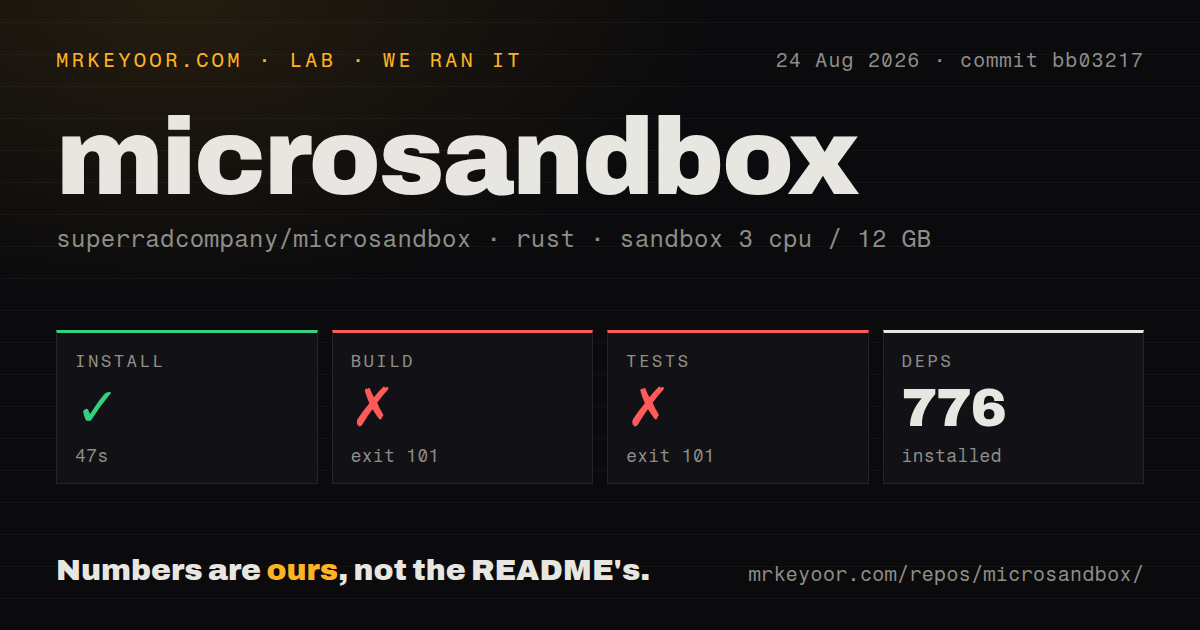
Building from source is for contributors, not casual users. The development guide calls for Rust, just, Git, pre-commit, submodules, a guest agent, and the libkrunfw firmware library. macOS and Windows require a Linux build backend for guest artifacts; Windows may use Docker Linux containers or Ubuntu in WSL. Kernel configuration prompts can appear. Published bundles and language packages are the sensible application path.

Cross-platform support has real edge cases

Microsandbox genuinely targets three desktop operating systems, which is unusual for a local microVM tool. Current reports show why that breadth is hard. On Windows, issue 1219 documents host error numbers crossing into a Linux guest without translation. Some statx calls on virtiofs mounts are then interpreted as symbolic-link loops, breaking tools that rely on that syscall. Another report says the interactive Windows terminal path corrupts UTF-8 output even though non-interactive output works.

Networking has its own host dependency. Issue 1226 shows a guest on an IPv4-only Linux host receiving IPv6 information and apparently completing an IPv6 connection, after which traffic disappears. Because the connection seems successful, common clients do not fall back to IPv4 and dual-stack destinations time out. Disabling IPv6 inside the guest is the documented reporter workaround. This can affect package managers, Git, curl, and Node, so it belongs in acceptance tests rather than a troubleshooting footnote.

These reports do not make the project unusable. They make its beta label credible. Test host operating system, architecture, virtualization, guest distribution, filesystem mounts, DNS, IP versions, terminal behavior, and secret-bearing HTTPS as one compatibility matrix.

Strong momentum, beta expectations

The repository was pushed on August 11, 2026. Release v0.6.8 arrived on July 29, and current pull requests cover secret placeholders, network rate limits, sockets, snapshots, and runtime verification. The 65 open items combine issues and pull requests, with active discussion and fixes on both sides. This is a healthy development pace, although rapid interface work also supports the warning about breaking changes.

Documentation is strong. The README gives concise starts, lifecycle examples, platform requirements, SDK choices, agent integrations, and an explicit maturity warning. Separate documentation and development guides go deeper into APIs, builds, testing, packaging, and releases. The MCP server and agent skills extend the sandbox to Claude Code and other tools without pretending that the core runtime itself is an MCP server.

Microsandbox is easy to recommend for prototypes and controlled internal agent workloads where stronger local isolation is worth testing. For a public code runner or high-value credential path, treat it as a security-sensitive dependency still earning its production history. Pin the release, minimize mounts and egress, cap resources outside the guest, collect metrics, and verify cleanup after crashes. The friendly API is a reason to evaluate it, not a reason to lower the threat model.

Alternatives

ProjectWhat it isPick it when
FirecrackerAmazon's minimal microVM monitor for secure, high-density server workloads on Linux.pick this instead when you are building Linux server infrastructure and want the lower-level microVM foundation with a longer production record.
Kata ContainersA container runtime that places workloads in lightweight virtual machines behind standard container interfaces.pick this instead when Kubernetes and OCI runtime integration matter more than an embeddable local SDK.
gVisorA userspace application kernel that adds a stronger isolation layer to containers.pick this instead when Linux container and Kubernetes compatibility is central and a microVM per sandbox is not required.

What people are saying

  1. [github-trending] superradcompany/microsandbox

Sources

  1. Microsandbox README
  2. Microsandbox v0.6.8 release
  3. Guest IPv6 connection issue
  4. Windows virtiofs error translation issue
  5. Secret injection TLS issue