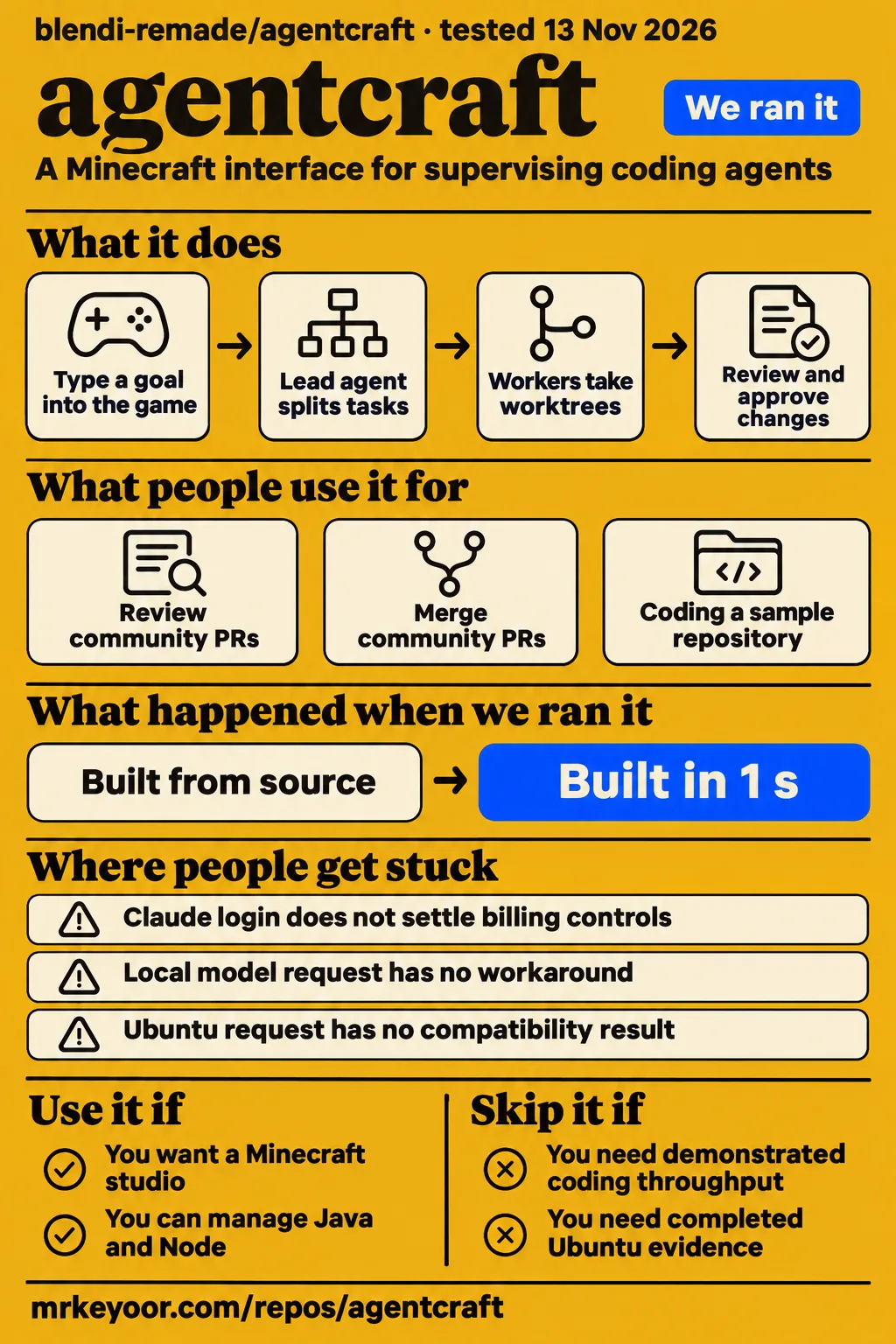
Our sandbox installed AgentCraft's Python asset tooling in 9 seconds and completed its build step in 1 second. That is a reason to distinguish a quick source check from a working Minecraft coding studio. Use this project if you want to experiment with supervising agents through a game and can own the development setup. Skip it if you need evidence of dependable coding throughput before adopting an orchestrator.
The project reviewed here is blendi-remade/agentcraft, the Minecraft coding-agent harness. The similarly named @idosal/agentcraft is a separate browser RTS orchestrator. Searching for AgentCraft AI also brings up a marketing service at agentcraft.ai. Match the owner and repository before following any setup guide. Minecraft README, browser project's documentation, marketing service.
What you can do with AgentCraft
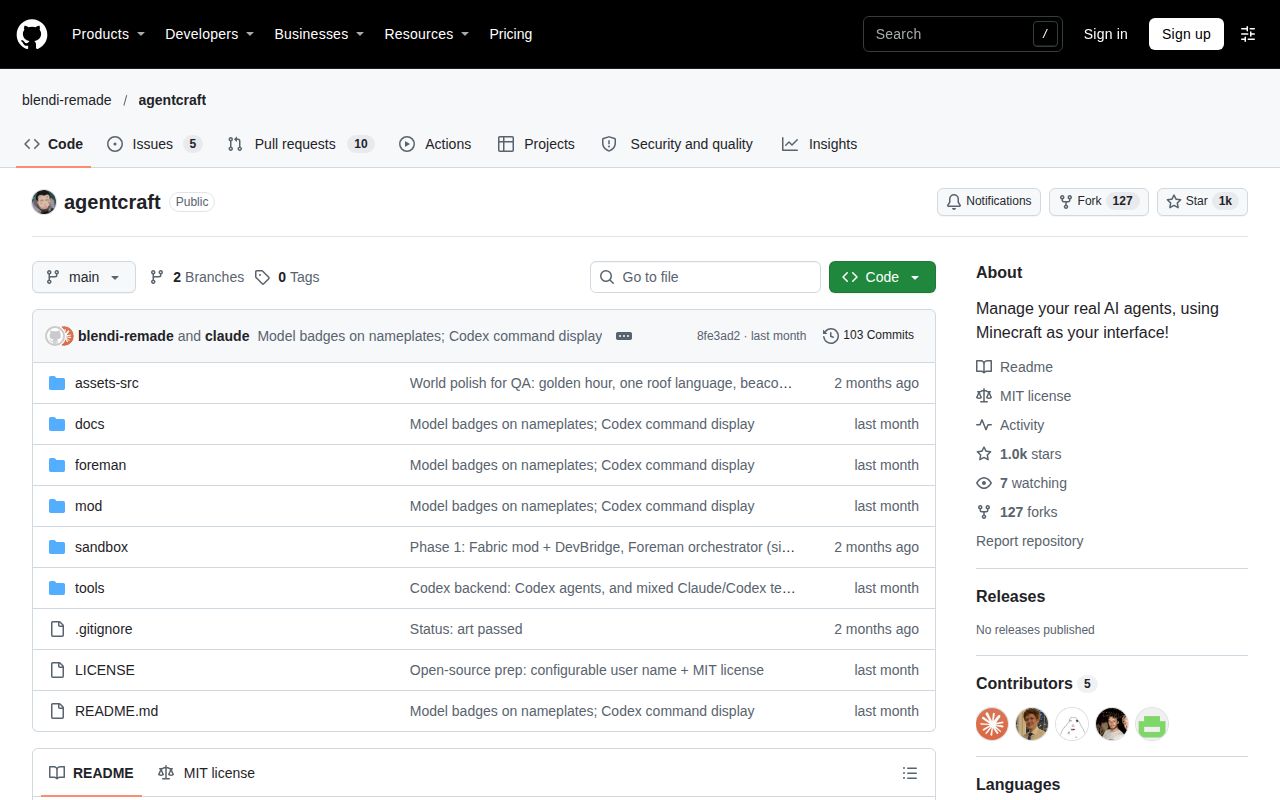
AgentCraft gives coding agents separate Git worktrees and puts their plans, questions and proposed changes inside a Minecraft studio, according to its README.
You type a goal into the game. A lead agent splits it into tasks, workers take their own worktrees, and you inspect their activity on virtual monitors. The consequential interaction is the merge screen: upstream says you review a real diff and approve the merge yourself. That gives the Minecraft setting a practical purpose. The room is a way to notice a blocked worker and reach the decision it needs. Project workflow.
The Foreman, a Node and TypeScript process, owns the agents and saved state. The Fabric mod displays that state and sends back your decisions. Upstream says closing the game leaves agents working. If you're evaluating the interface, ask whether walking around this studio helps you spot a pending decision sooner than your existing terminal workflow. Enjoying the setting is a fair reason to try it. Claiming it makes coding faster needs a different kind of evidence.
What people use agentcraft for
The supplied reports describe sample-repository coding and maintaining AgentCraft's own source, with both accounts tracing back to its author.
| Reported use | Who reported it | Reported outcome |
|---|---|---|
| Reviewing community contributions to AgentCraft | Project author BlendiByl on X | The author says agents reviewed and merged community PRs, including Linux support. Author's report |
| Coding against a sample repository | X user iamrexei, describing the author's demonstration | The post reports completed tasks and passing tests on the sample repo. It supplies a description of the demonstration rather than an independent reproduction. Secondary account |
The self-maintenance example is the more interesting use to me. Reviewing contributions involves deciding whether somebody else's change fits the project, rather than merely generating another file. Still, the author's post is a report about that workflow. It gives no basis for treating every contribution as correctly reviewed or the resulting Linux support as universal.
The sample-repository account has a different value: it describes the loop readers actually want to understand, from a goal to changes ready for review. Keep those two examples separate when deciding. One is an author reporting their own use. The other is another person describing an author demonstration. Neither becomes a separate customer deployment simply because it appears in another post.
What happened when we ran it
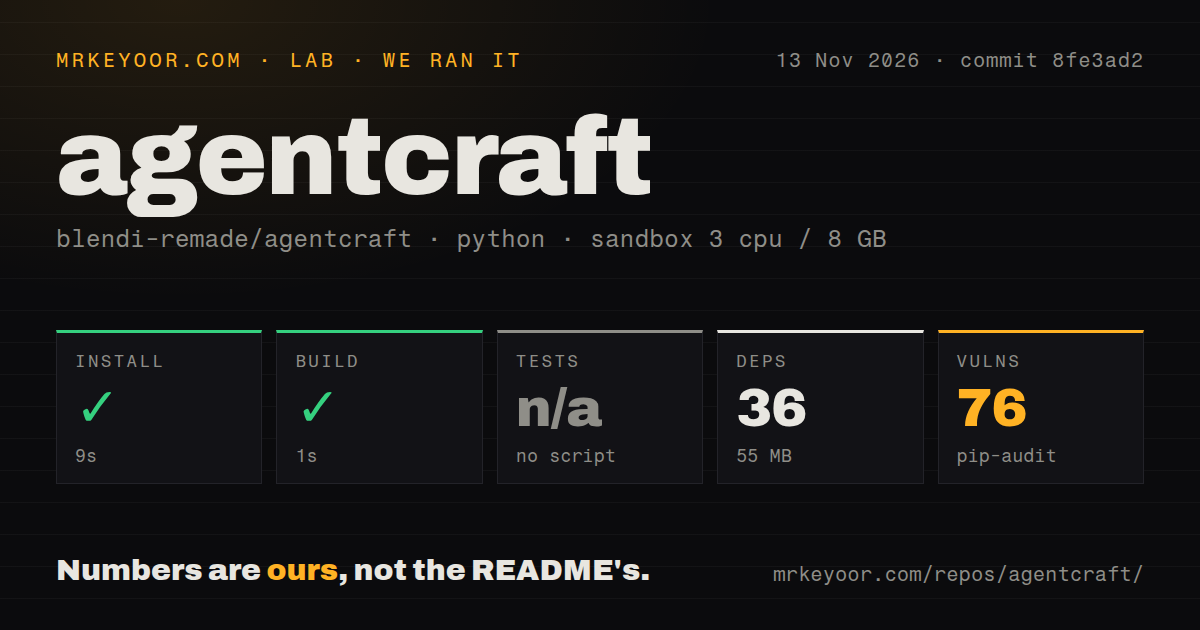
Our November 13, 2026 hands-on attempt stopped at its safety step because the repository lacked a Compose file; the separate source harness recorded a successful 9-second install and 1-second build.
The safety record says: "unsafe repo: none of compose.yaml, compose.yml, docker-compose.yaml, docker-compose.yml exists (rule: a compose file is required)". The word unsafe is the harness's label for its missing prerequisite. It is not a finding of malicious code. The teardown record reports success.
A conflicting run-summary record says it deployed through the repository's own Docker Compose with ports bound to 127.0.0.1. We reject that sentence as evidence of a working deployment because the recorded prerequisite step failed. There is no successful deployment step in these records to reconcile the contradiction. The useful outcome of this attempt is the named blocker, not an invented Minecraft session.
| Source harness observation | Recorded result |
|---|---|
| Install | Succeeded in 9 seconds |
| Build | Succeeded in 1 second |
| Tests | Skipped: no tests script or target |
| Dependencies | 36 recorded, 55 MB on disk |
| Dependency audit | pip-audit reported 76 known vulnerabilities |
| Repository scan | 932 files, approximately 63,005 source lines, 23.6 MB checked out |
| Automation signals | 0 CI workflow files, no Dockerfile, no tests directory detected |
Those source checks used commit 8fe3ad2 in a configured sandbox with 3 CPUs and 8 GB RAM. Its image label was ghcr.io/astral-sh/uv:python3.12-bookworm. The record identifies Python and assets-src/ as the selected project. Actual runtime and operating-system versions require the raw toolchain logs.
That directory matters more than the short timings. The README identifies assets-src/ as the scripts that generate skins, block textures and interface sprites. It identifies foreman/ as the orchestrator and mod/ as the Fabric mod. Our Python result therefore measures the asset tooling selected by the harness. The skipped test target belongs to that recorded check; it is not grounds for declaring that the whole repository contains no tests. Project layout.
Where people get stuck: billing and platform answers conflict
The captured issues request subscription billing, Codex, local models and broader Linux support, while the fetched README already documents some of those routes.
| Reader's obstacle | What the captured issue says | What to do with that evidence |
|---|---|---|
| Use an existing Claude subscription | Issue #9 asks to use Pro or Max allowance and avoid separate API billing; its captured state is open | Read the README's personal Claude-login option and restrictions before choosing credentials. Issue #9 |
| Choose Codex | Issue #18 asks for Codex as an alternative to Claude; its captured state is open | The README documents a Codex backend. The issue extract supplies no resolution history. Issue #18 |
| Use local models | Issue #20 requests LM Studio or Ollama; its captured state is open | No implementation or workaround appears in that issue extract. Issue #20 |
| Run on Linux | Issue #21 is captured closed, while #32 asks for Ubuntu and other distributions and is captured open | Use the documented Unix launcher as the starting point, without treating the closed request as a distribution compatibility matrix. Issue #21, issue #32 |
Issue #9 describes a concrete billing concern: a subscriber wants to avoid paying separately for API usage and asks that agents pause at subscription limits without silently switching to paid API calls. The README's personal-login option addresses an authentication route. It is not evidence that all of the issue's requested billing controls shipped. Choose and record the intended account before giving agents a real repository.
For Linux, the README names Java 25 and Node 22+, gives an Arch JDK example, and supplies node tools/unix.mjs commands. That is more useful than a bare promise of support. It still leaves an Ubuntu reader with a specific job: establish the required JDK and exercise the documented launcher on their own distribution. The issue excerpts contain no completed Ubuntu result. Unix instructions.
Setup needs Minecraft and a separate agent runtime
The README requires Minecraft: Java Edition, Java 25, Node 22+ and Git, so the 55 MB Python footprint is only one part of this setup.
The documented simulation mode uses a scripted team without API usage. Start there if your immediate question is whether the studio's task wall and review screens suit you. A simulated worker is useful for learning the controls, but choosing that backend should be explicit: it is different from asking a model to solve your coding task. Quick start and architecture.
For Claude API execution, upstream lists an Anthropic key or credentials for supported cloud providers. The fetched README also documents a personal Claude Code login option, off by default, and says it is meant for running AgentCraft yourself. Read that qualification before assuming a public product can offer the same login flow to its users. API access and subscription access are different setup decisions even when the characters look identical on screen.
The documentation rating is 3 out of 5 under this narrow rubric: 1 means the basic route is missing, 3 means concrete setup and operating instructions exist with conflicting support descriptions, and 5 requires those instructions to be corroborated across the supported routes. The README supplies real commands, credentials and controls. Its status section emphasizes Windows and macOS while its quick start includes Linux. Setup quality, community support and production maturity receive N/A because those broader outcomes were outside the completed assessment.
Security and shutdown need more attention than the scenery
The README describes user-approved merges and blocked Git network access, and our Python audit reported 76 known vulnerabilities.
Treat these as separate findings. The merge and command policies describe how upstream intends to constrain agents working on code. The audit count comes from the selected Python environment. It gives no severity breakdown or dependency paths here. A repository can have careful merge controls and still require dependency triage. The count alone is not a demonstrated exploit in the Foreman or game. Documented repository safeguards.
Shutdown also affects the operating bill. The tools documentation says closing only the game leaves the Foreman running. Its Windows stop script targets processes the launcher started, checks process identity, saves the world and Foreman state, and leaves a reused Foreman alone. Use the launcher-specific stop path when you intend to stop work. Closing the Minecraft window has a different documented meaning. Shutdown documentation.
A sensible first real goal belongs in a disposable repository with a diff you can understand. Inspect the permission request before approving it, read the resulting patch, and stop the recorded processes afterward. These are evaluation steps we recommend because the tool writes code and requests decisions. They are not additional security properties established by the sandbox check.
AgentCraft vs browser RTS tools and Claude Code
The separate @idosal/agentcraft documents a browser RTS interface, while Claude Code documents direct work through a terminal or IDE.
| Choice | Why consider it | Evidence behind the comparison |
|---|---|---|
| blendi-remade/agentcraft | You specifically want a Minecraft studio for plans, agent activity and merge decisions | The target README describes a Fabric mod connected to the Foreman. Target project |
| @idosal/agentcraft | You want game-style agent oversight in a browser | Its documentation describes CLI hooks feeding a browser-based game interface. Separate project |
| Claude Code | You want to work with a coding agent directly in your terminal or IDE | Anthropic describes codebase interaction and Git workflows through natural-language commands. Claude Code README |
| A 2D view or directed graph | You prefer the simpler display suggested by an Instagram commenter | The commenter prefers those views on presumed memory grounds; this is a preference, not a measured resource advantage. Comment |
The last row captures a fair objection to the Minecraft premise. The commenter calls it a fun idea for casual sessions while preferring a simpler view. Decide whether the room adds useful awareness for you. A browser map, terminal and Minecraft studio impose different ways of looking at the work, but their appearance alone tells you nothing about coding accuracy or CPU consumption.
For a reader who already gets enough visibility from Claude Code, my recommendation is to keep that direct workflow unless the studio solves a specific oversight problem. For someone who loses track of parallel workers, compare how each candidate exposes pending questions and reviewable changes. This is a decision about controls first. Performance comparisons belong to a matched workload.
What the other reviews get wrong
Ahmed Alassafi's Instagram promotion calls AgentCraft completely free, but the target README requires your own Minecraft copy and describes paid model access.
MIT source code gives you permission to use the project under that license. It does not pay for Minecraft or the account used by real agents. The simulation backend avoids API usage. That distinction should appear before somebody commits to the setup, rather than disappearing behind a free-software label. Promotion, license and prerequisites.
The Codex discrepancy needs a more careful correction. Swarogan's X post says the Minecraft project supports Claude and Codex, while the captured feature request asks for Codex. The fetched target README explicitly documents Codex launch commands. Calling the X post false solely because the request remains open in a captured extract would also mislead readers. The supported statement is that Codex is documented upstream; successful execution is a separate question. X post, request, Codex documentation.
AgentCraft Reddit results need the same identity check. The supplied r/aigamerdevs thread by kristiantalley679 describes World of AgentCraft, a World of Warcraft simulation. Its locally running characters are not evidence of users running blendi-remade's Minecraft coding harness. Likewise, a search for AgentCraft Limited does not identify this repository: use the full owner/name. Reddit thread, target repository.
Questions people ask
AgentCraft is a Minecraft interface for supervising coding agents, with a separate Foreman process managing their work and state.
What is AgentCraft, and how does the Minecraft project work?
The Minecraft mod displays plans, worker activity and decisions from the Foreman. Workers use Git worktrees, and the README says you approve merges through a diff screen. The AgentCraft GitHub repo covered here is blendi-remade/agentcraft. Architecture and workflow.
Can AgentCraft use my Claude Pro or Max subscription instead of separate API billing?
The fetched README documents an opt-in personal Claude Code login route, off by default and intended for running the tool yourself. The captured issue #9 asks for subscription billing and additional limit controls. That request is broader than documenting a login flag. Personal-login instructions, billing request.
Does AgentCraft support Codex as an alternative to Claude?
Yes in the fetched README: it documents an all-Codex team and Claude-led Codex workers. The captured issue #18 is an open request, so it supplies no completed support history by itself. Use the target README for the documented route rather than borrowing instructions from the unrelated browser project. Codex route, feature request.
Can AgentCraft run with LM Studio or Ollama?
The supplied LM Studio and Ollama request is open, with no implementation or workaround in its extract. That record supports an outstanding request, not instructions for a local-model backend. Issue #20.
Does AgentCraft support Ubuntu and other major Linux distributions?
The README documents Linux prerequisites and a Unix launcher. The captured Ubuntu request is open and contains no completed compatibility result; the earlier general Linux request is closed. Those facts support reading the Linux route, not assuming coverage of every distribution. README, Ubuntu request, closed request.
Can I use AgentCraft with a Grok bot?
An Instagram commenter asks about a Grok bot, but the captured comments supply no answer or working integration. The request is real; a setup procedure is absent from that record. Instagram question.
What we have not tested yet
We have not tested a live Minecraft coding goal, an approved merge, or restart recovery in this assessment. The Compose prerequisite stopped our hands-on attempt, and the successful Python checks concern assets-src/. No end-to-end coding result follows from those steps.
Codex execution, Claude subscription accounting, pausing at usage limits and Linux compatibility need dedicated runs on the intended versions and accounts. We also lack a measured memory or CPU comparison between Minecraft and simpler interfaces, a total operating bill, and an independent coding benchmark. The audit summary needs package-level triage before it can answer a severity or reachability question. The scan's missing test target cannot settle coverage in other components.
The supplied AgentCraft YouTube records have empty transcript extracts. They cannot support claims about what a creator installed, showed or achieved. The Bilibili record is a search listing rather than a reproduced coding session. Neither fills the missing workload evidence, and the unrelated Reddit simulation supplies no adoption evidence for this repository.
Our next useful result would be one small coding goal with known acceptance criteria: record the exact revision and billing mode, inspect the changes, exercise the merge decision and confirm that stopping the launcher ends the intended processes. Until that exists, the strongest reason to try AgentCraft is that you want its particular way of supervising agents and are willing to evaluate it yourself.