One skill routes an agent across many upstream tools
Agent Reach is a selection and health-check layer. It maps jobs such as reading a web page, searching GitHub, obtaining video subtitles, or reading a social post to an upstream command-line tool, reader, browser bridge, or MCP service. The agent reads a SKILL.md file and calls that backend directly. Channel files keep an ordered set of preferred and fallback paths, while agent-reach doctor reports which path is active.
This approach solves a real maintenance problem. Twitter, Reddit, Bilibili, and XiaoHongShu change access rules independently, and a working command can stop after a platform blocks its transport. Agent Reach lets maintainers replace or reorder one channel without asking users to redesign every prompt. The trade is another moving layer whose status checks and install instructions must keep pace with every upstream project.
The public paths are easier than the logged-in channels
The English guide describes public-page reading through Jina Reader, GitHub through gh, YouTube through yt-dlp, Bilibili through bili-cli, and feeds through feedparser. Some capabilities work immediately after the required commands are available. Search and richer GitHub actions can add MCP setup or GitHub authentication. The primary README is Chinese, while the English document covers installation, channel choices, cookies, proxies, and safety.
Social networks impose the harder limits. Reddit has no anonymous path in the current guide. Facebook and Instagram use OpenCLI with an existing desktop Chrome session. Twitter and some XiaoHongShu routes need manually exported cookie values. The project says it does not log a user into XiaoHongShu or read browser cookies itself. These boundaries are sensible, though they mean a server cannot reproduce every feature available on a logged-in desktop.
What happened when we ran it
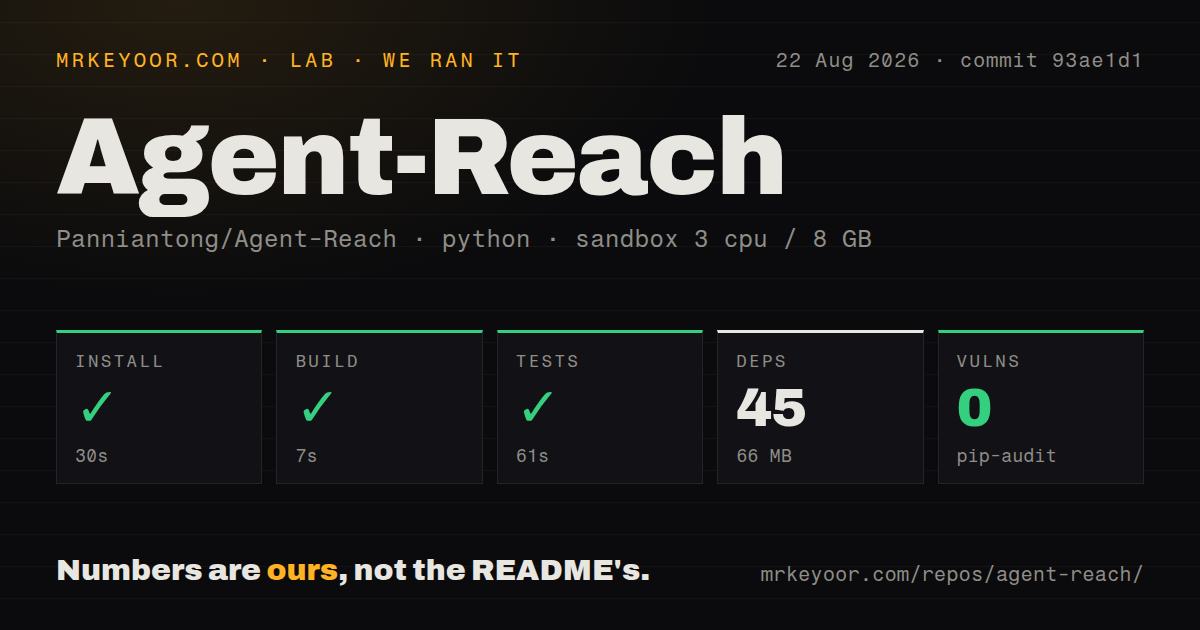
Our sandbox installed commit 93ae1d1 in 30 seconds, adding 45 Python packages and using 66 MB on disk. The build completed in 7 seconds. The test command then succeeded in 61 seconds. Pip-audit found zero known vulnerabilities in the installed dependency set. Those results establish a clean core setup in the supplied fresh Python 3.12 Debian environment.
The repository was compact: 120 files, roughly 17,587 source lines, and a 1.2 MB checkout. We found one CI workflow, a tests directory, and no Dockerfile. The successful suite is a useful contrast with the number of outside services involved. It tests the repository's own behavior; it cannot promise that Reddit, Instagram, Exa, or another platform will accept tomorrow's request.
We did not log into social accounts or run real requests against every channel in this lab block. No channel success rate or response-speed claim belongs in this review. The measured result says install, build, and tests completed. Platform availability still needs doctor plus a harmless real request using the exact account, machine, network, and backend intended for production.
Default checks avoid system changes until you add --system
The current installation design is conservative. agent-reach install --env=auto checks the machine and lists missing pieces without installing system packages or writing configuration. --dry-run previews actions. Passing --system authorizes external tool installation, configuration writes, and skill registration. OpenClaw also needs an execution-capable tool profile before its agent can run the setup commands.
That approval boundary matters because the friendly prompt asks an AI agent to consume a remote installation guide. Read the guide and pin the repository revision before giving it system authority. Cookies and tokens are stored under ~/.agent-reach with owner-only permissions according to the README, yet upstream tools still receive them when invoked. Use dedicated social accounts, narrow GitHub scopes, and a disposable browser profile where practical.
A green doctor result can still miss a broken request
Issue 623 reports exa_search as ready when mcporter is installed but the Exa MCP server is absent. The subsequent call fails because the named server is unknown. Issue 642 describes the Reddit cookie fallback returning 403 through the pinned client's HTTP transport, while the doctor deliberately avoids the live status request and therefore cannot mark it failed. Both reports attack the same assumption: installed and configured does not always mean usable.
Instagram shows a related partial-success case. Issue 550 reports a valid browser session, working identity and search commands, then HTTP 400 responses for profile and user actions. A single channel needs capability-level checks when its commands use different internal routes. Before relying on Agent Reach for research, create a small acceptance list for the exact operations you need and rerun it after upgrades.
v1.5.0 formalized backend routing and diagnosis
Release v1.5.0 arrived on June 11, 2026. Its notes describe ordered backends for several platforms, real command probes in the doctor, OpenCLI integration for desktop sessions, and a switch away from yt-dlp for Bilibili after access was blocked. The release text is mainly Chinese, consistent with the project's primary documentation, and the separate English guide makes the current setup usable for English readers.
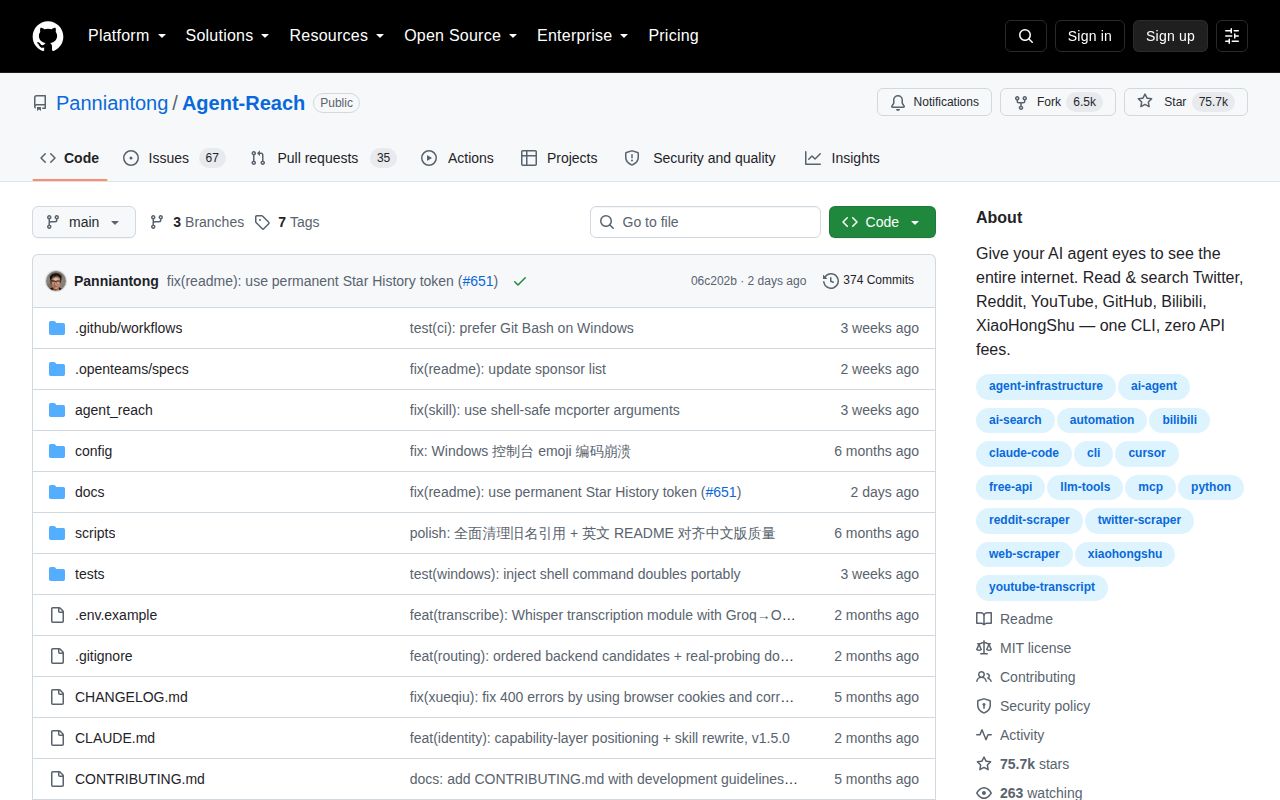
GitHub recorded the last push on August 25, 2026. The repository had 75,705 stars and 102 combined issues and pull requests when fetched. Recent issues include transport failures, Windows command detection, missing skill references, and authentication mismatches. That combination shows active use and maintenance. It also exposes the continuing cost of tracking sites that do not offer stable, anonymous interfaces.
Agent Reach is a good fit for an exploratory agent that needs several information sources and has a human available to configure accounts and verify output. Our 61-second successful test step lowers the cost of trying its core. Its value falls when one source is mission critical, because an ordered fallback list still depends on platform rules and credentials. In that case, own the direct integration, its account policy, and an end-to-end check you control.