inquirer review
inquirer 14.1.0 runs the repository's legacy question-object interface for interactive Node command lines. A prompt session accepts questions with names, messages, defaults, conditions, validators, filters, and choice providers, then resolves an answers object. Built-in types cover text, number, confirmation, select lists, raw lists, expand menus, checkboxes, passwords, editor input, and search. The current release updates the included prompt suite to 8.6.0 and core to 12.0.0. That brings a prefilled `initialValue` to search, fixes floating-point number steps and explicit `undefined` defaults, and changes the core `useState` setter type used by custom prompt authors.
inquirer 14.1.0 installed in 2.1 seconds and left 27 packages using 2 MB in our sandbox, but its browser build failed and its own README labels the API legacy. Keep it for existing question arrays and older plugins; start new prompt flows with `@inquirer/prompts`.
We installed it
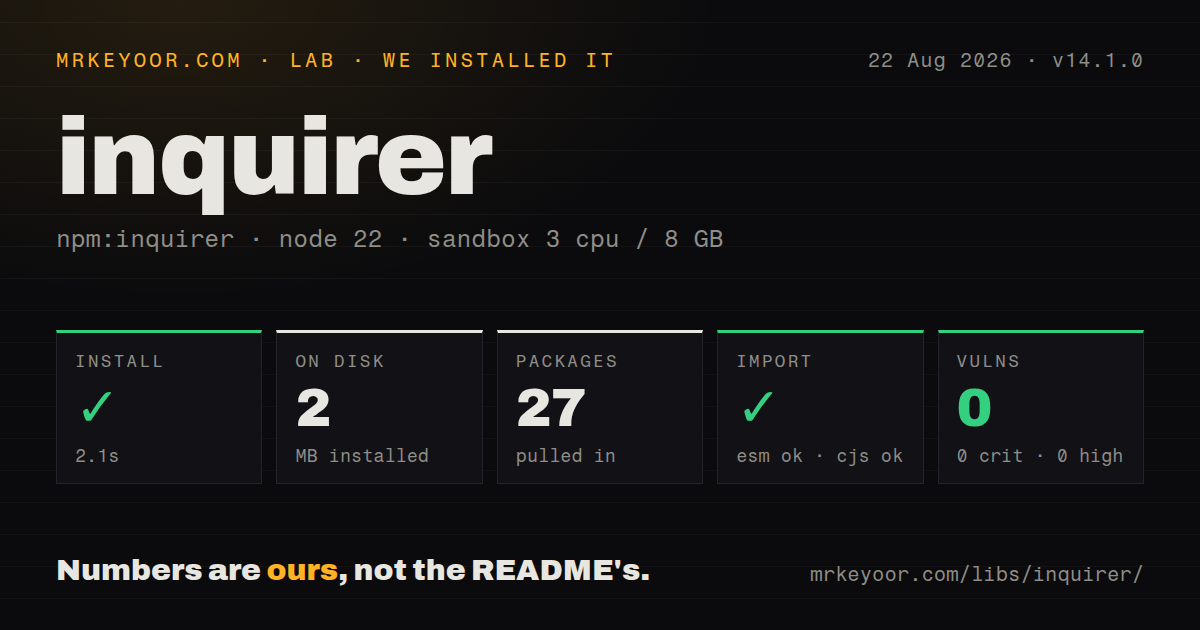
| Install | ✓ · 2.1s | 27 packages on disk · 2 MB |
| Import | ✓ | ESM import works · require() works · ESM package with exports map |
| Browser | n/a | could not be bundled for the browser (Node-only code, most likely) |
| Types | ✓ | TypeScript types bundled |
| Known vulns | 0 | 0 critical · 0 high · 0 moderate · 0 low (npm audit) |
Answers from our run
Does inquirer install cleanly?
Yes. In a fresh container with an empty cache, npm install inquirer finished in 2 seconds, leaving 27 packages and 2 MB on disk. npm audit reported no known vulnerabilities.
Can inquirer run in a browser?
Not directly: esbuild could not bundle it for the browser in our run, which normally means it depends on Node built-ins. Use it on the server, or find a browser-targeted alternative.
Does inquirer work with both ESM and CommonJS?
Yes. Both import 'inquirer' and require('inquirer') worked in Node 22 in our run. The package is published as ESM with an exports map.
Does inquirer include TypeScript types?
Yes, type declarations ship inside the package, so no @types install is needed.
inquirer or @inquirer/prompts: which should you use?
@inquirer/prompts: Choose the repository's current function-based API for new commands and import only the prompt functions you call. inquirer 14.1.0 installed in 2.1 seconds and left 27 packages using 2 MB in our sandbox, but its browser build failed and its own README labels the API legacy.
When should you not use inquirer?
You are designing a new CLI. The package's own README calls this interface legacy and directs new work to @inquirer/prompts.
Discussed on
- hnPhilly courts will ban all smart eyeglasses starting next week416 points
- hnPirate Bay founder is being held in solitary confinement without a warrant343 points
- hnMail delays hit Philadelphia residents, short staffed USPS struggles to keep up330 points
- hnUS claims all .com and .net websites are in its jurisdiction253 points
- hnWhy we’re removing comments on most of Inquirer.com224 points
Use it if
- An established CLI already has question arrays built around `when`, `validate`, `filter`, and one shared answers object.
- A migration must keep old `registerPrompt()` plugins working while newer command paths move to scoped prompt functions.
- Questions are produced over time through the documented RxJS-compatible observable interface.
- One session needs several legacy prompt types and prefilled answers from flags or a config file.
- You are designing a new CLI. The package's own README calls this interface legacy and directs new work to `@inquirer/prompts`.
- Production runs Node 20 below 20.17.0, Node 22 below 22.13.0, or Node 23 below 23.5.0. Version 14.1.0 excludes those patch levels.
- The interaction must execute in a web page. Our esbuild browser target failed because this package relies on Node terminal streams.
- Automation has no TTY and you cannot provide flags, environment variables, or config fallbacks. `prompt()` rejects when standard input is noninteractive.
- Only one simple confirmation is needed. Our install left 27 packages and 2 MB, while an individual `@inquirer/confirm` package avoids the legacy umbrella.
Setup reality
We installed inquirer 14.1.0 in a fresh Node 22 Bookworm container in 2.1 seconds. It left 27 packages and 2 MB on disk. The published package is 100 KB unpacked, declares 6 direct dependencies and 1 peer dependency, and bundles TypeScript declarations. npm audit found 0 known vulnerabilities. It identifies itself as ESM and has an exports map, yet both ESM import and require() loaded successfully in our sandbox.
Node patch level is an early failure point: 14.1.0 requires >=23.5.0, ^22.13.0, or ^20.17.0. There are no credentials or project configuration files, but there must be an interactive terminal. CI, redirected stdin, and background jobs need a noninteractive path before calling prompt(). Our browser bundle attempt failed, which is consistent with code that controls stdin, stdout, cursor movement, and terminal width.
Terminal ownership causes stranger failures than installation. Pause an existing node:readline interface before Inquirer takes stdin, then resume it afterward. When supplying a custom input stream or piping process.stdin, call setRawMode(true) if arrow keys stop working. Ctrl+C rejects the prompt with ExitPromptError, and a missing TTY rejects with isTtyError; handle both so users do not get a stack trace for an ordinary exit.
The editor type launches $VISUAL, then $EDITOR, then a platform default and waits for a temporary file. Password characters remain visible unless mask is set. Version 14.1.0 also carries @inquirer/core 12, whose state setter accepts updater functions. Built-in questions keep working, but locally authored core prompts should be compiled and exercised before this upgrade.
Patterns
Ask for a name and a boolean collect-basic-answers
import inquirer from 'inquirer'

const answers = await inquirer.prompt([
  { type: 'input', name: 'project', message: 'Project name:' },
  { type: 'confirm', name: 'typescript', message: 'Use TypeScript?', default: true },
])

console.log(answers.project, answers.typescript)
Each `name` becomes a property in the resolved object. A dotted name creates a nested answer path.
Store a value from a list select-one-choice
const { target } = await inquirer.prompt([{
  type: 'list',
  name: 'target',
  message: 'Deployment target:',
  choices: [
    { name: 'Preview environment', value: 'preview', short: 'Preview' },
    { name: 'Production environment', value: 'production', short: 'Production' },
  ],
}])
The menu displays `name`, resolves `value`, and prints `short` after the user confirms a choice.
Return checked task values select-many-choices
const { tasks } = await inquirer.prompt([{
  type: 'checkbox',
  name: 'tasks',
  message: 'Tasks to run:',
  choices: [
    { name: 'Unit tests', value: 'test', checked: true },
    { name: 'Lint', value: 'lint' },
    { name: 'Publish', value: 'publish', disabled: 'release role required' },
  ],
}])
Checkbox answers are arrays. A string-valued `disabled` property blocks the option and explains why.
Ask a follow-up conditionally branch-question-flow
const answers = await inquirer.prompt([
  { type: 'confirm', name: 'deploy', message: 'Deploy this build?', default: false },
  {
    type: 'list',
    name: 'region',
    message: 'Region:',
    choices: ['us-east', 'eu-west'],
    when: ({ deploy }) => deploy,
  },
])
When the `when` function returns false, Inquirer skips the question and omits its name from the answer object.
Validate a port and store a number validate-and-convert
const { port } = await inquirer.prompt([{
  type: 'input',
  name: 'port',
  message: 'Port:',
  validate(value) {
    const n = Number(value)
    return Number.isInteger(n) && n >= 1 && n <= 65535
      ? true
      : 'Enter an integer from 1 to 65535'
  },
  filter: Number,
}])
`validate` checks the typed value first. The value returned by `filter` is what Inquirer stores.
Fetch choices after an earlier answer load-choices-lazily
const answers = await inquirer.prompt([
  { type: 'input', name: 'owner', message: 'Repository owner:' },
  {
    type: 'list',
    name: 'repository',
    message: 'Repository:',
    choices: async ({ owner }) => {
      const names = await listRepositories(owner)
      return names.map((name) => ({ name, value: name }))
    },
  },
])
A choices function receives answers already collected. The current prompt waits for its returned promise.
Search choices with an initial term search-remote-choices
const { packageName } = await inquirer.prompt([{
  type: 'search',
  name: 'packageName',
  message: 'Package:',
  initialValue: 'inquirer',
  source: async (term, { signal }) => {
    if (!term) return []
    const url = `https://registry.npmjs.org/-/v1/search?text=${encodeURIComponent(term)}&size=10`
    const data = await (await fetch(url, { signal })).json()
    return data.objects.map(({ package: pkg }) => ({ name: pkg.name, value: pkg.name }))
  },
}])
Version 14.1.0 adds `initialValue` through the included search prompt. Pass its AbortSignal to cancel stale requests as the term changes.
Hide a secret while typing mask-password
const { token } = await inquirer.prompt([{
  type: 'password',
  name: 'token',
  message: 'API token:',
  mask: '*',
  validate: (value) => value ? true : 'A token is required',
}])
The password prompt does not hide characters unless `mask` is supplied. Avoid a default that could be printed back to the terminal.
Skip questions already answered by flags prefill-from-flags
const initial = {}
if (argv.project !== undefined) initial.project = argv.project
if (argv.yes !== undefined) initial.confirmed = argv.yes

const answers = await inquirer.prompt(questions, initial)
The second argument seeds the answer object, and matching questions are skipped unless `askAnswered` is true.
Fail with a useful CI message handle-noninteractive-run
if (!process.stdin.isTTY) {
  throw new Error('Noninteractive run: pass --project and --yes')
}

try {
  await inquirer.prompt(questions)
} catch (error) {
  if (error?.isTtyError) process.exitCode = 2
  else throw error
}
`prompt()` rejects outside an interactive TTY and marks that failure with `isTtyError`. Supply a flag or config path for automation.
Exit cleanly after Ctrl+C handle-user-cancel
try {
  await inquirer.prompt(questions)
} catch (error) {
  if (error instanceof Error && error.name === 'ExitPromptError') {
    process.exitCode = 130
  } else {
    throw error
  }
}
Ctrl+C rejects with an `ExitPromptError`. Catch that name separately so an expected cancellation does not print a stack trace.
Register a plugin on a private prompt module scope-custom-prompt
import inquirer from 'inquirer'
import autocomplete from 'inquirer-autocomplete-prompt'

const prompt = inquirer.createPromptModule()
prompt.registerPrompt('autocomplete', autocomplete)

const answers = await prompt([{
  type: 'autocomplete',
  name: 'packageName',
  message: 'Package:',
  source: searchPackages,
}])
A private module avoids changing the process-wide prompt registry. Verify the plugin explicitly supports this Inquirer major before upgrading.
Alternatives
| Package | Registry | Pick it when |
|---|---|---|
| @inquirer/prompts | npm | Choose the repository's current function-based API for new commands and import only the prompt functions you call. |
| @clack/prompts | npm | Choose it for visually grouped command flows, progress tasks, and explicit symbol-based cancellation. |
| enquirer | npm | Choose it when a single package with many built-in prompt classes and extension hooks fits the codebase. |
| prompts | npm | Choose it for a smaller question-array API when legacy Inquirer plugins and reactive sessions are unnecessary. |
More cli & tooling guides
commander · chalk · typescript · esbuild · yargs · click · the whole shelf →
How this guide is made: grounded in the library's documentation, release notes, changelog, and issue history, on a fixed rubric — not a hands-on install of every release. The 50 most-downloaded entries are additionally install-verified in clean containers. Corrections: contact the desk.