This is infrastructure for rooted phones only
ZygiskNext requires KernelSU 10940 with ksud 11575, or Magisk 26402 with its built-in Zygisk switched off. Its job is to supply the Zygisk API so modules can load code into Android application processes. A separate API reaches init-oriented processes. Those are deep system hooks, so this project belongs on a phone whose owner understands root recovery, boot logs, and module conflicts. It has no role on an ordinary unrooted handset.
The configuration rule is blunt: do not install multiple root implementations. Magisk users must also choose one Zygisk provider, because ZygiskNext replaces the built-in path rather than running beside it. The main README does not offer a step-by-step installation section. It gives version floors, publishes a ZIP through GitHub Releases, and expects the reader to know how their root manager handles modules and reboots.
Version 1.5.0 reaches Android 17 and HyperOS
The v1.5.0 release notes name Android 17 QPR2 Beta 3 support, add a HyperOS Runtime interface, and report fixes for unexpected Zygisk failure and a possible problem on 32-bit ARM devices. The release was published on September 20, 2026, with a SHA-256 checksum for its ZIP. Those notes show active compatibility work, though they are project claims rather than results from our lab.
The public zygisk_next_api.h declares API version 4, hook and symbol-resolution functions, companion-process connections, and runtime discovery. HyperOS uses runtime API version 1. Its callback runs after the application uid, gid, groups, and SELinux context have been applied. The HyperOS Runtime documentation warns module authors to avoid inherited locks, new threads, and allocation-heavy work in the post-fork child.
That HyperOS path is narrower than regular Zygisk compatibility. It is native-only and provides neither ART nor JNI objects to ordinary modules. A manifest entry selects children, then module code must validate the process or package name inside the callback. This is useful for a developer targeting Xiaomi's Rust Runtime. It does not turn every existing Zygisk module into a HyperOS Runtime module.
What happened when we ran it
We did not run commit 22fe320. The lab classifies the repository as C, for which this harness has no supported ecosystem, and the repo has no Dockerfile that could define a runnable environment. That means there are no installation seconds, build results, test totals, dependency counts, disk figures, or vulnerability findings from us. Any claim that our sandbox validated the release would be false.
The gap matters more here than it would for a theme or command-line helper. ZygiskNext injects into Android processes and works alongside a root implementation, while our sandbox is an unprivileged container with no rooted Android device. A useful independent test would need supported phone hardware or an appropriate Android target, the exact root-manager version, reboot and recovery access, module compatibility checks, and service logs. We did none of that in this run.
The post-v4-0.9.2 terms block forks and audits
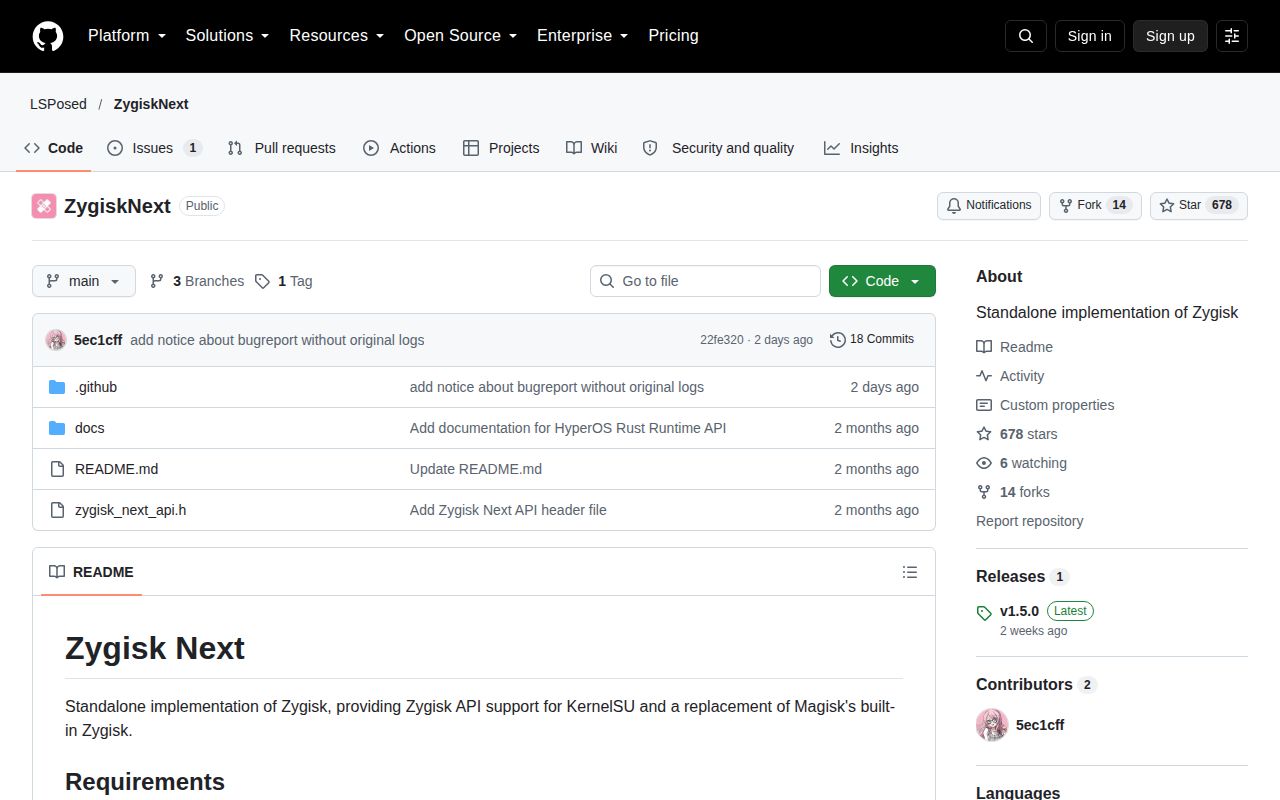
Starting with v4-0.9.2, the README says ZygiskNext is no longer GPL-3.0 and that all rights are reserved. It prohibits modification, redistribution, extracting pieces of code, and claiming succession. GitHub's repository metadata reports no recognized license. The current main tree contains the README, issue templates, a short HyperOS document, and the public API header, but not the implementation source or a build recipe.
That changes the buying decision. A root module can read and affect the entire device, yet independent reviewers cannot inspect the shipped implementation in this repository or make a patched build under the stated terms. Trust in the maintainers and the published checksum may be enough for a personal modding phone. It is a poor fit for an organization whose security process requires source review, reproducible builds, internal patches, or redistribution rights.
An October push and one open service issue show live maintenance
GitHub recorded 678 stars, 1 open issue, 0 open pull requests, and a last push on October 5, 2026. The sole open report says v1.5.0 could not connect to its service after an upgrade to KernelSU-Next 3.4.0 on Android 15. A project member replied on October 5 asking the reporter to reproduce the failure and provide KernelSU-Next logs. This is an active investigation, not a confirmed general incompatibility.
Other recent activity includes an Android 10 injector crash report closed on October 5 and a mount-restoration report closed on October 4. Combined with the September 20 release, that is evidence of current maintenance and issue handling. It cannot answer the question our lab left open: whether the release installs cleanly and behaves safely on your exact phone, kernel, root manager, and module set.
GPL alternatives exist for each trust preference
Magisk keeps its Zygisk implementation inside a GPL-3.0 root suite. ReZygisk is a GPL-3.0 fork that documents KernelSU, APatch, and Magisk support, while NeoZygisk uses a ptrace-based design and publishes its own DenyList model. All 3 expose implementation source and modification rights that the current ZygiskNext terms withhold. Their designs and compatibility claims still need device-specific testing.
Choose ZygiskNext for a supported rooted phone only when its v1.5.0 compatibility work or HyperOS Runtime API solves a problem you have and you accept a trust-based binary. Keep a recovery route and the exact release ZIP checksum before changing the module. If code review or patching is part of your safety model, the license and missing implementation source settle the decision before installation.