ZCF puts Claude Code and Codex setup behind one menu
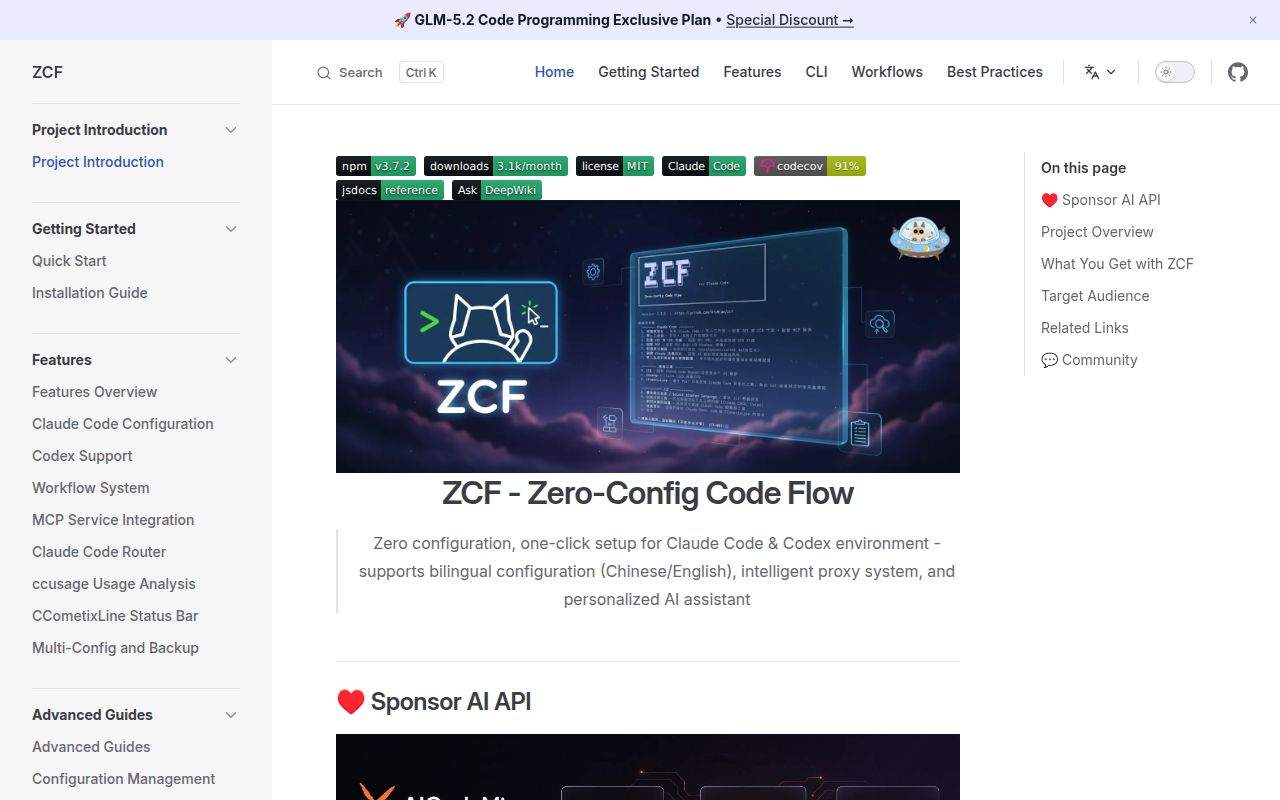
Running npx zcf opens an interactive menu. Full initialization can install the coding tool, import workflows, configure an API or Claude Code Router, and add MCP services. Separate commands update workflows or change the interface language. A noninteractive mode accepts a provider preset and API details, which is useful when several machines need the same baseline.
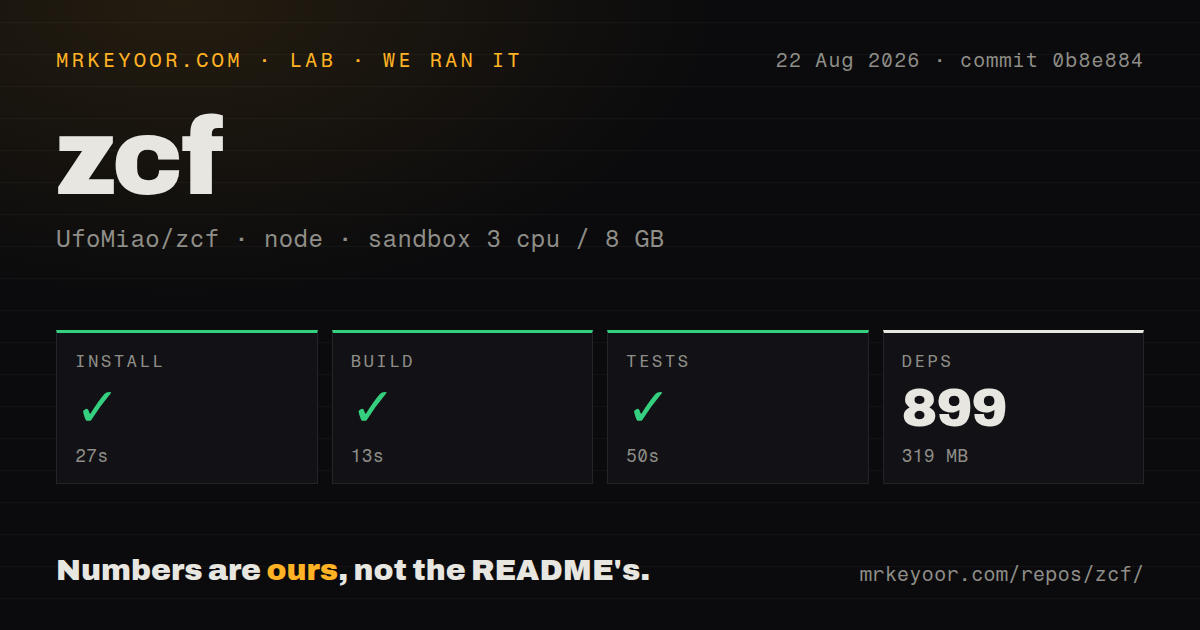
The convenience has weight. Our install added 899 packages and occupied 319 MB before any coding agent or provider dependency was counted. ZCF is best understood as a configuration distribution system, not a tiny shell shortcut. It decides how multiple tools and files fit together, and that decision is valuable only when the user wants most of the included arrangement.
English is the default, with Chinese and Japanese editions
The main README is in English and links to complete Chinese and Japanese translations. The interactive examples also show language selection, and the project describes bilingual workflows and personalized output preferences. That makes ZCF unusually approachable for mixed-language teams, though the short README sends detailed command and behavior questions to a separate documentation site.
GitHub listed 6,078 stars and 44 combined issues and pull requests when we fetched it. The last push was August 23, 2026, while release zcf@3.7.2 shipped August 4. That patch skipped sockets and other special filesystem entries during recursive copies. This is active maintenance around the exact kind of file handling an installer must get right.
What happened when we ran it
Our sandbox cloned commit 0b8e884 into an unprivileged Node 22 Debian container with 3 CPUs and 8 GB of RAM. The pnpm install completed in 27 seconds, adding 899 packages and using 319 MB on disk. The build passed in 13 seconds.
The test command also passed, taking 50 seconds. The supplied measurement does not state a test count, so a passing command is the limit of the claim. The repository measured 12.3 MB before dependencies, with 615 files and about 70,395 lines of source. It is a workspace monorepo with a tests directory and 3 CI workflow files.
Our scan found no Dockerfile, which is not a serious omission for an interactive user-level installer. It does mean the sandbox result covered repository mechanics rather than an isolated deployment image. We did not supply provider secrets, modify a real home directory, connect an MCP service, or exercise Claude Code and Codex sessions after repeated provider switches.
Configuration rewrites deserve the same care as code changes
ZCF touches files that coding agents use to decide providers, credentials, tools, permissions, and behavior. Full initialization bundles several changes behind one choice. Before running it on a working machine, copy the Claude and Codex configuration directories, inspect the proposed provider and MCP settings, and keep the first run away from production credentials. A successful 50-second test command cannot prove that a unique local file will merge as intended.
Pull request 361 documents a concrete Codex problem. Existing nested MCP environment tables could be rewritten as invalid TOML or left with duplicate env keys. The proposed change replaces a target service section and adds regression coverage. Whether merged or not, the report shows why custom MCP entries need a before-and-after diff rather than blind acceptance.
Issue 345 describes a separate provider-switching failure. Codex Desktop sessions appeared to disappear after the active provider changed, although session files stayed on disk. The reporter traced the view problem to stored provider metadata and also found that one direct switch path did not fully synchronize auth.json. Users with valuable session history should reproduce that flow with a copied profile before standardizing ZCF.
Sponsored relay providers need independent approval
The README includes many sponsored model API relays, with discounts, credits, and claims about pricing or upstream access. Those offers are project marketing, not evidence from our sandbox. A relay can see prompts, code context, and authentication traffic depending on how it operates. Company use therefore requires a contract, retention policy, incident process, data location, and billing review for the chosen provider.
You can avoid that decision by configuring an endpoint your organization already approves. The 27-second install does not require choosing a sponsor, and ZCF's value does not depend on accepting one. Keep keys out of command history where possible, restrict their scope, and check every generated endpoint before a coding agent receives repository access.
Windows and existing profiles are the harder cases
Issue 347 reports that ZCF's PowerShell route said Claude Code installed successfully, then failed verification because the command could not be found in a known location. Issue 368 says an initial failed Claude installation left the user unsure how to re-enter installation or uninstall. Both reports concern recovery after setup, the moment when an all-in-one configurator must be clearest.
For a clean disposable profile, ZCF is cheap to try: our build and test steps finished in 63 seconds combined. For a mature developer profile, start with workflow import or one narrow configuration action instead of full initialization. Claude Code's own repository is the simpler choice for users who need only Anthropic's agent. Claude Code Router is the tighter alternative when model routing, rather than broad setup, is the sole requirement.