mrkeyoor.com_
Sat 03 Oct 07:16 UTC
Dev Toolsevaluationupdated 03 Oct 2026

YOINK review

YOINK is a keyboard-driven note app that keeps an Obsidian-compatible markdown vault and lets you turn dated predictions into checkable claims. It scores settled claims and points out notes you never returned to, giving a personal knowledge base an unusually blunt memory of what proved useful or true.

Verdict

Our YOINK run built in 8 seconds, but 1 of 201 tests failed because the demo headline gained 1 due now while the expected screenshot text did not. Use it if plain markdown, terminal capture, and honest calibration belong in the same personal workflow. Wait if you need a green suite, shared access, full YAML, or a record that another party cannot rewrite.

We ran it

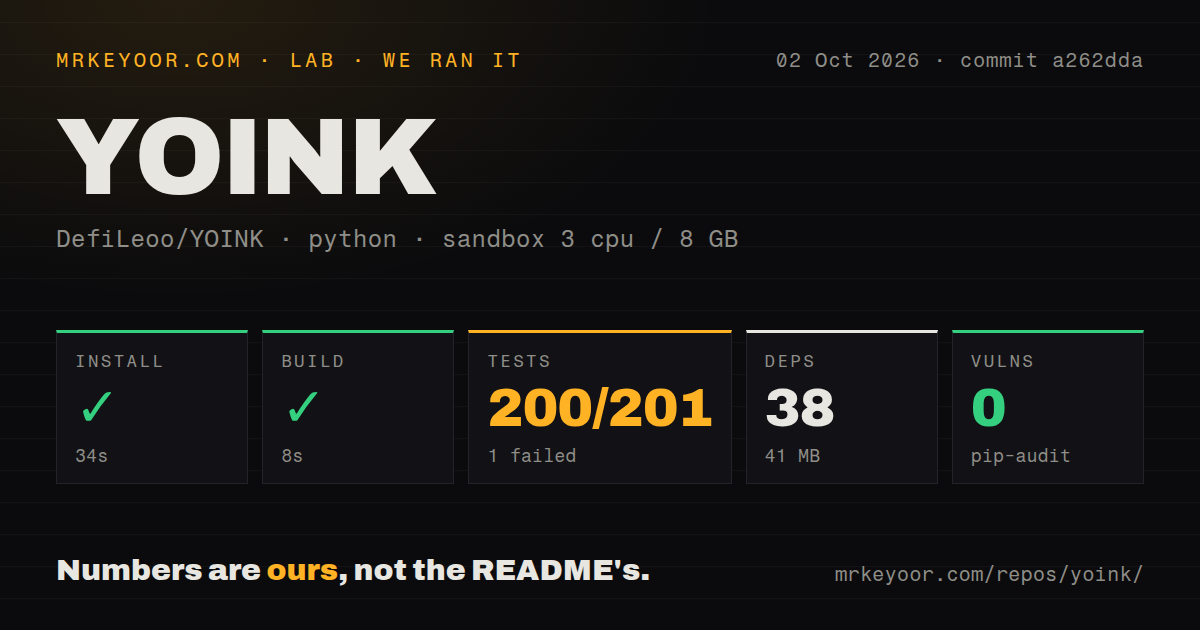
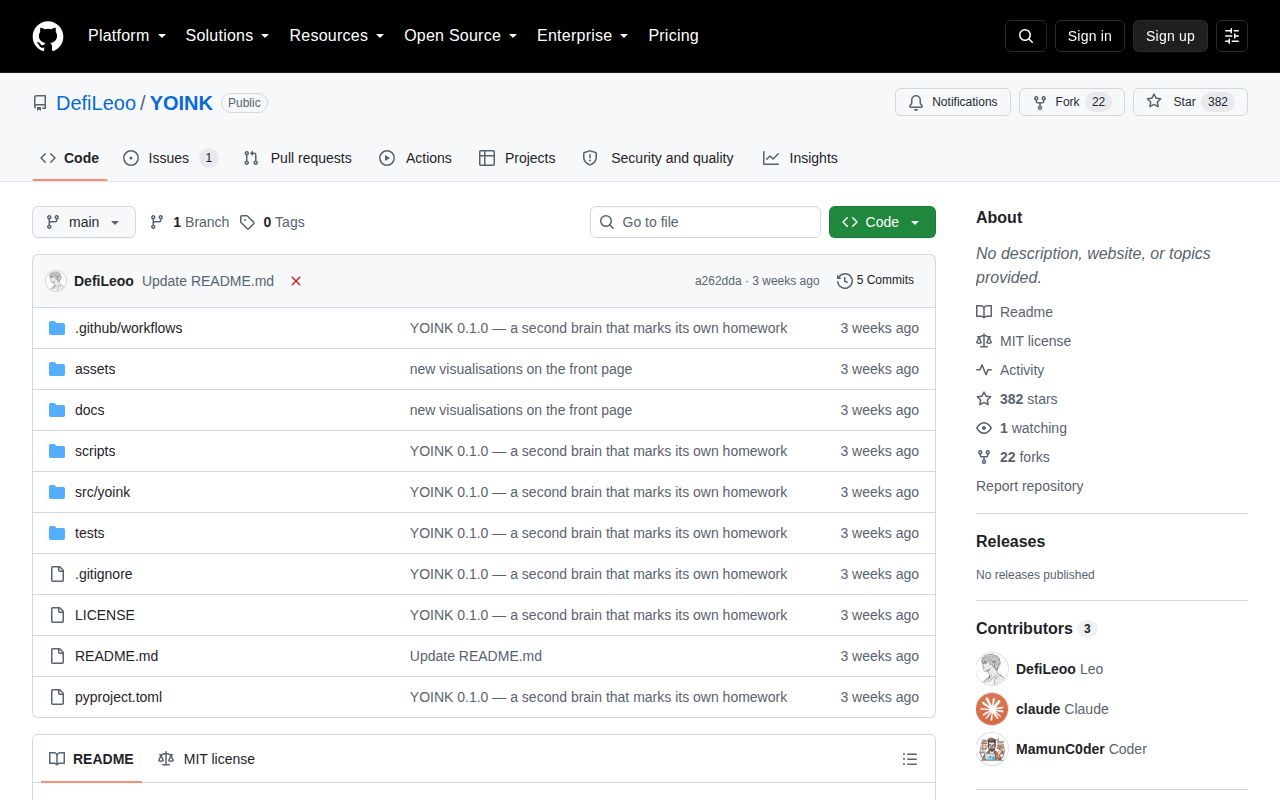
Lab card: what happened when we ran YOINKScreenshot of YOINK (github.com/DefiLeoo/YOINK)
Install✓ · 34s38 packages · 41 MB
Build✓ · 8s
Tests✗ · 12s200 passed · 1 failed of 201 (pytest)
Known vulns0(pip-audit)
Repo48 files~5,558 lines of source · 8.9 MB · 1 CI workflows · tests dir

Answers from our run

Does YOINK build from source?

Dependencies installed in 34 seconds (38 packages), and the build succeeded in 8 seconds. We cloned commit a262dda into a clean Debian container with 3 CPUs and no project-specific setup.

Do YOINK's tests pass?

Not all of them: 200 of 201 passed and 1 failed when we ran the project's own test command (pytest). Some failures need services or credentials a bare container does not have.

Does YOINK have known vulnerabilities in its dependencies?

pip-audit found none in the dependency tree at the time of our run.

Who should not use YOINK?

Teams requiring a green release gate: our run ended with 200 passed and 1 failed test.

What are the alternatives to YOINK?

zk, SilverBullet, Logseq. Our YOINK run built in 8 seconds, but 1 of 201 tests failed because the demo headline gained 1 due now while the expected screenshot text did not.

Setup4/534-second install and 8-second build, with no runtime services
Docs5/5Specific vault, scoring, claim, terminal, and honesty documentation
Community2/5382 stars, one open issue, and no tagged release
Maturity2/5Version 0.1.0 is new, and our 201-test run had one failure

Who it’s for

Terminal users who want plain markdown notes that still open in Obsidian.
Forecasters, researchers, or investors who want confidence estimates attached to dated claims.
People willing to inspect dead notes instead of treating capture volume as progress.
Python users who prefer a local folder and standard-library runtime over an account or service.

Who it’s NOT for

Teams requiring a green release gate: our run ended with 200 passed and 1 failed test.
Anyone needing a tamper-proof audit record: the README says the hash-chained ledger can be rewritten end to end by whoever owns the file.
Vaults that depend on full YAML behavior: YOINK parses only the frontmatter subset its docs describe.
People expecting prediction help: the project has no model and only grades claims you write yourself.
Users who read the animated graph as a live TUI pane: the README says the animations are explanatory drawings, and issue 1 disputes how clearly that was presented.
Shared note systems that need accounts, permissions, or built-in sync: YOINK stores local files and provides none of those services.

Setup reality

Our sandbox installed commit a262dda in 34 seconds, leaving 38 packages and 41 MB on disk. The build succeeded in 8 seconds. Pytest failed in 12 seconds with 200 passed and 1 failed out of 201; pip-audit found 0 known vulnerabilities.

The failure was a screenshot-headline expectation in tests/test_demo.py. The actual line ended with 1 due now, while the expected line stopped after +35 pts overconfident. The log shows a text mismatch, not a broken vault or settlement operation.

YOINK needs Python 3.10 or newer and defaults to ~/yoink-vault, overridable by --vault or $YOINK_VAULT. File and CSV claims stay local; chain claims need a reachable JSON-RPC endpoint, and manual claims need a person to supply the reading.

Five frontmatter fields turn a note into a checkable claim

YOINK starts with an ordinary folder of markdown files, the same format Obsidian understands. Add a claim, settlement date, reading source, test, and confidence value to a note's frontmatter, and the tool treats it as a prediction. When the date arrives, yoink settle reads a number, applies the declared comparison, and writes the outcome back into that file. The note keeps the thought and the result together.

A claim can read JSON, a dated CSV cell, a public EVM chain, or a manually supplied value tied to a URL. Tests are deliberately narrow: greater than, less than, equality, inequality, and an inclusive range. YOINK rejects vague claims, past settlement dates, unknown source forms, and confidence values at exactly 0 or 1. That constraint is useful because a score built on uncheckable prose would be decoration.

The score makes overconfidence visible in the same vault

Settled claims feed a Brier score, hit rate, stated-confidence average, and the gap between confidence and accuracy. The fixed demo contains 35 notes, 5 settled claims, and 2 open ones. Its author says 75 percent on average, lands on the correct side 40 percent of the time, and gets labeled 35 points overconfident. Those are demo fixtures, not evidence that the program improves forecasting.

YOINK also calls a note dead when it has no valid links, has not been reopened after its creation day, and carries no open claim. In the demo, 21 of 35 notes meet that definition. The rule will annoy people who use a vault mainly as an archive, yet it exposes a familiar second-brain failure: capturing material feels productive even when nothing later points back to it.

What happened when we ran it

Our fresh Python 3.12 sandbox installed commit a262dda in 34 seconds. The 48-file checkout contained about 5,558 lines of source and occupied 8.9 MB. Installation left 38 packages and 41 MB on disk. A build completed successfully in 8 seconds, and pip-audit reported 0 known vulnerabilities.

Pytest failed after 12 seconds with 200 passed and 1 failed out of 201, plus 27 passed subtests. The red case was test_the_headline_reads_the_way_the_screenshot_shows. The program produced the documented demo summary with an extra 1 due now suffix, while the expected string ended at +35 pts overconfident. The log supports calling this fixture or display-text drift; it does not show damage to notes or a failed settlement.

Plain files stay portable, while the ledger is weaker than proof

The vault has no database or search index. Every scan rebuilds links, tags, search results, and pulse data from markdown on disk. YOINK writes Obsidian-style frontmatter and [[wikilinks]], so the folder remains usable in another editor if the program disappears. Its parser handles strings, numbers, booleans, dates, timestamps, and flat lists rather than the whole YAML language.

Reading and settlement history lives separately in .yoink/ledger.jsonl. Each line includes a hash of the prior entry, so editing one event breaks the chain and yoink doctor can point at it. The README is candid about the limit: a person who controls the file can rewrite the entire chain. Use it to catch casual self-editing, not to prove a forecast's timing to an employer, customer, or regulator.

Chain settlement can read balances but cannot sign transactions

The chain adapter supports Ethereum plus Robinhood Chain mainnet and testnet in the documented source. It checks eth_chainId before reading block height, gas price, balance, or transaction count. The implementation contains no private-key handling, signing, or send-transaction method. A claim stays open when its endpoint cannot be read instead of accepting a guessed value.

That design reduces wallet risk, but it still introduces an external dependency for chain claims. An incorrect or unavailable endpoint can postpone settlement. File and CSV sources avoid that network dependency, while manual: requires the user to enter a value and records its URL. YOINK grades the number it receives; it does not independently decide whether a manual source is trustworthy.

The README now labels its animations as drawings

Open issue 1 argues that the animated images look like terminal features the app does not provide. The current README answers part of that complaint directly: its still terminal capture comes from a pseudo terminal, while 3 animations are drawn explanations. It also says the graph shown in an animation is a way to view the vault rather than a separate pane reached with its own key.

GitHub showed 382 stars, 1 open issue, and a last push on September 13, 2026, two days after the repository was created. There is no tagged GitHub release, while pyproject.toml calls the package version 0.1.0 and beta. The MIT license and detailed docs make inspection easy. The failed demo assertion and presentation dispute still put YOINK in the interesting-new-tool bucket, not the dependable-record-system bucket.

Alternatives

ProjectWhat it isPick it when
zkA command-line plain-text notebook built around markdown and links.pick this instead when fast linked-note work matters and you do not need prediction settlement or scoring.
SilverBulletA self-hosted markdown notebook with a browser interface and programmable queries.pick this instead when browser access and extensibility matter more than YOINK's terminal and forecasting focus.
Logseq gh↗A local-first outliner and knowledge graph for linked notes and tasks.pick this instead when outlining, journals, and a graphical app matter more than scoring dated claims.

What people are saying

  1. [velocity-scout] DefiLeoo/YOINK

Sources

  1. YOINK README
  2. YOINK package manifest
  3. YOINK claims documentation
  4. YOINK scoring documentation
  5. README animation issue 1

More dev tools reviews

ToolReplay · CUDA-for-AMD-Windows · DuoFold-Android · wutw-public · viserys-agent · birdview · the whole board →