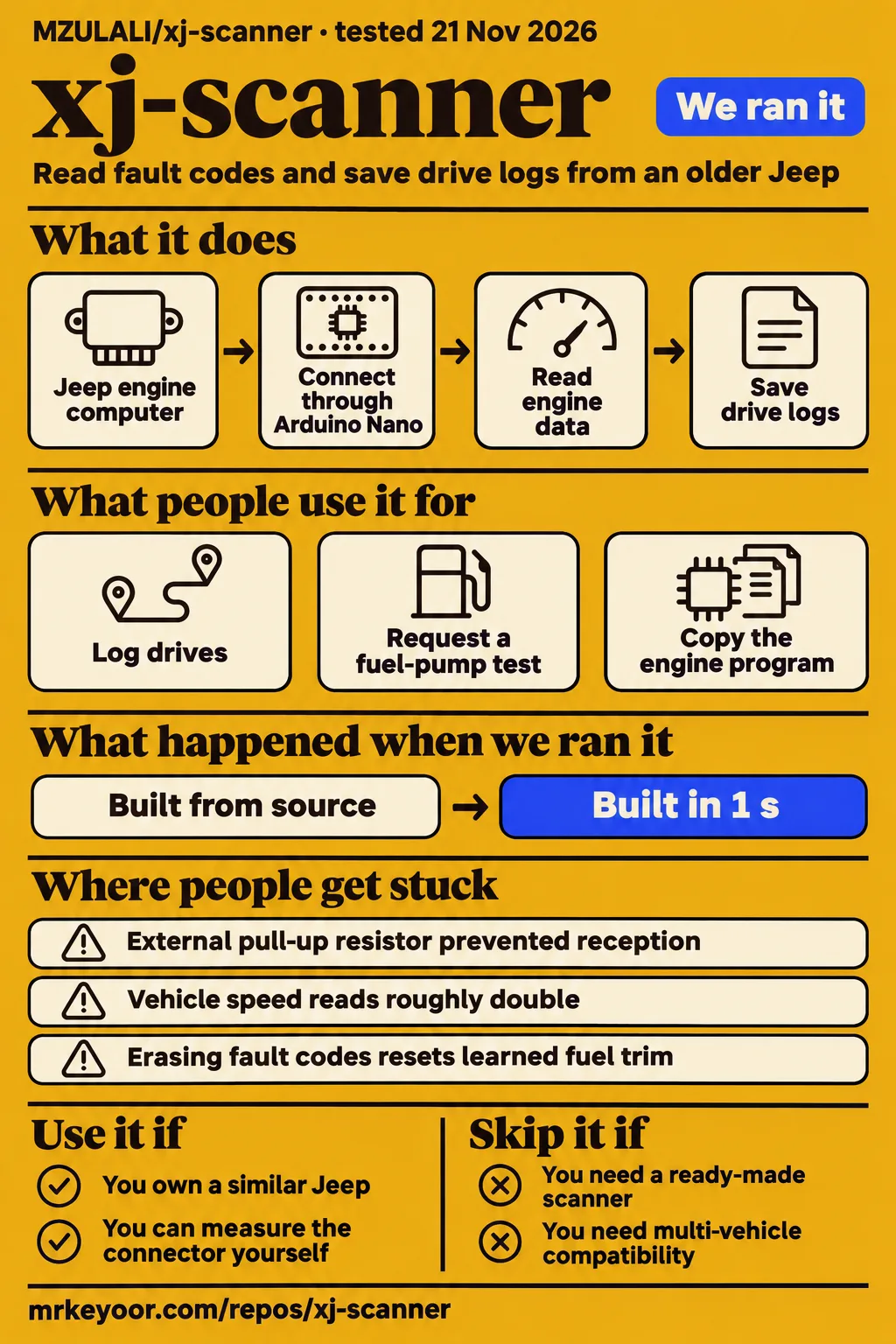
Our sandbox installed xj-scanner in 4 seconds and built it in 1 second, but the vehicle case rests on the author's 1994 Cherokee. Use it if you want inspectable diagnostics for a similar Jeep and can work through the electrical checks. Skip it if you need a ready-made scanner with demonstrated compatibility across several vehicles. The README identifies the tested car as a Cherokee XJ 4.0L with computer 56030117.
What people use xj-scanner for
Muhammad Zulali used xj-scanner to collect engine readings and fault codes during drives while investigating repeated California smog-test failures, according to Tom's Hardware's account. That is the useful starting point for you: get interpretable data out of a car that predates the modern diagnostic interface, then decide what the readings support.
| Use | Who did it and what happened |
|---|---|
| Log an investigation | Muhammad Zulali collected engine data and fault codes on drives; the investigation included a misleading fuel-trim interpretation, described by Tom's Hardware. |
| Request a built-in fuel-pump test | Zulali reported approving Claude Code's request to activate the pump, then asking it to stop after roughly ten seconds, according to Zeniteq. |
| Copy the engine program | Zulali reported that Claude copied the full program to his laptop; the protocol documentation describes a 32 KB read-only dump taking about 18 minutes. |
| Explore custom code | Zulali reported that Codex moved experimental code into EEPROM after temporary code was overwritten, according to Cyber Security News. EEPROM is memory that retains its contents without power. |
These uses require different permissions. Reading a coolant value, switching a pump and executing code inside the computer are separate operations. For an owner trying to understand a rough-running engine, live data and a saved drive log already offer something useful without making the custom-code story the reason to adopt the project.
The agent instructions route first-time setup, scanning and connection troubleshooting into separate playbooks. They tell the assistant to explain each step in plain words and wait for the person's observations. You still supply the physical observations: an agent cannot measure the voltage in your connector through a chat window.
What happened when we ran it
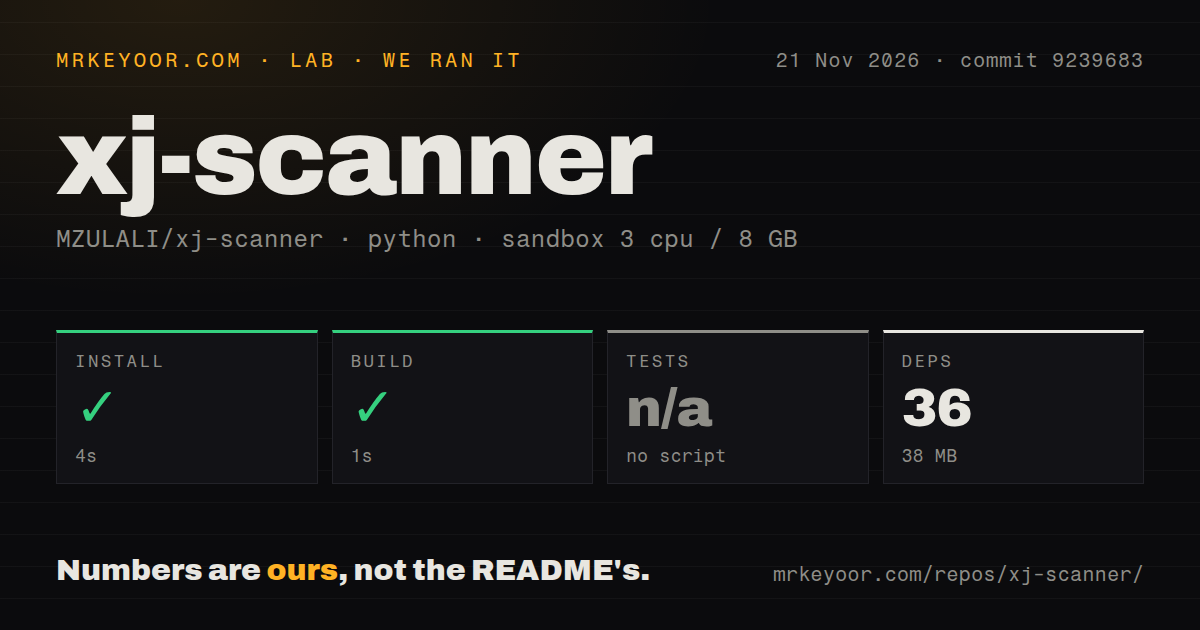
Our November 21, 2026 sandbox run installed the Python project in 4 seconds and built it in 1 second at commit 9239683; tests were skipped because there was no test script or target. Our harness recorded software checks, separate from the attempted lab deployment below.
| Sandbox observation | Recorded result |
|---|---|
| Project location | Python project in ./pc/ |
| Checkout | 27 files, about 1,575 source lines, 0.5 MB |
| Install | Succeeded in 4 seconds; 36 dependencies recorded, 38 MB on disk |
| Build | Succeeded in 1 second |
| Tests | No test script or target; skipped |
| Repository signals | 0 CI workflow files, no Dockerfile, no tests directory |
| Configuration | 3 CPUs, 8 GB RAM; image label ghcr.io/astral-sh/uv:python3.12-bookworm |
Our run completed the software steps quickly. There was no passing test-suite result to follow them, because the harness had no test target to execute. The image name records the chosen sandbox configuration; actual runtime and operating-system versions require the raw toolchain logs.
The separate hands-on attempt stopped at its safety check. The log says "none of compose.yaml, compose.yml, docker-compose.yaml, docker-compose.yml exists", under a rule requiring a Compose file. That requirement blocked this lab workflow. It is not a diagnosis of a broken Python scanner: the README's documented route uses a laptop, a Nano and a serial connection.
There is a contradiction in the run paperwork. Its summary says it was deployed with its own Docker Compose, while the failed step says the required file was absent. The failed step takes precedence over that deployment summary for this review. The teardown log reported success. No vehicle result follows from this attempt.
Where people get stuck: wiring and decoding change the answer
The original external pull-up resistor prevented reception, and removing it restored communication, according to the wiring documentation. That is a useful failure report because it names the part and the observed result, rather than promising that three wires always work on the first attempt.
| Symptom or misleading result | What the project documents | Status |
|---|---|---|
| Nothing received with the original circuit | External R1 held the transmit line high; removing it fixed reception. | Fixed on the author's car, wiring notes. |
| Transmit line idles HIGH after reconnecting | Reseating terminals in the right cavities fixed the reported occurrences. | Fixed on those occasions, connector notes. |
| Vehicle speed looks too high | It reads roughly double on the test car; the drive-report tool accepts a 0.5 factor. | Documented workaround, parameter notes. |
| No fuel-system-status response | Neither identifier 3B nor 57 answers; the notes use oxygen-sensor switching to infer closed-loop operation. | Indirect reading, parameter notes. |
| Minimum throttle-position voltage differs from closed throttle | The notes show 1.02 V versus 0.63 V and call the difference unexplained. | Open question, parameter notes. |
| A comparison drive starts with different learned trim | Erasing fault codes and resetting fuel trim both return the learned value to 128. | Avoid those resets before comparing drives, parameter notes. |
The fuel-trim error deserves more than a troubleshooting row. Fuel trim is the engine computer's correction to the amount of fuel it supplies. The parameter documentation says raw 110 means approximately −4.7%. An inherited formula instead read it as +21.6%, sending the author through a day of investigation into a fuel-delivery problem the notes say did not exist.
The scanner records counts relative to 128, so that same raw value becomes −18 counts. Don't read −18 as −18 percent. The notes give approximately 0.26% per count and explain how the scale was checked against the computer's code. For you, the lesson is practical: keep the raw value and its conversion together when an assistant proposes a diagnosis. A fluent explanation cannot repair incorrect units.
The hardware estimate is about $15, plus a laptop
The README estimates about $15 for its hardware list, including the Nano, breadboard, wires, terminals and multimeter; the $3 figure describes the Nano alone. That estimate is the author's parts budget, not a worldwide retail quote or our purchase receipt. You also need a laptop, and choosing a paid coding agent can add a separate expense.
The documented manual route creates a Python virtual environment, runs pc/xj_scan.py --cli DEMO, and uses Arduino CLI to put the bridge sketch on the Nano. The wiring notes distinguish new and old Nano bootloaders. That detail matters when a clone board differs from the one the author used. The README's Homebrew example is an example command, not a statement that every supported laptop has identical setup steps.
Start with DEMO because it checks the laptop side before you add the vehicle connection. When using the serial port, the agent instructions say to close other programs holding it open, including Arduino's Serial Monitor. You are assembling a diagnostic interface, rather than buying a finished handheld unit with a cable already matched to the car.
Hardware access goes beyond asking an agent to be careful
The protocol documentation lists both actuator start and stop commands, and the same scanner exposes manual byte sending. An actuator is a component the computer can switch, such as a fuel pump, injector or fan. This makes permission to use the scanner consequential even if your initial purpose is reading sensor values.
The project's instructions require approval before actuator tests, specify key on and engine off, and call for short runs. They also flag erasing codes and resetting learned trim as actions beyond reading. Zeniteq's account of the pump event includes that approval. Its suggested enforcing service, with the agent denied direct device access, is a proposed architecture rather than a feature demonstrated by xj-scanner.
The electrical warning is equally specific. The connector notes say cavity 6 carries 12 V with the key on, shares a wire color with ground and can beep on a key-off continuity check. A continuity beep alone therefore does not identify ground. The project's cavity numbering is its own convention, so copying another diagram's numbers would also defeat the purpose of its meter-first instructions.
The working circuit documented by the author has no series resistor between the transmit path and the Nano pin. The wiring page warns that a mistaken 12 V connection can destroy the Nano. Its suggested protective resistor belongs in the outstanding hardware checks collected at the end of this review.
xj-scanner vs ChryslerScanner and modern OBD-II tools
ChryslerScanner supplies protocol knowledge used by xj-scanner, while a modern OBD-II tool addresses a different interface from the author's 1994 Cherokee, according to the project's credits and Technology.org's account. Choose by the interface and the work you need to do, before comparing feature lists.
| Option | Why you would consider it | What this comparison supports |
|---|---|---|
| xj-scanner | You want the Nano bridge, laptop logging and agent-guided playbooks documented for this Cherokee. | A documented workflow for the author's car, agent instructions. |
| ChryslerScanner | You want to inspect the upstream project credited for parameter IDs, message sequences and fault-code text. | A technical starting point; xj-scanner documents a different fuel-trim interpretation for its test computer, parameter notes. |
| Modern OBD-II scanner | Your vehicle uses the interface the tool supports. | The author's Cherokee predates OBD-II; this is an interface distinction, Technology.org. |
| AR1972/jeep_2.5L | Your task is inspecting Jeep and Dodge ECU program images rather than simply logging a drive. | Its README describes an EPROM collection and cross-flashing utilities; it is a specialist reference, not an equivalent finished scanner. |
The comparison should not turn into a claim that old Jeeps have no other diagnostic equipment. In the video "1986 XJ 2.5L. Scanner Uncovers Problems !!! Part 1.", the creator uses a Snap-on MT2500, discusses fuel-trim readings and flags several values for further investigation. That is a different Jeep and tool, not a reproduction of xj-scanner. It does show why a video about an old Jeep scanner cannot be counted as an xj-scanner compatibility result.
What the other reviews get wrong
Technology.org and MotorBiscuit's Yahoo article connect modified code to the reported smog pass, but Zulali denies a smog-test patch in issue #3. That disagreement changes what you can reasonably expect this repository to deliver.
| Published claim | Correction grounded in the project |
|---|---|
| Technology.org and MotorBiscuit on Yahoo attribute the pass to corrected fuel delivery or modified code. | The author's reply in issue #3 says there was no patch for the smog test. The causal story is disputed. |
| Yahoo says the computer was removing 22% of the fuel. | The parameter notes give about −4.7% for raw 110. Reversing the sign of 22% still gives the wrong answer. |
| Tom's Hardware says the first connection attempt succeeded. | The wiring notes describe the pull-up resistor that initially prevented reception. |
| Skaifomo's X post calls $3 the whole setup and says internal tests run without anyone touching anything. | The X post overstates both: the README's hardware estimate is about $15 and the instructions require approval for actuator tests. |
| Skaifomo's follow-up says it works on 1991-95 Jeeps and Chryslers with SBEC computers. | The README says related computers should be close and identifies one tested vehicle. Expectation is not a compatibility matrix. |
The more careful X post by KeisukeIshikawa names the tested Cherokee and tells readers not to assume every car works. Treat that distinction seriously: sharing the author's story does not create another vehicle test.
Questions people ask
Claude Code can request built-in actuator tests through xj-scanner, beyond reading data, and Zulali reports approving a fuel-pump activation. That is the concrete event behind the question about an AI controlling the Jeep.
Can Claude Code actually control the Jeep, or does it only read diagnostic data?
The scanner exposes actuator tests as well as readings. Its protocol page lists start and stop requests for pumps, injectors, coils and fans. That is control over specific diagnostic functions, not evidence of autonomous driving or unrestricted control of every vehicle system.
Can you share the custom code or patch and the emissions evidence?
The requester in issue #3 asks for the code, writing routine and before-and-after inspection reports. The author responds that there was no smog-test patch. The visible exchange supplies that denial rather than the requested artifacts, so this review cannot link you to a reproducible emissions fix.
What code was running during the inspection, and what did it change in the PCM's behavior?
The author's issue #3 reply denies a patch for the inspection; it gives no inventory of code running then or description of changed behavior. PCM means powertrain control module, the engine computer discussed throughout the project. A reported experiment with custom code does not answer which code was present during a later inspection.
Did any custom code remain active after the smog test?
The question is asked in issue #3, but the reply does not describe post-test memory state. The account of EEPROM retaining experimental code cannot answer whether that code was present after the inspection.
Are redacted before-and-after smog inspection reports available?
No reports are attached in the issue #3 exchange checked for this review. The requester explicitly asks for redacted copies. Closing the issue does not supply those copies or settle the account of why the car passed.
What actually caused the high NOx readings, and could an electronic adjustment conceal a mechanical fault?
King_V raises that exact concern in the Tom's Hardware comments, asking what component was failing and whether electronics masked it. Those comments propose possibilities, not a diagnosed cause. The correction to fuel-trim scaling explains a mistaken reading; it does not establish the mechanical cause of the emissions failure.
Does the whole setup cost $3?
No. The README puts the listed hardware at about $15, while $3 refers to the Nano. A laptop is also required. Prices depend on what you already own and where you buy, so use the parts list rather than the headline as your shopping checklist.
What enforces the safety limits on hardware commands beyond the agent's instructions?
The agent instructions require permission; that text is a procedure, not an access restriction. Zeniteq proposes enforcement at the protocol-command layer and denying direct device access. A proposal in a review is not an implemented protection in this project.
What limits actuator duration and ensures it stops if communication fails?
The protocol page documents an explicit actuator stop command. It separately documents automatic return to normal idle when idle-speed requests stop. That behavior belongs to idle control, so it cannot be borrowed as proof of a fuel-pump timeout. The pump account ends when Zulali asks the agent to stop.
One recent push and closed issues are a small support sample
GitHub's repository metadata records the last push as November 10, 2026. The sampled issue #3 is closed and includes one author reply. Those records show recent activity and a specific response, rather than a history of support across Jeep models. The reply addresses the smog-test-patch claim; it does not describe another completed scanner installation.
The other sampled conversation, issue #2, links an SBEC2 emulator project and receives a brief positive reply. It is an exchange between people working on related hardware, not a report of another successful xj-scanner installation. The README provides a source-checkout route. If you need help, report your actual computer part number, measured connector pattern and observed scanner output rather than only the vehicle's model year.
What we have not tested yet
Our checks cover the Python installation and build, not a connection to a real engine computer. The Compose safety failure prevented the separate deployment workflow from proceeding. We have no independently reproduced vehicle readings, actuator results, program dump, emissions measurements or multi-vehicle compatibility matrix. The repository metadata contains no verified latest-release result; its null value can reflect a failed lookup and supplies no HTTP response status.
The documentation's proposed series-resistor protection remains untested on the author's car. A hardware evaluation would need to establish both communication and protection, rather than assume that a component suggestion is a finished circuit. Actuator duration limits, communication-loss behavior and restrictions that survive direct serial access also need demonstration. The documented idle fallback is not that demonstration for every actuator.
The public issue exchange leaves the requested custom-code artifacts and redacted inspection reports absent. Resolving the emissions story needs those artifacts and a clear account of the vehicle's mechanical condition. A controlled comparison with another compatible scanner would also need accuracy, connection reliability, setup effort and complete ownership costs measured on the same vehicle. Until then, begin with the project's documented DEMO check and treat a matching part number as a starting point for electrical checks, not permission to copy somebody else's wiring blindly.