This is a shipped game to study, not a starter kit
Worlds Upon The Wind gives away the source of a commercial Godot 4 game under CC0, apart from named third-party material. The useful part is its accumulated structure. Cards, relics, characters, events, quests, skills, and map objects are represented through Godot resources, while editor plugins help the developer jump to story states, export localization strings, and stamp builds with Git information. You can inspect decisions that only appear after a small prototype grows into a finished product.
That makes the repository unusually instructive, but also awkward as a beginning point. Our checkout held 10,332 files, about 52,179 lines of source, and 4,126.6 MB on disk. It includes giant layered art sources, platform binaries, third-party addons, Japanese language datasets, and production scripts. A beginner trying to learn one scene pattern will spend more time separating signal from shipped-game baggage than they would in a purpose-built demo.
Godot resources carry most of the game's content
The README's architecture map is the strongest documentation here. It identifies the high-level run controller, persistent run data, save-game source of truth, signal bus, map renderer, dialogue system, localization exporter, debug tools, and dozens of content folders. The main game is GDScript, with a C++ GDExtension handling map generation and sprite management where the author wanted more speed. Standard Godot shaders carry much of the visual work.
The project file declares Godot 4.7 and version 1.4 of the game configuration. Six editor plugins are enabled, including Steam, an in-game console, resource grouping, and three project-specific tools. This is valuable if your question is how a solo or small-team Godot project keeps hundreds of content objects editable. It is less useful when you want an engine-neutral architecture: many choices depend directly on Godot scenes, resources, autoloads, and editor docks.
What happened when we ran it
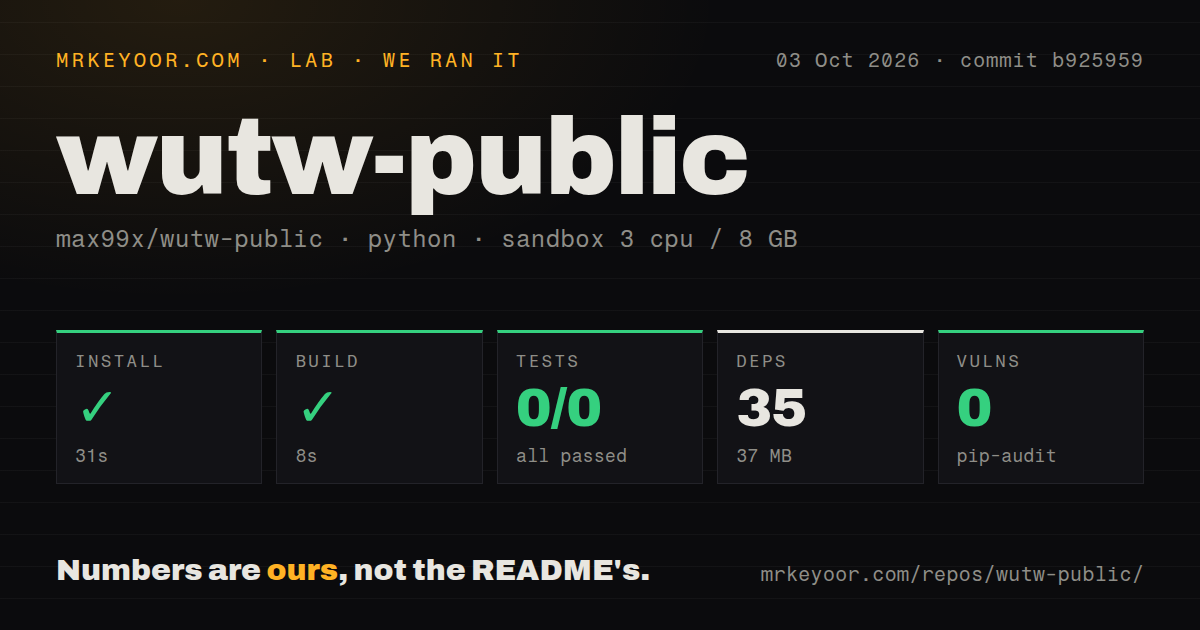
Our sandbox cloned commit b925959 with 3 CPUs, 8 GB of RAM, Python 3.12 on Debian, no secrets, and no elevated privileges. The measured project path was wutw-gdext/godot-cpp, not the wutw game directory. Installation completed in 31 seconds, adding 35 packages and using 37 MB. The selected build completed in 8 seconds. Pip-audit reported 0 known vulnerabilities.
The test step failed after 8 seconds with exit code 5. Pytest's entire useful result was no tests ran in 0.02s: 0 passed and 0 failed because it collected 0 tests. The repository has a tests directory, but the log does not establish why pytest found nothing runnable. We will not turn an empty collection into a claim about test quality or guess whether another runner was intended.
Those numbers prove that the harness-selected godot-cpp path can install and build in our container. They do not prove that Godot imported the assets, loaded the main scene, accepted the bundled native libraries, or completed a campaign. The repository has no CI workflow to supply that broader signal. Treat the passing 8-second build as one narrow check inside a much larger project.
The local game path needs Godot 4.7 and patience
The README's playable route is editor-led: install Godot 4.7, import wutw/project.godot, wait for data import, reopen the project if console errors remain, and press F5. That is short documentation for a 4,126.6 MB checkout. It does at least warn about the likely first-open behavior instead of pretending import is instant. Prebuilt Windows, Linux, and macOS GDExtension binaries live under the Godot project as well.
The public copy will be quiet. All music and sound effects are excluded because their licenses do not permit redistribution, although voiced cutscenes remain and the Wwise-facing code is present. This matters beyond atmosphere. Anyone using the repository for classroom play, automated capture, or a derivative game must plan around missing assets and review each third-party license. The CC0 headline does not erase the separate terms for GodotSteam, dictionaries, fonts, example sentences, and other bundled material.
The build scripts reveal a personal production setup
The root scripts cover Windows and Linux exports plus Steam upload. The export script invokes Windows tools and WSL, builds debug and release GDExtension targets, and places Steam Deck configuration beside Linux exports. That is useful evidence of how this game was shipped. It is not a portable release pipeline waiting for a new project name. Paths, presets, platform assumptions, and Steam details need inspection before reuse.
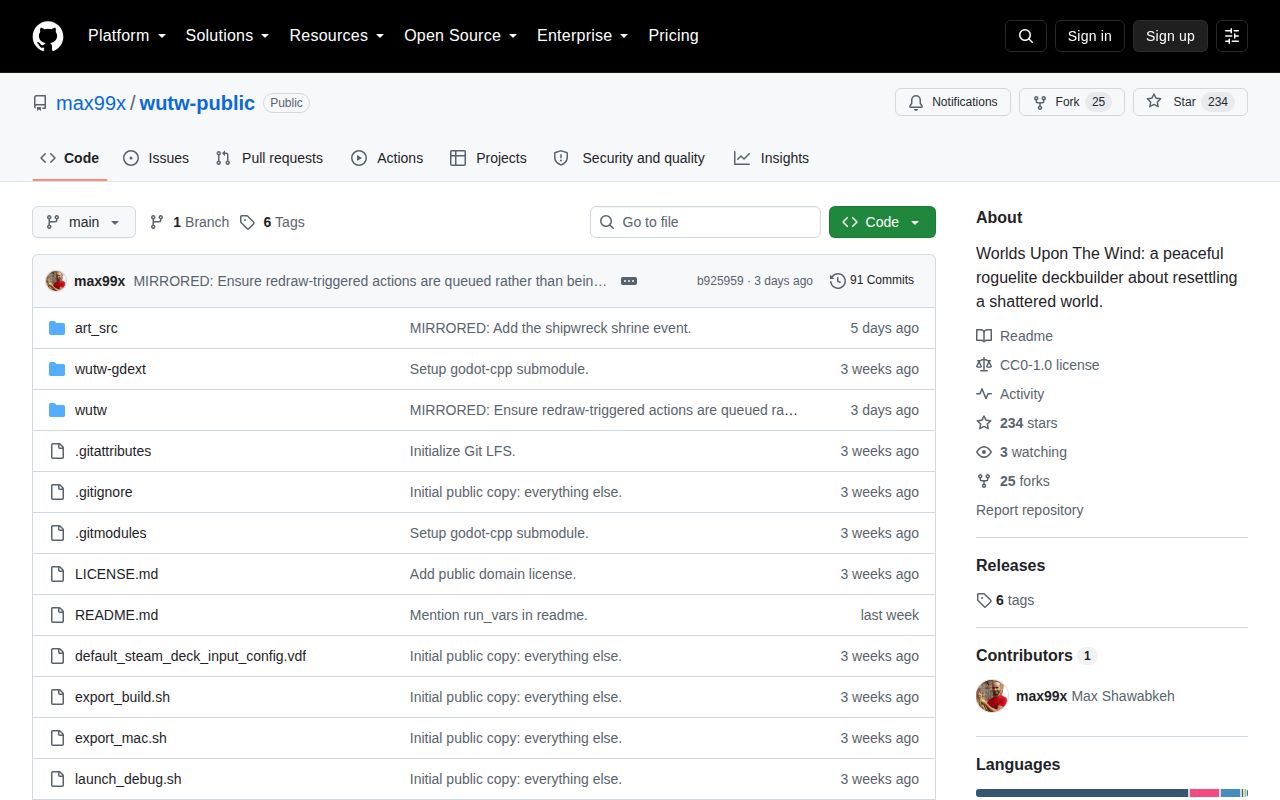
There is also no GitHub release object for the repository. The README says the mirror is updated alongside the Steam release, and GitHub records the last push on September 30, 2026. GitHub listed 234 stars and 0 open issues or pull requests when checked. The empty queue should not be read as a large support community: the author explicitly describes the repository as read-only and can only accept significant contributions manually.
Its best use is answering one concrete design question
Do not try to absorb this project from the root down. Start with a question: how are card effects represented, how does save state remain authoritative, how are localization strings extracted from resources, or how does one map renderer manage many sprites? Follow that system through its scripts and resources, then compare it with a smaller official demo. The large checkout becomes justified when the production context changes your decision.
Our run leaves one firm caution beside that advice. A 31-second install and 8-second build look easy, yet the only test command ended with 0 collected tests. Worlds Upon The Wind is worth downloading for code archaeology and reusable ideas. If you fork it into a product, your first serious contribution should be your own repeatable check that the complete Godot 4.7 project imports, starts, and exercises the systems you kept.