The package turns 906 frames into a usable catalog
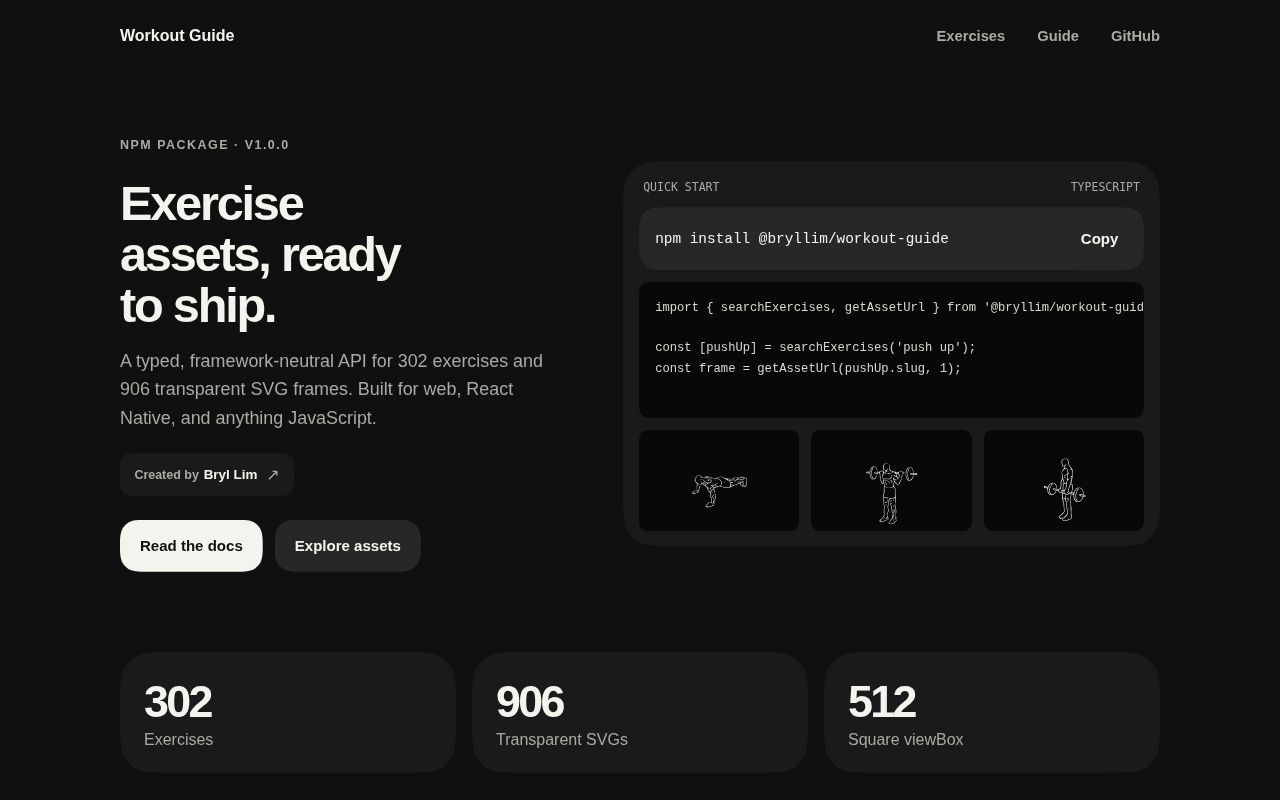
Workout Guide contains 302 exercises with exactly three transparent 512 by 512 frames apiece. A canonical manifest gives each movement a stable record, while the npm package supplies typed lookups, search, filters, and asset URL helpers. The Astro site adds a gallery and integration guide. This is enough for consistent exercise cards without building an image pipeline first.
Our checkout held 1,871 files but about 786 lines counted as source because checked-in artwork and catalog data dominate it. The repository keeps 906 SVGs plus PNG sources. Consumers receive deterministic files instead of depending on an image service, though clone and package size matter more than the code count suggests.
Three frames explain movement but do not coach it
Each exercise follows the same three-frame format. The package supports ESM, CommonJS, TypeScript declarations, direct imports, and React Native require() patterns. An app can search by term, choose a record, and render local art without turning loose filenames into application data.
Three 512 by 512 poses are still snapshots. They cannot show tempo, breathing, joint paths between frames, or whether a user's form matches. Workout Guide does not provide routines, timers, accounts, rep counting, or progress records. A coaching product needs instruction and a separate application layer around all 302 entries.
What happened when we ran it
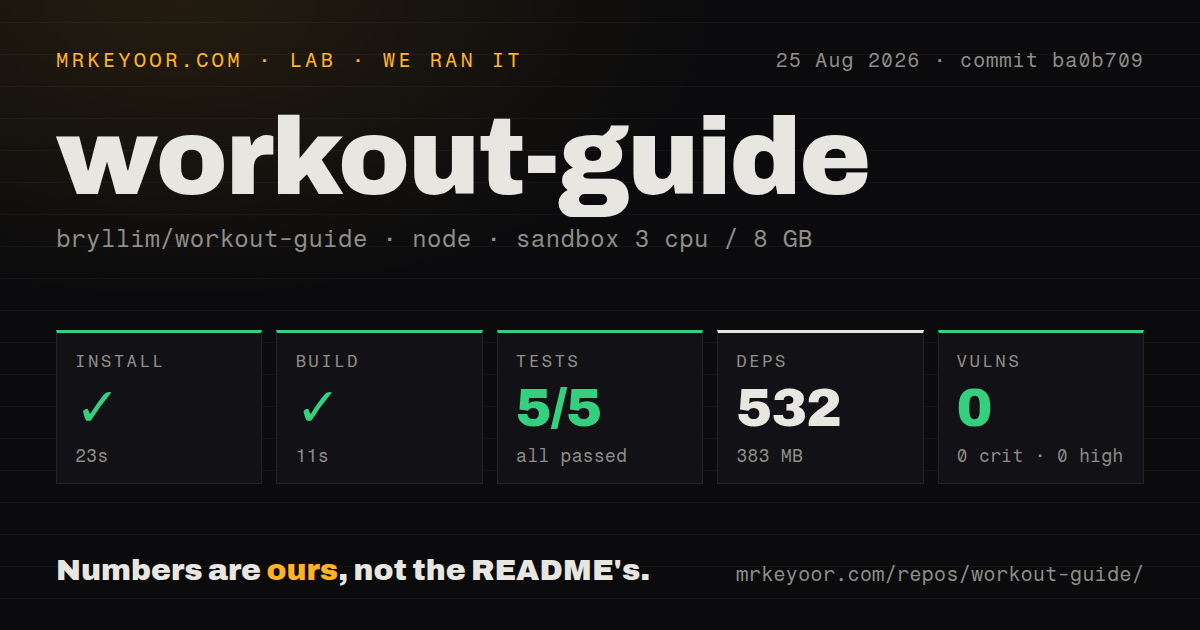
In our Node 22 sandbox, npm installation finished in 23 seconds. It added 532 packages and used 383 MB. The audit reported zero known vulnerabilities across all severities. The 57.9 MB checkout included three CI workflow files, a tests directory, and npm workspaces.
Our build succeeded in 11 seconds. Vitest ran five tests in 5 seconds, with all five passing. Five tests cannot cover every record, import style, site route, or rendering environment. The check command also calls catalog validation, type checking, linting, tests, and the build; separate scripts cover package consumers and Playwright checks.
Package use is lighter than monorepo development
Most users install @bryllim/workout-guide, then import getExercise, searchExercises, or getAssetUrl. The package includes its manifest, assets, ESM and CommonJS outputs, and declarations. It supports Node 18 or newer, has no runtime service, and needs no API token.
Contributors enter a heavier workspace. Our install brought in 532 packages for the build, Astro gallery, linting, vector processing, and tests. The root currently declares Node 24 or newer, although our Node 22 run passed. There is no Dockerfile. Use the declared engine for maintenance rather than treating our run as an unsupported-version promise.
The artwork license can decide adoption
Code and documentation use MIT, but exercise art uses CC BY-SA 4.0. The npm manifest tells users to consult the license file instead of calling the whole package MIT. Attribution points to Everkinetic, and 76 first-pose frames are vector-traced adaptations of rasterized Everkinetic SVGs. Their source URLs and changes live in the manifest.
That distinction matters more than the 11-second build. Distributing modified CC BY-SA art brings attribution and share-alike duties. Legal review should examine the actual asset use. Contributors must provide source-license details and publish new visual assets under CC BY-SA 4.0.
Catalog rules keep all 302 entries consistent
Normalized catalog files and assets are checked into Git. Maintainers can regenerate them from a compatible export, then run catalog validation. Contributions must keep exactly three transparent 512 by 512 SVG frames plus PNG sources per exercise. These rules reduce one-off images that break a consumer layout.
The lab saw about 786 source lines, so this is not a large application hidden behind the gallery. Most work is editorial: naming exercises, maintaining metadata, preserving attribution, and producing consistent art. Deterministic import and validation matter more here than a server.
Version 1.0.0 has little public history
The first release, version 1.0.0, appeared on August 24, 2026. The repository was pushed on August 25, and GitHub showed no open issues or pull requests. That is current maintenance, but there is too little history to judge response time. The five passing Vitest tests are better evidence than an empty queue, though both describe a young project.
The gallery lets users inspect all 302 exercises before installation. The README, contribution guide, license split, and attribution file are specific. The open questions are whether the asset license fits and whether three frames communicate enough for the intended audience.
Choose it for illustrations, not a fitness backend
Workout Guide packages exercise art and metadata for application developers. wger is better when users need plans, measurements, nutrition, and accounts. Free Exercise DB suits a data-first integration. Everkinetic is the upstream option for teams willing to normalize and package assets themselves.
The 383 MB development install looks outsized beside 786 source lines, but consumers need not run the monorepo. The durable constraints are format and license. If 906 local frames and CC BY-SA attribution fit, the 11-second build and five passing tests make this a practical base. Coaching or motion analysis needs a different source.