Version 0.12.0 joins WeChat, Redis, and an external model
WeChat-AI is a Chinese-first project, with an English column beside the Chinese feature list and English lines through the quick start. Version 0.12.0 turns a WeChat bot into a managed roleplay service: users scan a QR code, administrators approve peers, and each peer can receive a persona. Messages travel through Tencent iLink, while Redis holds bot credentials, conversation state, personas, and sticker data. An OpenAI-compatible endpoint writes replies, so the service is self-hosted without making inference local.
The browser side is unusually substantial for a young bot project. It includes a user center, admin dashboard, persona square, sticker review, token totals, deployment-node controls, and a visual chatflow editor. One deployment can serve several bots and peers, with the same image running on multiple nodes against shared Redis. That opinionated bundle is the appeal. A team that only wants a message callback will inherit far more policy and interface code than it needs.
What happened when we ran it
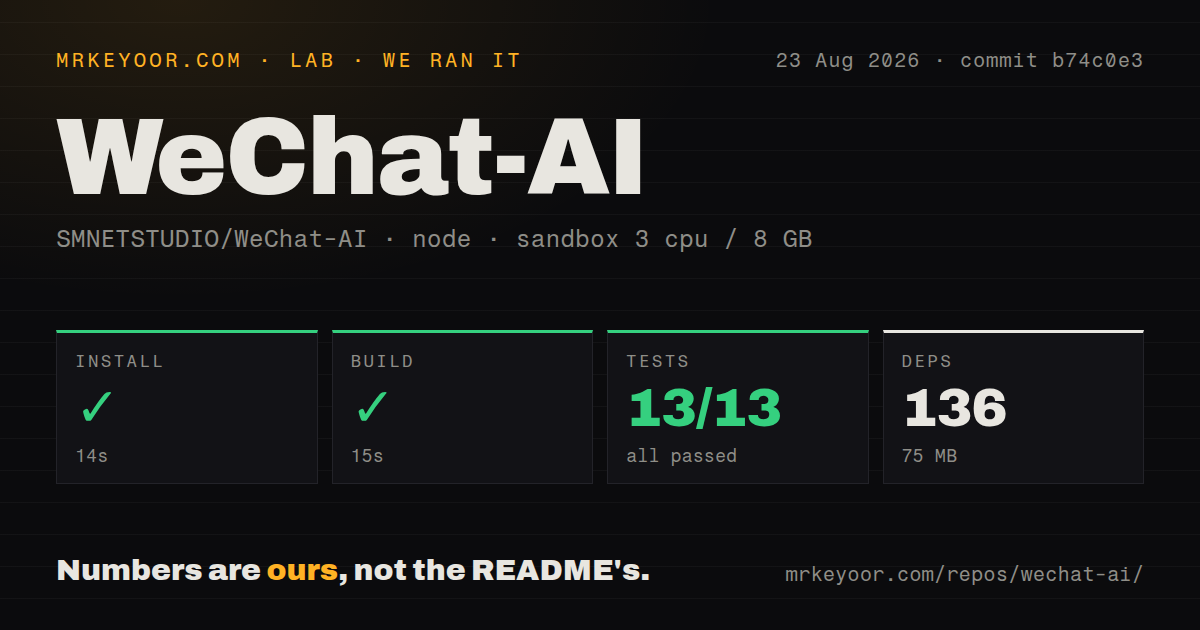
Our sandbox installed 136 pnpm packages in 14 seconds and used 75 MB on disk. The monorepo then built in 15 seconds. Those are friendly numbers for a service spanning an API, Redis package, iLink client, model client, chatflow engine, static browser interfaces, and a separate tools component. We ran commit b74c0e3 in an unprivileged Node 22 Bookworm container with 3 CPUs and 8 GB of RAM.
The test command finished in 13 seconds: node:test reported 13 passed and 0 failed of 13. The checkout itself contained 192 files, about 42,051 lines of source, and occupied 2.5 MB. We also found 1 CI workflow, a Dockerfile, a Compose file, and pnpm workspaces, although no tests directory. This result proves that the documented repository checks work in a clean container. It does not exercise QR login, a live iLink session, Redis persistence, or an LLM reply.
The 15-second build hides several service accounts
Getting useful output takes more work than the passing build suggests. Redis is required, and the examples point to a remote TLS-backed Upstash database. The platform model needs a base URL, API key, and model name. LINUX DO OAuth needs a client ID, secret, administrator identifiers, public base URL, and an exact callback. Local username and password accounts are available, but they still need an administrator bootstrap policy and optional invite settings.
Custom user models and web search add another deployment. The tools gateway is the sole outbound path for user-supplied model credentials and search, and the main service needs its URL plus a shared secret. Chatflow HTTP nodes have an allowlist and are capped at 32 steps and 40 nodes by the sample configuration. Docker simplifies packaging, yet the operator still owns TLS, callbacks, secrets, Redis availability, model bills, and the public route.
Thirteen passing tests do not verify a WeChat conversation
The project ships an acceptance checklist for the work its unit command cannot cover. It asks a human to scan a bot login, send messages from two WeChat users, approve accounts, switch personas, restart the service, test memory, force typing failures, and inspect media behavior. Optional sections cover a second bot, user-to-user relay, the tools gateway, and chatflow. That checklist is useful documentation, and it is also a candid list of integration points that need a real account.
The README gives the iLink adapter a clear warning: its protocol comes from observed behavior and fields can change. Personal bots may encounter rate limits or enforcement, with approved users enabled by default as a guardrail. Roleplay text also leaves the host through the configured LLM API. A 13-test pass therefore supports source-level confidence. It says nothing about account longevity, provider privacy terms, response quality, or the behavior of tomorrow's iLink fields.
Commons Clause blocks paid hosting and resale
Version 0.12.0 uses Apache 2.0 with the Commons Clause. The repository license withholds the right to sell the software, and its definition includes paid hosting, consulting, or support when the offering's value comes substantially from WeChat-AI. That restriction matters before evaluation inside any business. Calling the repository open source without explaining the added sales condition would give a commercial reader the wrong impression.
Local-only authentication also needs attention. Open issue 7 reports that the first browser signup still requires an invite code even when the backend is configured to make the first local user an administrator. The same report says an unauthenticated visit to the admin page redirects toward disabled LINUX DO login. Release v0.12.0 fixed a related OAuth-disable problem, but this newer report describes a remaining frontend bootstrap path rather than the old setting-cache bug.
One open issue and a September push show a young active project
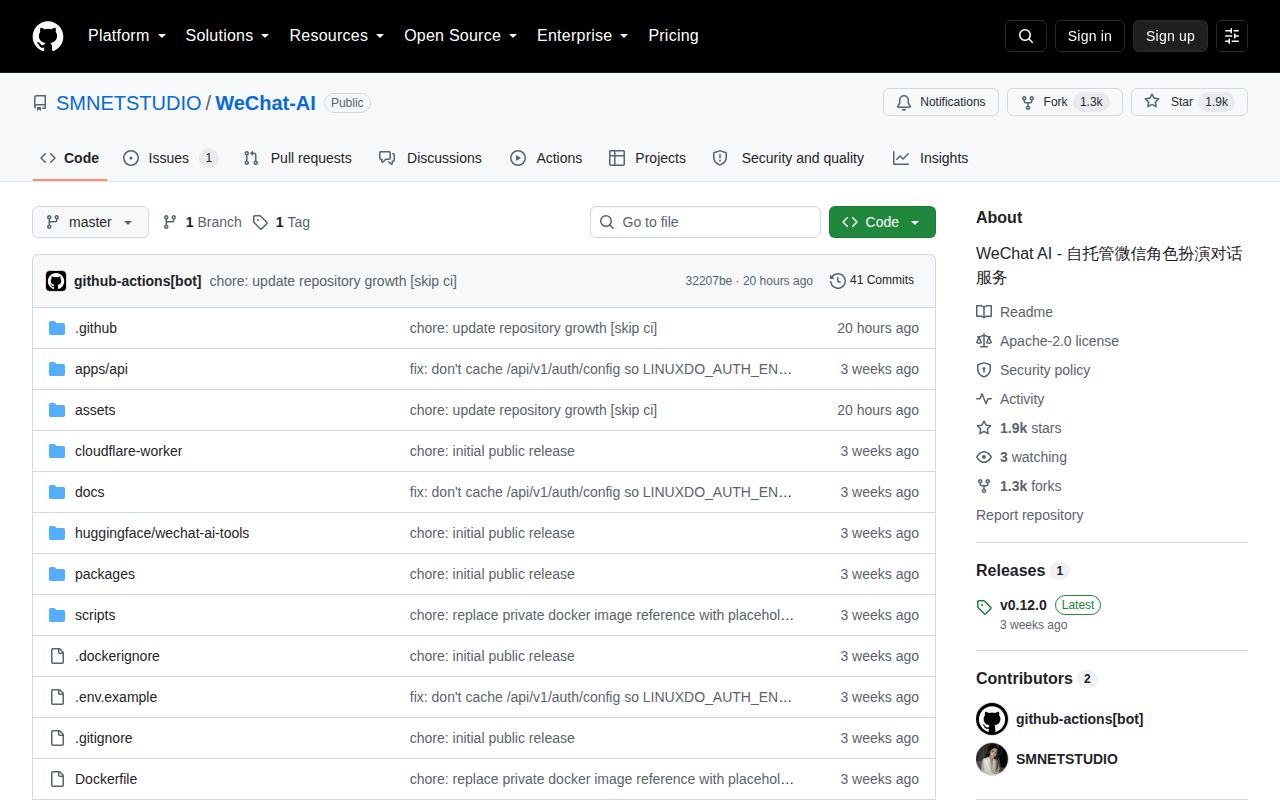
GitHub recorded 1,875 stars, 1 combined open issue and pull request, and a last push on September 2, 2026. The only published release returned by the API was v0.12.0 from August 13. The small tracker includes quick closure of an earlier iLink message-parsing report and the OAuth setting report, while issue 7 was still open. That is current maintenance activity, although the brief history does not establish long-term stability.
The decision comes down to how closely your use matches the supplied product. WeChat-AI saves work when you need approved peers, personas, moderation, multi-node coordination, and a web control plane in one non-commercial service. Our 42 seconds of install, build, and tests make a trial inexpensive. Production still means accepting a changeable WeChat integration, external model traffic, several secrets, a real-device test pass, and license terms that rule out selling the result.