LiveKit supplies the media layer beneath a finished product
LiveKit is a Selective Forwarding Unit, or SFU, written in Go on top of Pion WebRTC. Clients publish tracks to a room, and the server forwards selected tracks to other participants. The feature set includes simulcast, selective subscriptions, speaker detection, webhooks, moderation APIs, end-to-end encryption, and VP9 and AV1 SVC. Access tokens carry an identity and room permissions, so an application can decide who joins and what each participant may do.
That scope explains the size of the code without making it a turnkey conferencing app. commit e18fbcc contained 422 files and roughly 149,938 lines of source in a 4.9 MB checkout. Your team still owns user accounts, token issuance, interface design, moderation policy, and application state. LiveKit Meet is useful proof that the parts fit together, but it lives in a separate example repository rather than turning this server into a deployable Zoom replacement.
The SDK catalog reduces client integration work
The README links official client SDKs for browsers, Swift, Android, Flutter, React Native, Rust, Unity, and C++, plus several server SDKs. That breadth is the clearest reason to choose LiveKit over a bare SFU. A mobile and web team can share the same room concepts without maintaining its own WebRTC signaling protocol. The Go server SDK can also join as a client, which is useful for bots and other backend participants.
The ecosystem also draws a line around the main server. Egress handles recordings and multistream output, Ingress accepts RTMP, WHIP, HLS, or OBS sources, and SIP has its own project. Our source install fetched 240 Go packages in 80 seconds before any of those companion services entered the picture. Budget them as separate deployables, logs, upgrades, and failure domains if the product needs more than interactive rooms.
What happened when we ran it
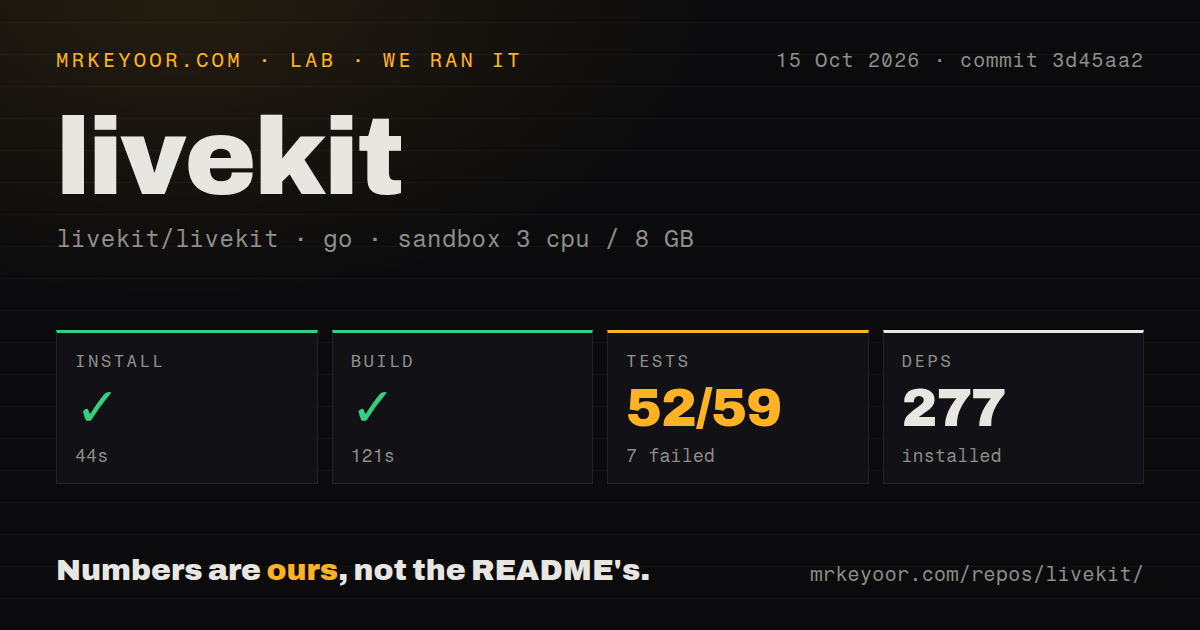
Our sandbox installed the 240 Go packages in 80 seconds, then built commit e18fbcc successfully in 139 seconds. The run used an unprivileged Debian container with Go 1.24, 3 CPUs, 8 GB of RAM, and no secrets. The successful compiler result matters because this is a sizable media server, although it says nothing about call quality or how many participants a target host can carry.
The test step exited with code 1 after 75 seconds. Go test reported 50 passes and 5 failures out of 55. The supplied log tail names TestAgentMultiNode; it shows the other package checks near the end passing, then the top-level test package failing. It does not identify the other four cases or explain why they failed. We therefore treat the checkout as buildable in our environment, with a suite that was not clean.
Self-hosting requires public media paths as well as HTTPS
Development mode is deliberately easy: one command starts the server with a documented placeholder API key and secret. Production is network engineering. The sample configuration places signaling on port 7880 behind TLS, exposes ICE over TCP on 7881, and uses a UDP range for client traffic. TURN, STUN, public IP discovery, interfaces, NAT, firewalls, and load balancers can all change whether signaling succeeds and media actually flows.
Our 3-CPU, 8 GB sandbox did not open those public routes or measure a call. It only installed, compiled, and ran the repository tests under Go 1.24. Open issue 4814 gives a specific edge case: the server can rewrite an advertised IP but does not support a different externally mapped UDP port, so ICE can fail behind non-1:1 NAT. Test the same topology and firewall rules that production will use.
Redis makes distributed rooms possible and adds a failure domain
Adding Redis switches LiveKit into distributed mode, allowing clients to reach any node and still be routed to the right room. That is a clean architectural step, yet it puts room routing and node coordination behind another stateful service. Open issue 4663 reports that a roughly seven-minute Redis outage caused a six-node Kubernetes deployment to become unavailable for about 53 minutes. The reporter says recovery required manually deleting every pod.
This is active operational code, not an abandoned sample. The checkout contains 5 CI workflow files, a Dockerfile, and a tests directory. Even so, our multi-node test result failed, and the Redis incident remained under discussion in late August 2026. Anyone running a cluster should rehearse Redis loss, pod drain, node recovery, and room recreation rather than counting a healthy single-node demo as availability evidence.
September pushes and v1.13.6 show active maintenance
GitHub recorded 20,739 stars, 194 open issues and pull requests, and a last push on September 5, 2026. The issue queue was active on that date too, with reports and patches covering FlexFEC, SCTP, Redis recovery, ingress cleanup, and connection behavior. Release v1.13.6 arrived on August 26 with request-size limits, TURN quotas, migration changes, and fixes around WebSockets and token logging. The combined open count includes pull requests, so it is a workload signal rather than a defect total.
LiveKit earns a serious trial when a team needs programmable rooms across several client platforms. The 139-second successful build and 50 passing test results make the code approachable enough to inspect, while 5 failed results argue for pinning and testing the exact release. Its hosted option removes much of the networking burden. Self-hosting makes sense when control over media infrastructure is worth owning Redis, public UDP, companion services, observability, and incident drills.