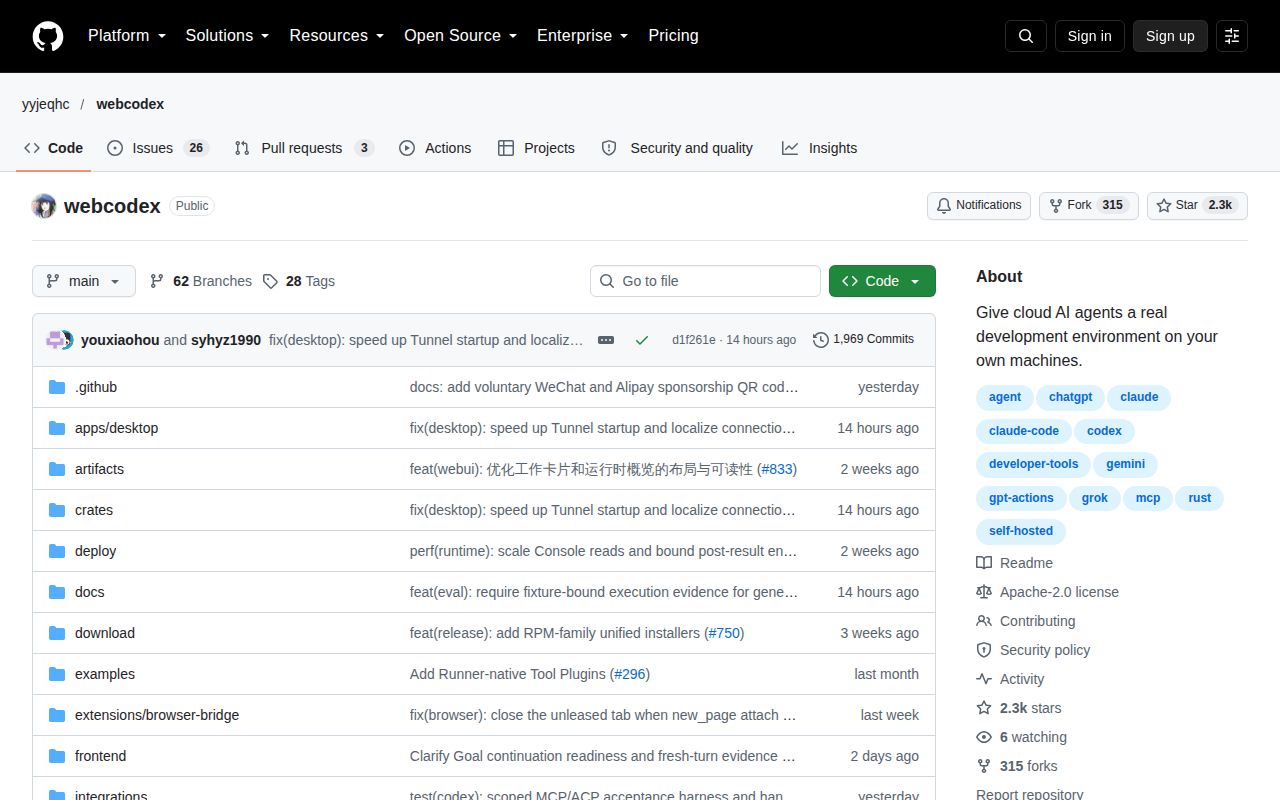
WebCodex is a Rust server that sits between an AI client and your local development machine. The README's pitch is direct: instead of moving a repo into a hosted workspace, WebCodex exposes files, Git, commands, tests, and long-running jobs to ChatGPT, Claude, and other MCP clients over HTTPS. The repo checked out to 1,031 files and about 621,826 lines of source, a substantial codebase for a tool in this category.
What happened when we ran it
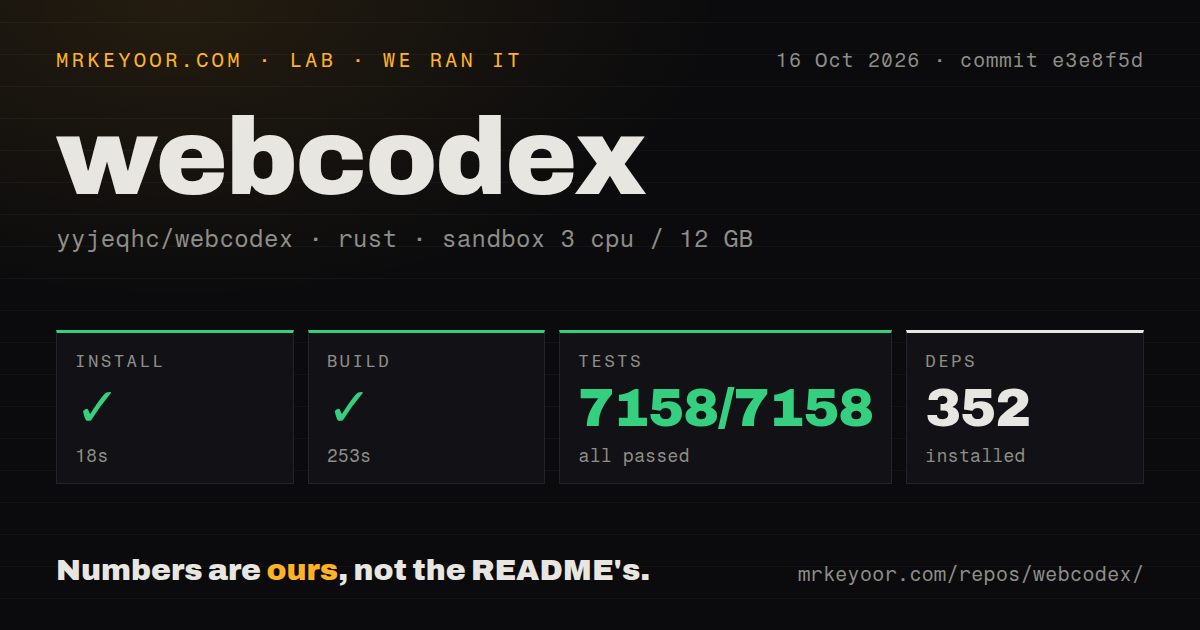
Our clone was at commit 2a848ef, run on 2026-09-10 in an unprivileged Debian sandbox with 3 CPUs, 12 GB RAM, and no secrets. Installation via the lockfile completed in 29 seconds after pulling 366 packages. A release build with cargo build --release --workspace --bins finished in 246 seconds. The test suite was the bad news: cargo test failed with exit code 101 after 689 seconds, with 4,958 tests passing and 4 failing. The two visible failure names are in the Git tooling: git_diff_hunks_committed_exact_range_isolated_targeted_and_head_attributed and git_review_summary_uses_reviewed_head_committed_attributes. The final log snippet shows an assertion mismatch, left: Number(0), right: 1. We do not know if this is a sandbox-specific issue or a real bug, but the README does not list any required system packages beyond a Rust toolchain, so a fresh environment should be able to run the suite.
Strengths
The strongest design choice is that the repository never leaves your machine. WebCodex runs a Server and Runner on your own hosts, and AI clients connect over MCP or HTTPS. This avoids the security and sync headaches of copying a whole repo into ChatGPT's sandbox or another cloud workspace. The README also has unusually complete documentation for a 623-star project: desktop installation, CLI setup, quick trial, MCP reference, deployment, troubleshooting, and a dedicated security model.
The temporary share mode is the easiest on-ramp. Running npx --yes @yyjeqhc/webcodex share inside a repository starts a single-project, restricted environment and prints connection values; the endpoint and temporary credential stop when the process exits. For everyday use, the README recommends a regular Server + Runner with public HTTPS, Cloudflare Tunnel, or OpenAI Secure MCP Tunnel, plus a Desktop app on Windows or macOS. The 0.4.0 release from 2026-09-07 and a push on 2026-09-10 show the project is being actively developed.
Weaknesses and rough edges
The test failures are the obvious rough edge. Four of 4,962 tests failed in our run, all in Git diff and review summary logic. For a tool whose selling point is safe code inspection and Git visibility, a failing Git assertion is more concerning than a failure in an obscure utility. Even though 99.9% of tests passed, a pre-1.0 tool with any failing core test should be treated as experimental. The 689-second test run is also long enough that contributors may skip full validation.
Platform support is broad but uneven. Linux x64/arm64 gets the full local share, Server, and Runner workflows. macOS x64/arm64 gets the Desktop local Server + Runner and OpenAI Secure Tunnel. Windows x64 gets the Desktop installer and Cloudflare/OpenAI/none tunnel options. Windows arm64 is the weakest: the Desktop installer is x64-only, managed Server services are unsupported outside the Desktop foreground runtime, and Cloudflare requires an external cloudflared because the pinned Cloudflare release has no official Windows ARM64 artifact. That is a lot of fine print for a first-time user.
Community health
Community health is a mixed but encouraging picture. The repository has 623 stars, 5 open issues, and the last push was the same day as our review. The latest release, v0.4.0, landed three days before. The small issue count suggests either a quiet user base or a responsive maintainer; the fresh release and same-day push point to active upkeep. There are 4 CI workflow files, a Dockerfile, and a compose file, so the project is set up for automated checks, even if our local cargo test did not go green.
Where it fits in a real stack
In a real stack, WebCodex fits as a local MCP endpoint in front of your existing development tools, not as a replacement for an editor plugin or a cloud coding agent. If you already run local tests, compilers, and Git, WebCodex lets an AI client drive those exact tools without uploading code. The Runtime Console and task workflow add human review, which matters when the agent can execute commands. The architecture doc explains Server/Runner authority boundaries, but that is follow-up reading; the quick share command is the shortest path to deciding if the workflow clicks.