Version 0.1.0-preview.1 builds a person profile for an agent
Distilly 0.1.0-preview.1 takes material a user selects and turns it into a Person Profile that an agent can recall temporarily or install as a persistent Skill. The useful distinction is revision control for judgment and voice. A correction creates a candidate that can be reviewed, promoted, rejected, or rolled back instead of quietly rewriting the current profile. The local Panel makes that approval step visible.
The agent-facing surface contains exactly 5 MCP tools for retrieval, ingestion, pending work, commits, and corrections. Behind them, the product creates a person, parses the chosen evidence, prepares a briefing, commits a profile, and returns either the profile or a complete prompt. Distilly refuses silent truncation when a verified host budget cannot carry the full value. That is the right failure mode for a profile whose missing tail could change how an agent represents someone.
Codex CLI 0.146.0 is the only complete Preview route
The install guide pins Codex CLI 0.146.0, Node.js 22.19+ or 24, and pnpm 10.32+. Users clone the distilly-plugin branch, install the workspace, build it, then run setup and doctor through the compiled CLI. Codex must be restarted before the Plugin appears. The runtime and the selected person's source material remain under the local Distilly home rather than being copied into the host Plugin.
Host claims are narrower than the compatibility table first suggests. OpenClaw 2026.3.24 and Hermes v0.9.0 have recorded transport-capacity fixtures, with respective net budgets of 65,536 bytes and 49,752 bytes. Distilly says those fixtures do not certify their packaged restart, persistent Skill, or uninstall lifecycles. Claude Code has a binding but still lacks its exact fixture, so its documented route is a separate file-based Legacy Skill with fewer guarantees.
What happened when we ran it
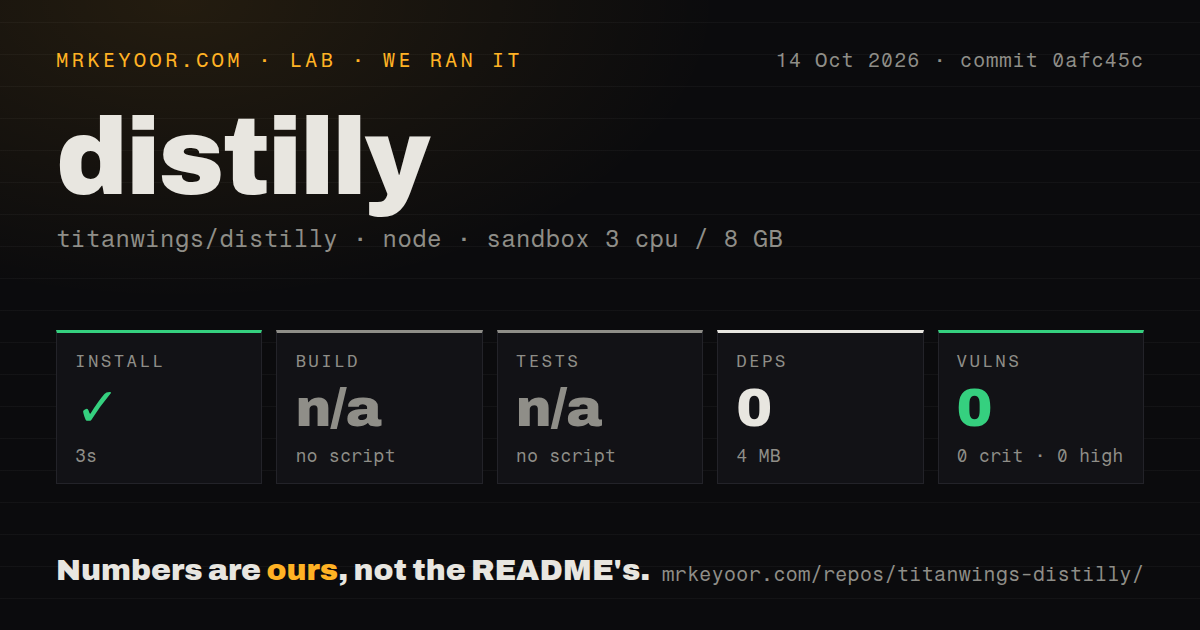
Our sandbox installed 252 pnpm packages in 27 seconds, consuming 211 MB on disk. The TypeScript build then succeeded in 19 seconds. We ran commit cf15171 in an unprivileged container with 3 CPUs and 8 GB of RAM. The checkout was 7.6 MB, with 445 files and about 100,719 lines of source arranged as a workspace monorepo.
The test command did not finish within our 900-second limit. Before the timeout, the log showed one failed case named validates pending added-material counts against the verified current-version baseline; that case had run for 5,115 ms. Several neighboring state-store cases passed, including checks for immutable material and canonical directories. Node also printed that SQLite is experimental and may change. The tail contained no final suite summary, so we cannot state how many tests ultimately passed or failed.
The repository scan found 1 CI workflow, no Dockerfile, and a tests directory. A successful 19-second build establishes that the TypeScript compilation completed in our stated environment. It does not cancel the named assertion failure or turn a 900-second timeout into a passing suite. The log does not identify why the count check failed or why the process remained active, so either explanation would be guesswork.
A 30-minute lease protects the local SQLite profile state
Distilly's Preview stores its authority in SQLite with write-ahead logging and keeps raw plus normalized material in a SHA-256-addressed blob store. The architecture documents a 19-table schema for subjects, materials, versions, operations, and events. Briefing work receives a 30-minute lease, and mutations use transactions plus request identifiers so retries can return the same recorded result. This is much more deliberate than writing a persona Markdown file over the previous copy.
Local storage does not make the material unimportant. Person Profiles can encode someone's reasoning habits and writing voice, while the blob store retains selected source bytes. The development guide tells contributors never to commit person data, generated databases, credentials, or local host state. Uninstalling the Plugin deliberately preserves the Distilly data and any separately installed Person Skills, so removal of the integration is not deletion of the underlying profile records.
Five accepted text formats leave PDF and email outside the Preview
The 0.1.0 Preview directly accepts TXT, Markdown, JSON, SRT, and VTT files, along with pasted text and public URLs selected through the host's research flow. It rejects symlinked selected files and duplicate filenames, and it does not crawl nearby directories or silently read chat history. Deterministic parsers handle the supported local types before the model works from the resulting briefing.
PDF, email containers, provider exports, and hosted source adapters remain follow-up work in the roadmap. The same applies to a standalone Panel command and deeper recovery operations. Those items are written as unchecked work rather than current features. This boundary matters for buyers: a profile product sounds broad, but the first release candidate is best matched to a curated folder of text and transcript files, not an existing mailbox or document archive.
September activity has not produced a tagged release
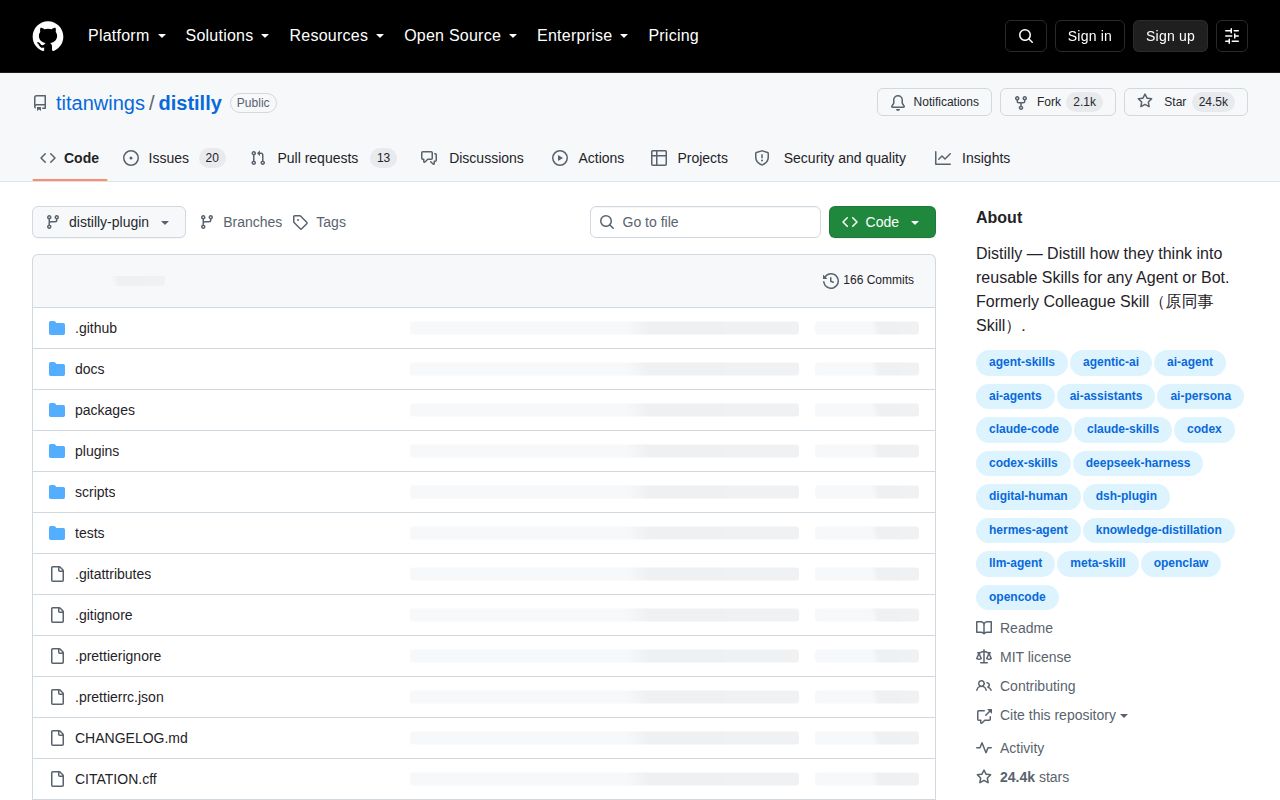
GitHub recorded 24,450 stars, 33 combined issues and pull requests, and a last push on September 6, 2026. A separate issue search found 20 open issues; the most recently updated open issue was active on August 25, while an open pull request was created on August 31. The default branch is the Preview line, so repository visitors see the TypeScript rewrite rather than the older Skill implementation.
The latest-release endpoint returned no release. Distilly's changelog records 0.1.0-preview.1 on September 4, but the README explicitly says that version is not a tag or npm publication. Current commits and issue activity show maintenance, while the missing package and incomplete host matrix keep adoption risk high. The best use today is evaluation on the recorded Codex version with copied, non-sensitive material and an expectation that setup contracts may still move.