No AI Slop v1.0.6 is an editing prompt, not an AI detector
No AI Slop v1.0.6 gives a language model a firm editing brief. The default mode revises a supplied draft, keeps its point and personal habits, then reports what changed. Detect mode takes a different job: it quotes each named pattern and proposes a short fix without rewriting or scoring the text. Its own instructions forbid guessing whether AI wrote the draft. That limit is sensible because repeated phrasing can be inspected, while authorship cannot be proven from style alone.
The repository is tiny in our measurement: 14 files, roughly 128 lines of source, and 0.3 MB checked out. Most of the product is prose inside SKILL.md and eval.md, plus a plugin manifest and packaging script. This makes the tool easy to read before trusting it. It also means results come from the host model interpreting editorial directions, rather than from a parser that will flag the same line identically on every machine.
More than 20 named patterns make feedback inspectable
The rule set targets recognizable habits such as binary contrasts, throat-clearing openings, vague attribution, inflated importance, synonym cycling, dramatic fragments, and generic endings. It also tells the editor to keep jokes, uncertainty, unusual vocabulary, and uneven cadence when those traits belong to the writer. Detect mode must quote the offending line and name the pattern, so a user can accept or reject a finding without taking an unexplained score on faith.
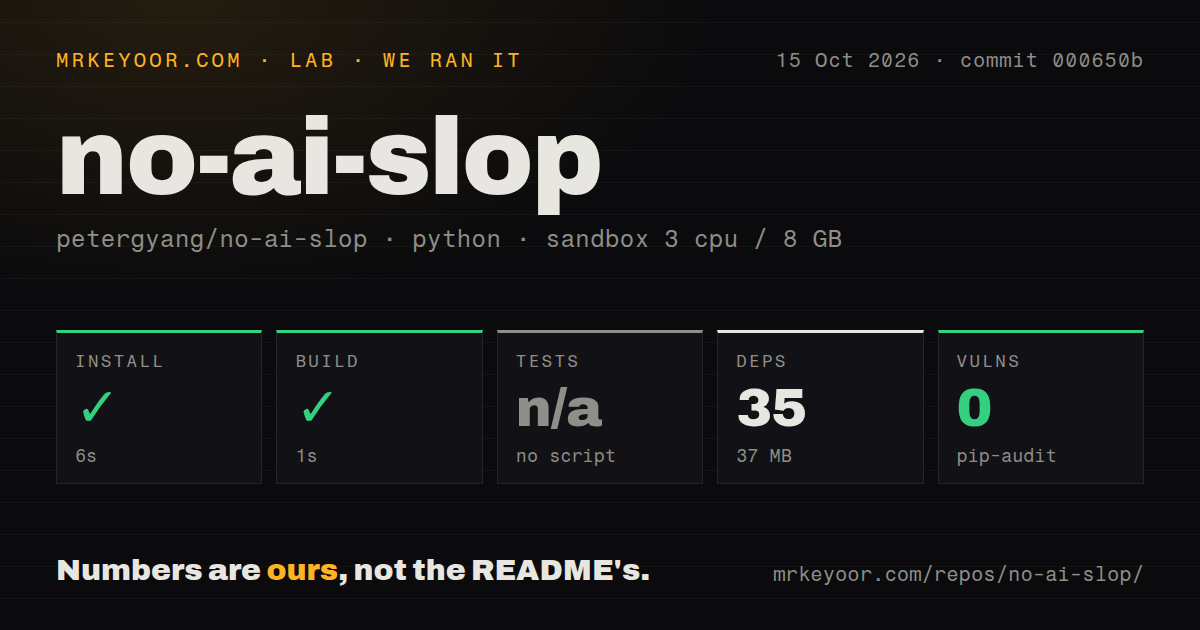
No AI Slop installed 35 packages and occupied 37 MB on our box. That is modest compared with an application or model runtime, yet the installed environment is larger than the 0.3 MB checkout because the build uses Python tooling. The skill does not run an external service or maintain an account of its own. According to the project's privacy file, the host product processes the supplied text under that product's terms. Sensitive drafts therefore inherit the privacy boundary of ChatGPT, Codex, Claude Code, or another chosen agent.
What happened when we ran it
Our sandbox cloned commit 000650b and completed installation in 39 seconds. The process added 35 packages and used 37 MB in a fresh Python 3.12 Debian container with 3 CPUs and 8 GB of RAM. The build succeeded in 7 seconds. Its Python script checked required manifest fields, copied the plugin files, created a ZIP archive, compared packaged instructions with their source, and confirmed that the result was a valid ZIP.
There was no tests script or target, so the lab skipped tests rather than treating their absence as a pass. Pip-audit reported 0 known vulnerabilities in the installed Python environment. The repository has 1 CI workflow, which runs the package builder and uploads the resulting archive. None of those checks submits sample prose to an agent, judges whether voice survived, or measures agreement between runs. The 7-second success therefore supports package integrity, not editing accuracy.
The evaluation file asks questions instead of enforcing rules
eval.md contains a useful review sheet. It asks whether the edit kept the meaning, preserved the writer's vocabulary and rhythm, avoided invented facts, fixed named habits, and ended on a concrete point. Those questions can catch careless rewriting when the same agent reviews its work. They remain instructions to a probabilistic model. There is no fixture set with expected edits, no scorer for pattern recall, and no test showing that a second model reads the rules the same way.
The missing behavioral test target matters more than the passing 7-second package build for a publication workflow. Issue 31 asks the skill to preserve line breaks so writers can compare revisions more easily. Open pull request 24 argues for stricter binding between numbers, named subjects, and claims after an edit. Neither report proves that every current revision loses structure or moves facts. Both identify review work that the user, not the ZIP validator, must still perform.
Agent support is advertised broadly but varies by host
The README suggests pasting one installation request into ChatGPT, Claude Code, Codex, or another coding agent. It also supplies an npx skills add command for a global install. The manifest labels the package as a plugin, while a separate OpenAI agent file gives it a default prompt. Those routes are convenient when the host already understands the directory layout and slash-style invocation. There is no standalone editor, browser extension, or command that rewrites a file without an agent.
commit 000650b built successfully with 35 installed packages, but that check did not exercise every advertised host. Issue 42 reports that the natural-language setup did not work in GitHub Copilot Agent IDE. Issue 43 describes a more specific plugin-directory collision: two products reportedly shared the no-ai-slop canonical ID, leaving installation, updates, and removal ambiguous for the reporter. Users of a curated plugin catalog should confirm the displayed developer and version before changing an installed entry.
English rules are current, while translations live elsewhere
The checked-in examples and pattern definitions are written for English constructions. An issue links a separate Japanese adaptation, and open proposals discuss Chinese and Korean coverage. Those efforts show interest outside English, but they are not bundled language modes in v1.0.6. A direct translation of the English checklist would also miss grammar-specific habits, so multilingual publishers should choose a tool with explicit coverage for each language rather than assuming the same phrases transfer.
GitHub recorded 7,730 stars, 22 combined issues and pull requests, and a last push on September 2, 2026. Pull request activity continued on September 9, while the latest release, v1.0.6, was published August 1. That combination points to an active contributor queue and a maintainer release that trails current proposals. No AI Slop is easy to inspect and cheap to try, but publication still requires a side-by-side read of the original and edited draft because the repository tests packaging, not prose behavior.