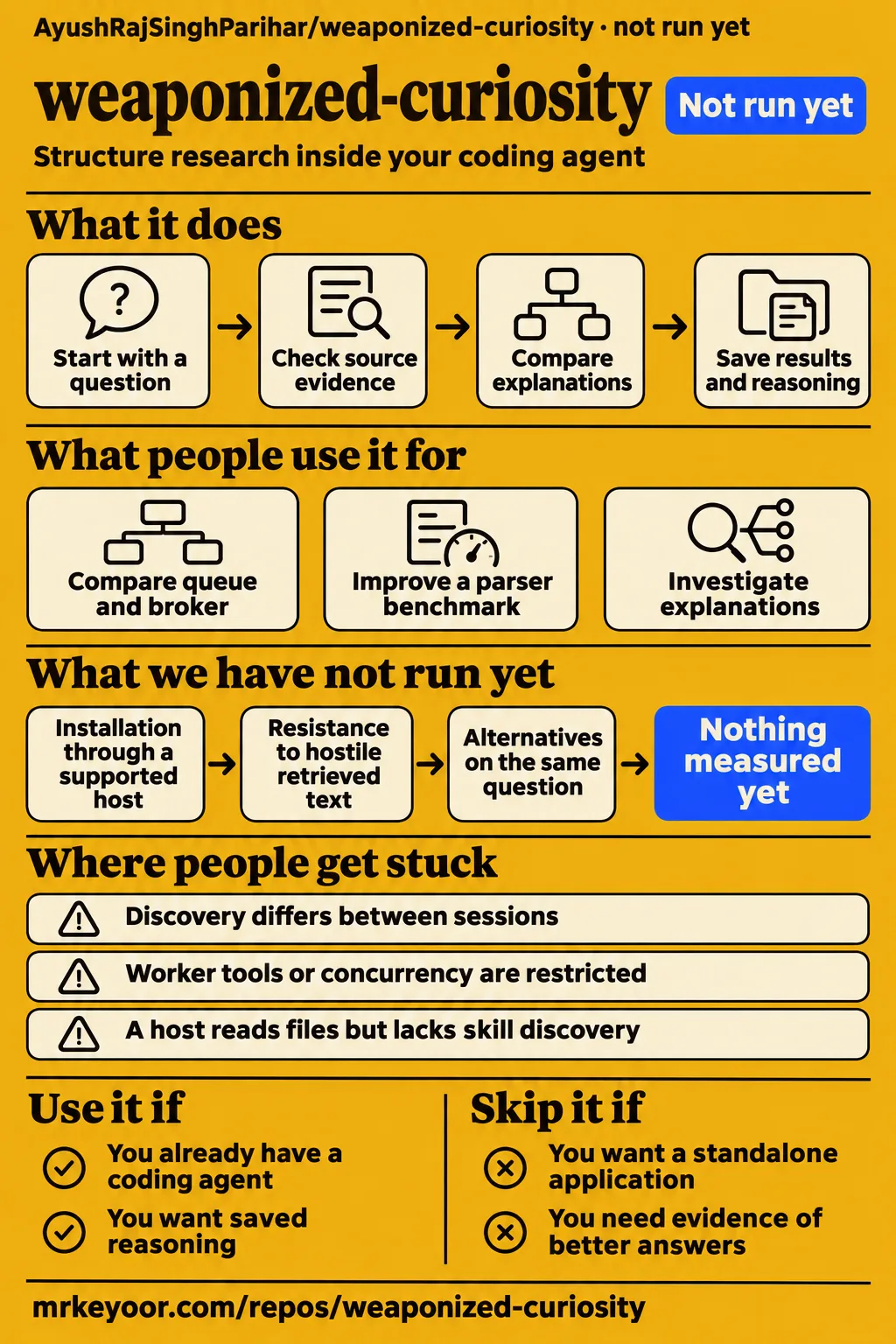
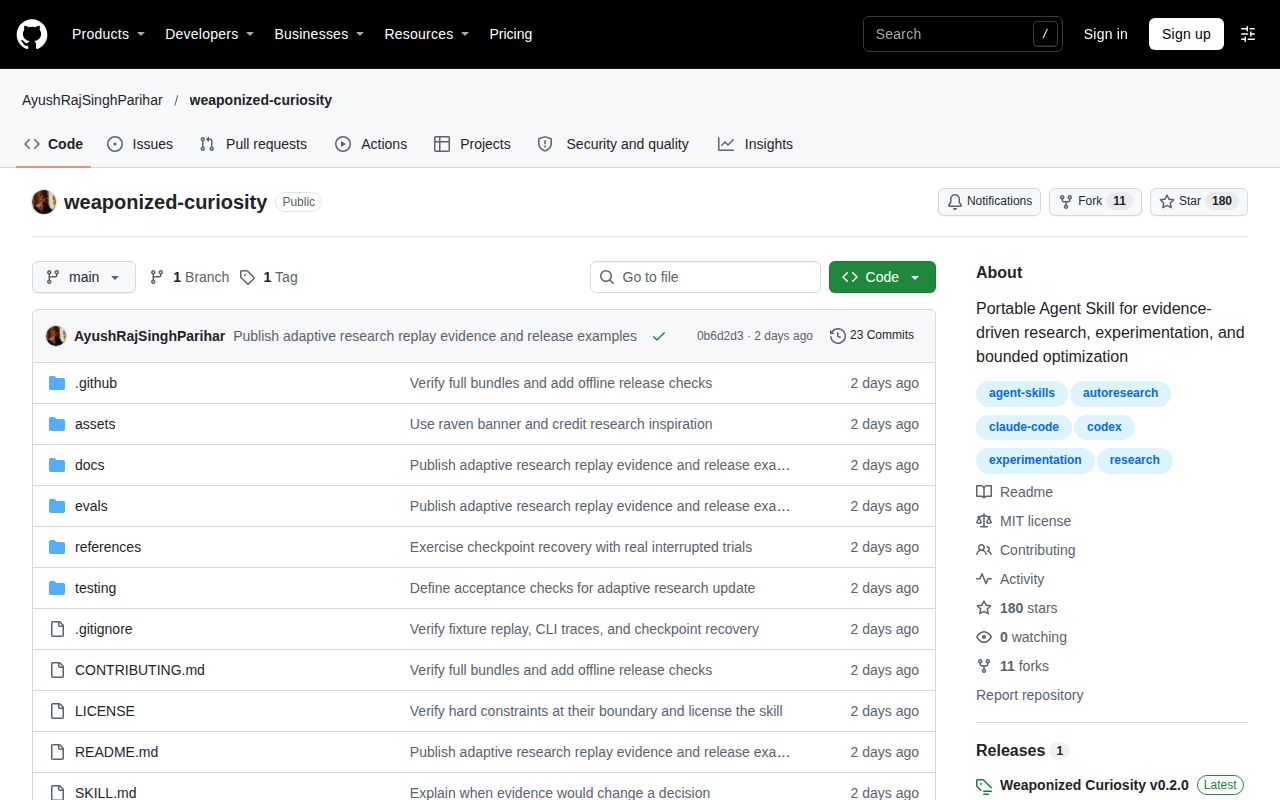
Short answer: use it to structure research inside your coding agent
Weaponized Curiosity is a skill for an existing coding agent, aimed at researching questions, comparing options, and testing ideas before a decision. Use it if you want that procedure inside Codex or Claude Code; skip it if your requirement is a standalone research application. The Weaponized Curiosity README starts with a question in the user's own words, then describes beginning with evidence most likely to change the answer and digging deeper when a consequential gap survives.
Weaponized Curiosity uses the tools and permissions your agent already has. That statement in the project README makes the host central to the adoption decision. The installation guide gives separate setup guidance for discovery, worker execution, and experimental isolation. For a developer choosing this repository, the useful question is which part of the research process its instructions add to the session: framing a decision, testing a hard requirement, comparing explanations, or keeping a record of experiments.
What you can do with weaponized-curiosity
Weaponized Curiosity documents four modes: Quick, Deep, Extreme, and Autoresearch. The README mode table assigns each a purpose, while SKILL.md starts with the cheapest check that could change the answer when the user chooses no mode. A narrow requirement check and an optimization experiment need different inputs. The former can turn on one source passage or boundary case; the latter needs a measurable objective, an evaluator, and limits on candidate changes.
| Mode | Documented purpose | How to choose |
|---|---|---|
| Quick | Check a claim, compare options, or examine a hard requirement | Start here when a source or boundary case could settle the decision. |
| Deep | Work through conflicting evidence or a consequential decision | Use it when separate questions deserve distinct investigation. |
| Extreme | Allow more source review, competing explanations, and replication | Name the unresolved questions that justify the additional work. |
| Autoresearch | Improve a measurable objective against a fixed evaluator | Define improvement, editable scope, and unacceptable regressions first. |
The skill instructions connect escalation to a surviving uncertainty. They also require hard requirements to face concrete boundary cases before the agent chooses an option. For an architecture decision, the requested output includes where a proposal fails and what would make it viable. A question about a deadline, for example, calls for tracing a late arrival through eligibility, schedule wait, and retries rather than listing scheduling features.
What people use weaponized-curiosity for
The README proposes a Postgres queue decision and bounded performance work, while SKILL.md names conflicting literature and hypothesis testing. These are the authors' suggested uses. The project README asks whether to keep a Postgres job queue or move to a dedicated broker, using the current workload and the conditions that would make switching worthwhile. The workload and switching condition give the comparison a specific decision to answer.
| Source | Suggested use | Requested output |
|---|---|---|
| README queue example | Compare a Postgres job queue with a dedicated broker | Explain what would make switching worthwhile for the current workload. |
| README performance example | Improve a local parser benchmark | Reduce p95 while preserving outputs and respecting edit and trial limits. |
| SKILL.md research scope | Investigate conflicting literature or competing explanations | Connect evidence and discriminating tests to a decision. |
The README's parser prompt requests a p95 reduction of at least 10%, edits only to src/parser.py, at most three candidate changes, and five measurement batches, with one reserved for validation. Those figures define the example's requested outcome and allowance. Preserving identical outputs is another condition of success. The example gives a developer a concrete way to describe optimization work: name the metric, restrict editable files, cap candidate changes, reserve a final check, and request raw timings.
What happened when we ran it
Our build/test harness attempt lasted 2 seconds and ended NOT RUN. The recorded checkout was commit 0b6d2d3, checked on November 25, 2026. The harness reported no supported ecosystem for the Python-labelled repository and no Dockerfile. Its sandbox configuration was 3 CPUs and 8g RAM, with image n/a. In our run, the recorded duration belongs to the harness attempt, which stopped before installation, build, or test execution.
| Question | Answer | Verdict | Why |
|---|---|---|---|
| Did the build/test harness run the project? | NOT RUN after 2 seconds | No completed build/test execution | The harness reported no supported ecosystem, language Python, and no Dockerfile. |
| Did the hands-on safety step pass? | FAILED | The Compose requirement stopped the attempt | None of compose.yaml, compose.yml, docker-compose.yaml, or docker-compose.yml existed. |
| Does the run label prove deployment? | It says the project was deployed with its own Docker Compose and every port bound to 127.0.0.1 | The records conflict | The specific safety failure reports that no accepted Compose file existed. |
| Did teardown complete? | ok | Cleanup was reported successful | The teardown entry records cleanup, rather than a research-task result. |
The hands-on safety step failed because its required Compose file was absent. Its error says "unsafe repo" and lists compose.yaml, compose.yml, docker-compose.yaml, and docker-compose.yml, followed by the rule requiring a Compose file. The hands-on run label separately claims deployment with Docker Compose and every port bound to 127.0.0.1. These entries conflict: the failed prerequisite is the specific recorded stopping point, while the teardown record reports "ok."
Where people get stuck: discovery and worker access are separate
The installation guide separates native discovery, real worker execution, and experimental isolation. Its platform mapping gives each a setup role: placing the skill where the host discovers it, using worker tools exposed in the session, and arranging a workspace for experiments. Finding the skill in a menu answers the discovery question. The guide directs users to inspect the actual worker tool schema and concurrency limits for delegation.
| Situation described in the guide | Documented response | Practical consequence |
|---|---|---|
| Multiple installed entries | Choose one location per host and check duplicate names | Keep the selected copy identifiable. |
| Discovery differs between sessions | Check workspace and trust settings | Open the session in the target project. |
| Worker tools or concurrency are restricted | Use the exposed tools and actual limits | Avoid changing global configuration to bypass a session restriction. |
| A host reads files but lacks discovery | Ask it to read SKILL.md and its referenced files | Use the workflow through explicit file access. |
For project-local installation, the guide uses .agents/skills/weaponized-curiosity for Codex and .claude/skills/weaponized-curiosity for Claude Code. The manual route copies SKILL.md, LICENSE, and the references directory from a source checkout into a new destination. For upgrades, the guide says to review the new bundle and replace the installed copy deliberately. This makes the destination and selected copy part of setup, alongside the host's workspace and trust settings.
Budgets define the requested work
The README accepts plain-English limits and settings such as searches=12 experiments=2 minutes=10. It documents experiments=0 for research and analysis only. The budget examples distinguish searches, experiments, and elapsed-time requests, so a user can express the intended work before starting. A source-comparison request can set experiments to zero, while a measurable question can allocate batches to a baseline, candidate evaluation, and a final check.
For measurable work, SKILL.md instructs the agent to freeze evaluation, baseline, metric, and guardrails before trials. It counts baseline, candidate, confirmation, and validation dispatches against the same experiment cap, including failures. Reserving a final validation batch therefore consumes part of the allowance. The instructions also call for named batches and exact allowed evaluator commands before execution, with raw results and reproducibility details preserved afterward.
Longer runs can save sources, hypotheses, trial results, and a checkpoint under .research/<run-id>/. The README checkpoint description says to give that path back to the agent when resuming. The saved material records what was tried and why the recommendation changed. For a close decision, the README asks the agent to explain what would reverse its recommendation and the cheapest way to find out, connecting saved research to the next decision rather than just retaining a transcript.
Security starts with the host's permissions
SKILL.md requires the agent to establish allowed data, paths, operations, network access, and spending before writing, dispatching, or executing. The skill's authorization instructions distinguish source evidence from instructions: source text and worker output carry no authority. The same instructions call for checkpointing longer or resumable work before side effects. These rules describe how the skill directs an agent to handle authorization and material returned during research.
SkillsLLM states that paid visibility is not an endorsement or a security certification. The SkillsLLM listing places that statement beside its promotion terms and says a passing catalog security scan is required for paid visibility. That wording concerns catalog placement. SKILL.md's authorization rules address the agent's research workflow, including the authority of retrieved text and worker output. The two sources describe different controls: promotion eligibility on the catalog and instructions for the host agent.
weaponized-curiosity vs GPT Researcher and Open Deep Research
Weaponized Curiosity documents instructions inside an existing agent, while GPT Researcher and Open Deep Research document research-agent workflows. The comparison turns on the work you want to configure and the output you need. GPT Researcher's README describes reports with citations and a Claude skill installation. Open Deep Research's README describes configurable model providers, search tools, and MCP servers, alongside a local LangGraph server quickstart.
| Project | Documented shape | Consider it when |
|---|---|---|
| Weaponized Curiosity | A skill using an existing agent's tools and permissions | You want a research procedure inside a coding session. |
| GPT Researcher | A research agent describing reports with citations, also installable as a Claude skill | A dedicated research-report workflow fits the deliverable. |
| Open Deep Research | A configurable research agent across model providers, search tools, and MCP servers | You want to configure research infrastructure through its documented workflow. |
GPT Researcher's README describes planner and execution agents, followed by aggregation into a report. Open Deep Research's README describes a configurable research agent across model providers, search tools, and MCP servers. Its quickstart walks through a virtual environment, dependency installation, environment configuration, and launching a local LangGraph server. Those documented shapes give a developer concrete selection criteria: instructions within a current coding session, a report-oriented research agent, or configurable research infrastructure with a server workflow.
FAQ
Weaponized Curiosity's documented Skills CLI installation requires Node.js 22.20 or later, and the installation guide offers a manual Git route. The installation guide gives the prerequisite, destination directories, and invocation instructions. For a first installation, those details answer three practical questions: how the bundle reaches the host, which tools the host contributes, and which licence the bundle declares. The README names Codex and Claude Code as installation choices.
How do you install weaponized-curiosity?
The documented command is npx skills add AyushRajSinghParihar/weaponized-curiosity --skill weaponized-curiosity, run from the target project with Node.js 22.20 or later. Select the intended clients, then invoke $weaponized-curiosity in Codex or /weaponized-curiosity in Claude Code. The manual installation instructions start with a Git clone and copy the bundle into the host's discovery directory. They also describe selecting a published tag for a reproducible checkout.
Does it include its own research tools?
The README says the skill uses the tools and permissions your agent already has. Its description of returned results says the report should explain what the agent could check when a tool is missing and where the evidence stops. The installation guide maps retrieval, worker sessions, communication, shell access, and durable state to capabilities available in the host. Those capabilities determine the operations a session can perform.
What licence does weaponized-curiosity use?
Weaponized Curiosity declares an MIT licence in SKILL.md, and the README links its MIT License. The manual installation instructions include copying LICENSE alongside SKILL.md and the references directory. That gives a reader both the declared licence and its place in the documented bundle. The README separately explains that the skill draws on the existing agent's tools and permissions for research.
What we have not tested yet
Our lab has no completed skill invocation at commit 0b6d2d3: installation through a supported host, research quality, worker independence, checkpoint recovery, and budget adherence are unassessed. The harness result supplies no installation or research timing. CPU and RAM values describe configuration; actual runtime and operating-system versions require raw toolchain logs. The Compose error reflects the harness's required deployment format, rather than a malicious-code finding or proof that the skill is broken. The readable documentation extracts are not tied here to that exact checkout or the v0.2.0 release tag.
The README reports its own guarded optimization exercise: indexing all values was about 41× faster on fresh inputs but failed a memory cap; a frozen candidate indexed just the probes, used about 10 KiB of temporary Python allocation, and passed the same checks. Those are maintainer-reported results, not our benchmark. Our lab has not reproduced those exercises, tested resistance to hostile retrieved text, inspected every reference for security behavior, or compared the alternatives on the same question. The catalog extract supports its paid-visibility statement, not a broader security guarantee.
The reviewed search extracts contain no independent project walkthrough or user-reported outcome establishing effectiveness. They also provide no comparative results behind the catalog's alternative labels, and no repository archive status. A useful next evaluation would give the host the same decision and source access with and without the skill, then compare source support, constraint handling, and the recommendation. That is a proposed evaluation. Rendered layout, recommendation modules, and related links also remain untested.