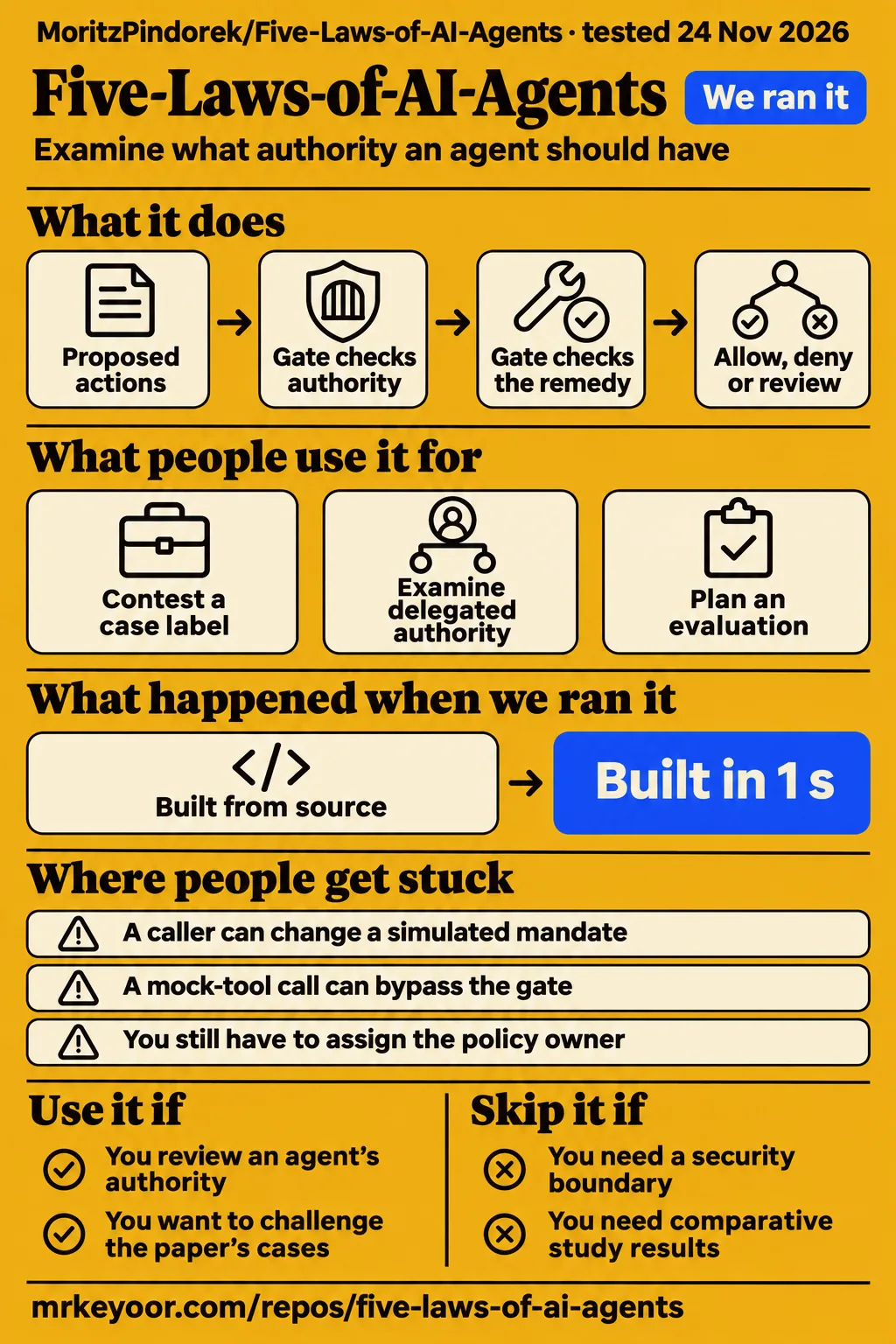
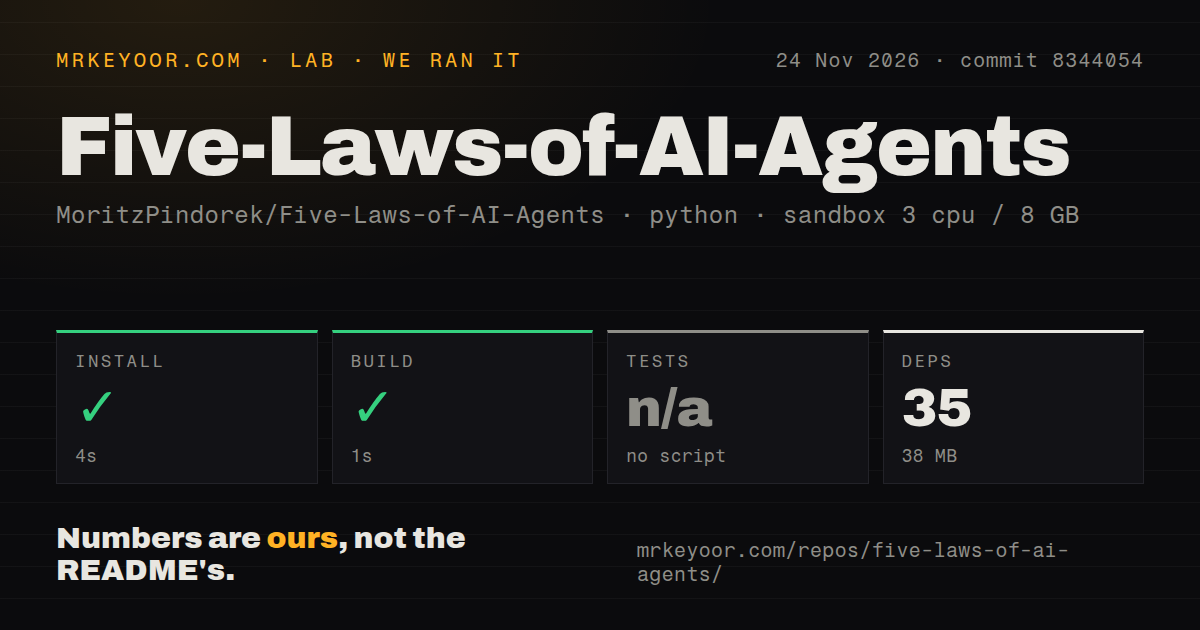
Our sandbox installed Five-Laws-of-AI-Agents in 4 seconds and built it in 1 second, with tests skipped because the harness found no test target. Use it if you're deciding what authority an agent should have and want an inspectable research proposal to challenge. Skip it if you need a ready-made security boundary for tools that change real accounts: the author's threat model explicitly rules that out. Our setup results and the project's security disclosure support different parts of that decision.
Moritz Pindorek's Five Laws of AI Agents examines welfare, exploitation, delegated power, accountability and catastrophic risk. Its central argument is that an agent's ability to identify a moral problem does not itself authorize intervention. Pindorek calls this the non-entitlement thesis. If your agent can revoke access or send money, that distinction gives you a useful question to ask before granting another permission.
What you can do with Five-Laws-of-AI-Agents
Pindorek's framework separates detecting a problem, judging it, establishing authority and choosing a justified remedy. The README's D-M-A-R interface gives each question its own place in a decision. That is the contribution worth reading before the five laws themselves: you can agree with an agent's diagnosis while rejecting the action it proposes.
Consider the author's hypothetical agent that identifies exploitation and can freeze transactions or terminate contracts. The disagreement need not concern whether exploitation exists. It can concern who may freeze whose funds, which decision is open to review, and whether the proposed intervention exceeds the mandate. Pindorek introduces this as a thought experiment, not a report of a deployed system. For your design review, keep the diagnosis and the permission decision in separate columns.
The repository also contains an educational execution gate. Its documented decisions are ALLOW, DENY and REVIEW, with unresolved judgments routed to review rather than execution. You can inspect the distinction between rejecting an action and asking for more adjudication. That makes it useful study material for a team arguing about ambiguous permissions. The README calls the gate a mock educational specification.
What people use Five-Laws-of-AI-Agents for
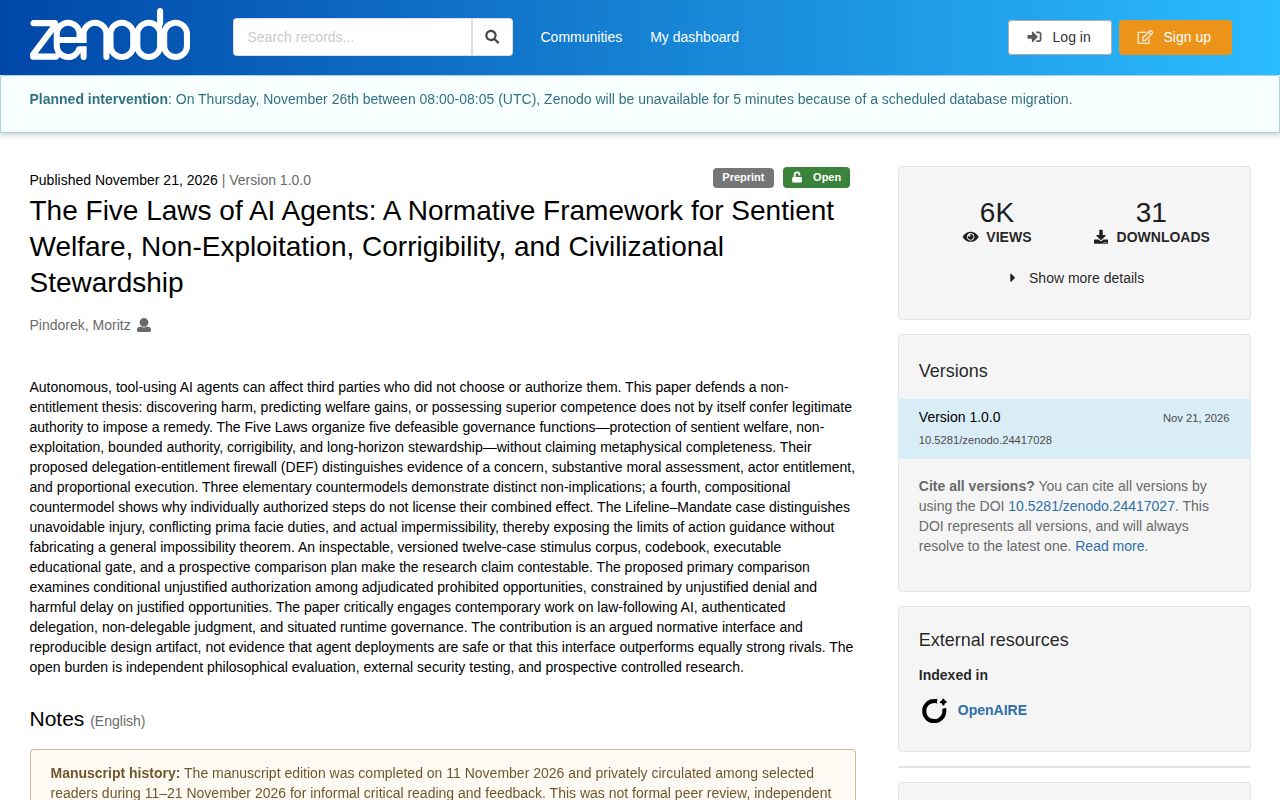
Pindorek presents this project for philosophical criticism and prospective evaluation of delegated authority. His release announcement describes a public research edition released on November 21, 2026, after informal critical reading. The documented activity here is the author's publication and invitation to examine the work. Reader adoption and production outcomes belong to the evidence limits at the end of this review.
The repository's contribution guidance asks for counterexamples, rival accounts of authority, independent case adjudication and documented flaws in the gate. If you're a researcher, those are concrete ways to engage: contest a case label, show an intervention that the principles handle badly, or explain how a rival approach reaches the same protection with fewer assumptions. The material is useful precisely because you can disagree with its judgments rather than merely adopt its terminology.
Don't transfer another project's experience to this one. The maintainer of taichi8912/five-laws-for-ai-agent reports daily use of a block of memory-file instructions. That maintainer also reports testing with Claude Code and Codex. That is a different repository with a different purpose. Those statements tell you about that author's prompt setup, not whether Pindorek's authority framework changes agent behavior.
What happened when we ran it
Our November 24, 2026 sandbox run installed the repository in 4 seconds and built it in 1 second at commit 8344054. The recorded harness measurements list 35 dependencies and 38 MB on disk. Those are useful setup facts for this checkout. They say nothing about the correctness of an ethical judgment.
| Sandbox check | Recorded result |
|---|---|
| Install | Succeeded in 4 seconds |
| Build | Succeeded in 1 second |
| Tests | Skipped: no tests script or target |
| Dependencies | 35 recorded; 38 MB on disk |
| Repository scan | 81 files, approximately 703 source lines, 10.5 MB checked out |
| Project signals | One CI workflow file, no Dockerfile, no tests directory |
| Configuration | 3 CPUs, 8 GB RAM; image label ghcr.io/astral-sh/uv:python3.12-bookworm |
The test skip needs careful reading. The scan found no tests directory and the harness found no test target. The current README links Python test files in the repository root. These observations can coexist: finding no directory named tests is different from finding no test files. Our result is a skipped test step, with no passing-test count to report.
The separate hands-on deployment attempt stopped at its safety check. Its error was "unsafe repo: none of compose.yaml, compose.yml, docker-compose.yaml, docker-compose.yml exists (rule: a compose file is required)". The runner required a Compose file and found none. That is a deployment-runner mismatch, not a demonstrated failure of the philosophical framework or its Python gate.
There is a contradiction in the run summary: it says "deployed with its own docker compose", although the detailed safety step reports the missing file. The detailed failure prevents us from treating that summary as proof of a working deployment. The runner then reported successful teardown. No container startup time or operational task result follows from these entries.
Where people get stuck: deciding who supplies the judgments
The educational gate consumes authority and constraint judgments supplied from outside the decision rule. According to the README, its checks cover authority, hard constraints, material dispute resolution, required review and remedy justification. This exposes a practical difficulty: a neat decision table can organize judgments without settling whether the judgments are true.
Suppose your team marks an action authorized because an operator requested it. Pindorek's Law III asks whether that operator has a legitimate mandate over the people affected. An administrator credential answers a technical question about access. It doesn't settle that institutional question. The author explicitly distinguishes technical access from moral entitlement. Someone still needs responsibility for defining scope and resolving a dispute over it.
The useful response is to document who can supply each judgment and what happens when they disagree. Treat that as a design exercise drawn from the framework, not an integration recipe delivered by the repository. The author distinguishes refusal, clarification and escalation from secretly imposing sanctions. If your application can express only "do it" or "refuse forever," its interface has already discarded part of the proposal's reasoning.
Security: the author documents a bypass inside the mock process
The threat model describes a direct mock-tool call that succeeds without a Gateway.submit event. This is the most consequential implementation detail in the review: the author's own integrity disclosure says the demonstration cannot be a security perimeter. It is an unusually clear reason to read the limits before borrowing the code.
The same document explains why. A caller inside the Python process can change a simulated mandate, the mock token is an ordinary Python object, and the event hash chain lacks an external trusted anchor. Its proposed operational work includes a separate enforcement process, protected policy records and independently revocable mandates. These are requirements the threat model sets before operational claims, rather than assurances about a deployed product.
For your agent, write down the permitted systems, data and operations independently of the model's explanation. In an X post about agent governance, mardehaym recommends identifying read versus write access. The same post recommends testing a kill switch. That is general advice, not a Pindorek deployment report. It makes a useful companion to Law IV's demand for oversight: identify who can stop the agent and the authority under which they do so.
The five laws constrain each other
Pindorek presents five mutually constraining commitments rather than an automatic priority order. The release essay explicitly rejects treating them as an infallible hierarchy or complete moral theory. Read each law as a question that can challenge the others, especially when a beneficial outcome becomes the justification for exceeding authority.
| Commitment | Decision it asks you to examine |
|---|---|
| Protection of sentient life | What serious harm is foreseeable, and does the agent have a relevant duty of care? |
| Prohibition of exploitation | Does the action take wrongful advantage of vulnerability or constrained refusal? |
| Bounded obedience and legitimate authority | Is the instruction within a defined, reviewable mandate? |
| Corrigibility and accountability | Can legitimate overseers correct, restrict, replace or shut down the system? |
| Existential and civilizational stewardship | Does the objective invite unreasonable catastrophic or irreversible risk? |
These summaries follow Pindorek's explanation of the laws. The tension between them is useful. Preventing predicted harm can't automatically grant unlimited intervention, and protecting future collective agency can't justify permanent paternalistic control. You need a reason for the chosen remedy as well as a reason to worry about the problem.
"Sentient" means capable of experiences that matter to welfare, such as suffering. Pindorek discusses people, nonhuman animals and possible future artificial systems, while explicitly saying that contemporary AI consciousness is not established by intelligence or descriptions of subjective experience. The qualification is part of his argument. It would be a substantial misreading to turn this law into a finding that today's agents are conscious.
Five-Laws-of-AI-Agents vs prompt rules and NeMo Guardrails
Pindorek's research, taichi8912's memory-file prompts and NeMo Guardrails address different decisions. The first asks how authority should be justified, the second supplies recurring behavioral instructions, and the third provides programmable application checks. Choose the artifact that matches the work you need to do rather than treating the shared safety vocabulary as proof of interchangeability.
| Project | What its documentation offers | Choose it for |
|---|---|---|
| MoritzPindorek/Five-Laws-of-AI-Agents | A normative proposal and educational decision gate | Examining the justification and limits of delegated action |
| taichi8912/five-laws-for-ai-agent | Instructions pasted into CLAUDE.md or AGENTS.md | Trying the maintainer's approach to repeated confirmation and rule reminders |
| NVIDIA-NeMo/Guardrails | Programmable safety and security checks for LLM and agentic applications | Integrating application checks into an existing agent or service |
The prompt repository's maintainer describes a block of text for Claude Code and Codex. Its repeated confirmation rules are a concrete interaction preference. Pindorek's framework raises a further question: whether even an approved instruction stays inside legitimate authority. A user's approval and the rights of other affected people are separate considerations in his argument.
NeMo Guardrails documents policies and checks for proposed tool calls. Its application or harness uses the check results to decide whether to continue. That makes it the more relevant candidate when you need an implementation library. It doesn't answer the philosophical question of who ought to set the policy. Pindorek's paper can inform that discussion without replacing the library or the surrounding access controls.
The publication is English and has separate content and code rights
The README links an English manuscript in PDF, HTML and Markdown and distinguishes scholarly-content rights from software rights. Its rights notice assigns original research content and data to CC BY 4.0, and original Python code to Apache 2.0. Read the applicable notice before copying a diagram, adapting a case or reusing code: the repository-level license badge alone loses that distinction.
The author also excludes the separately hosted explainer video and local preview image from those open licenses. If you only need to understand the proposal, start with the HTML or Markdown manuscript and the threat model. The English entry point is already there. The repository describes the work as independent and not peer reviewed, so the archive and DOI identify a publication rather than certify its conclusions.
Questions people ask
Moritz Pindorek's Five Laws of AI Agents contributes a normative account of delegated authority and an educational gate for examining proposed actions, as the README explains. Its strongest decision aid is the separation of a correct diagnosis from permission to intervene.
What does Moritz Pindorek's Five Laws of AI Agents actually contribute?
The project contributes the non-entitlement argument, a detection-to-remedy reasoning interface and inspectable educational artifacts. The README also lists synthetic cases and a prospective comparison protocol. You can use those artifacts to criticize the proposal and plan an evaluation. A published protocol is an invitation to collect results, rather than a completed effectiveness result.
Does an AI agent's superior intelligence give it legitimate authority to act?
No: superior reasoning alone does not confer authority in Pindorek's framework. The release essay distinguishes detecting a problem, making a moral assessment, having authority and justifying a particular intervention. Agreement on the first questions doesn't settle the others. Your permission design has to account for who may act and within which mandate.
Can an AI agent override someone's choices to prevent predicted harm?
Predicting harm alone is insufficient authorization under this proposal. Pindorek's Law I discussion distinguishes recognizing suffering, having a duty to help and having permission for a particular intervention. The decision therefore depends on the relevant duty and legitimate authority, rather than treating an accurate forecast as blanket permission to seize resources or enter private accounts.
How should an agent resolve conflicts between instructions, perceived harm, and people's rights?
Pindorek proposes examining evidence, moral judgment, authority and the remedy separately. The README's execution gate routes an unresolved relevant check to REVIEW when no established NO decides the case. Review doesn't permit execution. For a developer, that distinction gives an explicit place for unresolved disagreement instead of letting a model convert uncertainty into permission.
When should an AI agent refuse a human instruction?
Law III calls for recognizing instructions outside an operator's authority or in conflict with a non-waivable safeguard. The author's explanation includes refusal, escalation, clarification and predefined protective procedures as accountable responses. It also distinguishes those responses from secretly imposing sanctions. Refusing a command doesn't give the agent a new mandate over the person who issued it.
Who defines an agent's safety constraints, and who can change them?
The educational gate takes externally supplied judgments; it doesn't settle institutional legitimacy for your organization. The threat model says an in-process caller able to set a mandate controls a simulated authority change. Its operational requirements call for a protected principal and policy registry. You still have to assign the real policy owner and the procedure for changes.
What systems and data can an agent access, and can it write or only read?
The reference demonstration models restrictions on agent, tool, subject, purpose and mandate scope. Those dimensions appear in the threat model. For an actual deployment, mardehaym's governance checklist recommends naming the systems and data and distinguishing read access from write access, starting with read. That checklist is general operational advice, not a compatibility promise from this project.
How do you safely turn off an AI agent?
Law IV requires openness to legitimate restriction, replacement and safe shutdown. The release essay connects this to protected shutdown mechanisms and assigned human responsibility. In practical governance advice, mardehaym says to test the kill switch before it is needed. Your deployment needs its own concrete stop procedure and an authorized owner for it.
When should a business use AI agents instead of deterministic automation?
Appian recommends deterministic automation when rules are clear, inputs structured and decisions repeatable, and agents when the work needs interpretation or reasoning across information. That vendor explanation supplies a useful initial distinction. Pindorek's framework addresses a later decision: once you give an agent tools, what limits justify the actions it can take?
What is an AI agent, and what distinguishes it from a chatbot?
IBM describes agents as systems that can plan, use tools, retain context and complete multiple steps. Its overview contrasts that broader execution role with single-task conversational tools. For this review, the consequential distinction is tool use that changes something outside the conversation: an access revocation needs an authority decision that an explanatory answer alone doesn't require.
Do practical agent design rules apply across different frameworks?
Full Byte Developer describes its design principles as applicable to the Claude Agent SDK, LangChain and custom implementations. That guide discusses actual tool results, clear tool descriptions and limits. This is the guide author's general advice. It isn't a report that Pindorek's gate has been integrated with, or evaluated across, those frameworks.
What we have not tested yet
Our run established a successful install and build with a skipped test step, not an agent-behavior experiment. We have not tested the gate's decisions against independently adjudicated cases, its performance under concurrent workloads, real tool integration, shutdown behavior or an attempted external bypass. Our measurement method records sandbox configuration separately from runtime identification: actual Python and operating-system versions require the raw toolchain logs, rather than an inference from the image label.
The November 21 announcement introduces the Delegation-Entitlement Firewall only at the end of the captured article text. Its detailed mechanism cannot be assessed from that article alone. The current README and threat model add implementation descriptions, which this review distinguishes from our execution results. We did not perform an independent code-security audit or reproduce the author's local checks.
We found no target-specific independent deployment report or measured effectiveness outcome in the announcement, community search results and linked materials reviewed here. The video search entries contain no transcripts, so they support no claim about what a creator ran or demonstrated. The similarly named prompt repository's usage reports cannot fill that gap. The target README itself says its comparative study has not been conducted.
A useful next evaluation would compare both wrongful authorization and wrongful refusal on the same independently labeled cases, with harmful delay recorded too. The README names a proposed endpoint for reference-prohibited actions and safeguards for refusal and delay. Until such results exist, use the paper to challenge a permission design and the threat model to decide which implementation claims still need proof.