1 runtime spans desktop, cloud, edge, and browser
Wasmer is not merely a command that opens a WebAssembly file. It is a Rust-based runtime, an embeddable SDK family, and an entry point into Wasmer's package registry and Edge offering. The practical problem it addresses is portability: compile 1 workload to WebAssembly, then run it in places ranging from a developer laptop to a browser without granting file, network, or environment access by default. That permission model is the most useful claim in the README because it describes an operational boundary, not just speed marketing.
The project has been around since 2018 and now reports 21,014 GitHub stars. Its README presents WASI and WASIX support, a CLI, community packages, and SDK routes for languages including Rust, C, C++, JavaScript, Python, Go, PHP, Ruby, Java, and others. That breadth makes Wasmer attractive to platform teams that want one WebAssembly story across several application layers. It also creates a verification burden: a long integration table is not the same thing as equally current, equally packaged support for every language.
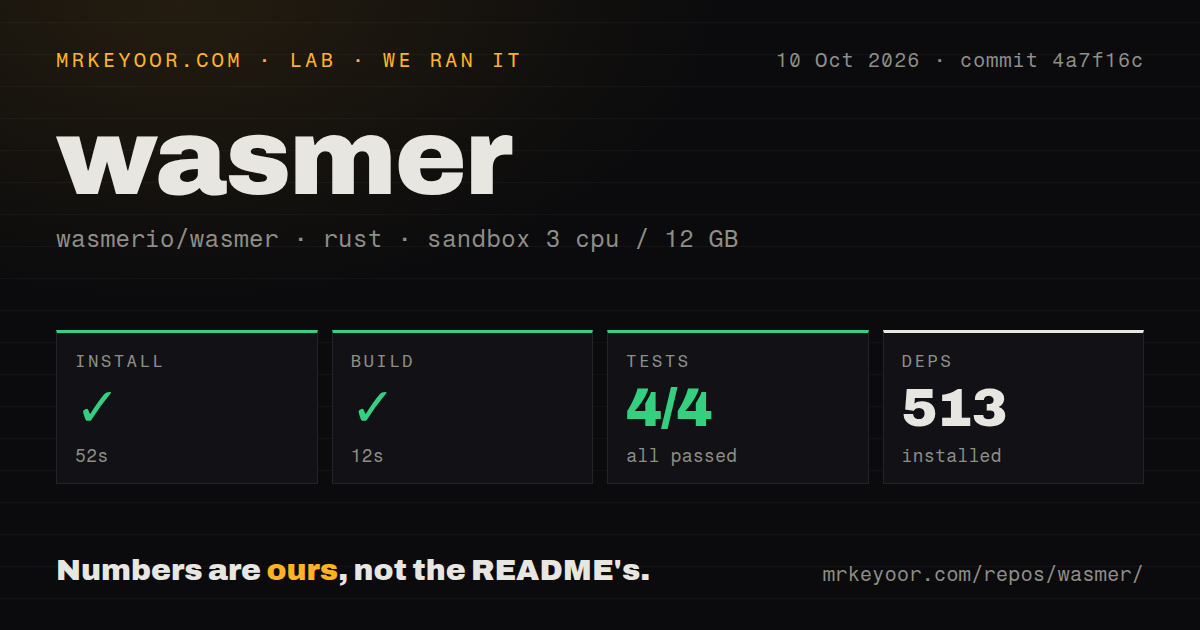
Our 3-CPU run installed, built, and tested successfully
On our box, the installation stage succeeded in 43 seconds and brought in 519 packages. The build then succeeded in 28 seconds. Cargo test completed in 294 seconds with 4 tests passed and 0 failed. Those are the only execution numbers we can responsibly attach to this review: we did not measure WebAssembly startup time, throughput, memory use, or the README's near-native-speed claim. The result says Wasmer was buildable in the supplied sandbox, not that it beat another runtime.
The environment was a fresh, unprivileged Debian container with 3 CPUs and 12 GB of RAM, using the lab-rust:1 image and no secrets. At commit 38f3932, the checkout contained 3,187 files, roughly 494,221 lines of source, and occupied 359.9 MB. There were 10 CI workflow files, a tests directory, and no Dockerfile. For contributors, this is plainly a substantial Rust codebase. For CLI users, the README offers a much simpler curl installer plus Homebrew, Scoop, Chocolatey, cargo-binstall, and Cargo choices.
4 concrete strengths make Wasmer worth evaluating
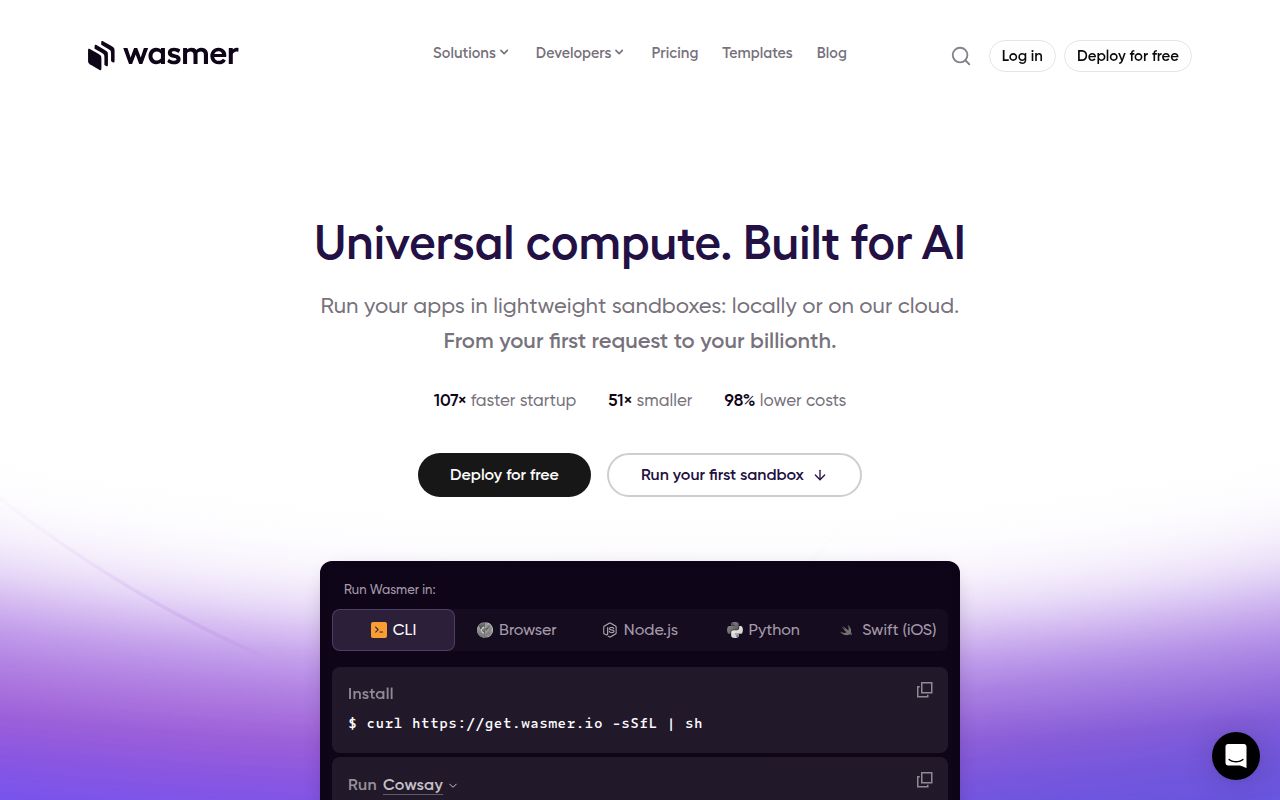
Of 4 concrete strengths, the first is stated clearly: host resources stay unavailable until enabled. Second, WASI and WASIX support gives teams more than a proprietary execution format. Third, the same project can be used through a command-line tool or embedded into an application. Fourth, distribution is treated as part of the workflow, with documented paths to run, create, and publish packages. The cowsay quickstart is modest, but it demonstrates the shortest path from installation to executing a named package with an argument.
3 rough edges require checking before adoption
The SDK table is broad but uneven. Several languages are marked as having no published package, some rows lack documentation links, R has 2 rows, and the Java entry references a Bintray package. That does not invalidate the Rust core, but it means the table should be treated as a directory of leads rather than a procurement-ready compatibility promise. Before committing, confirm the package, documentation, release date, and maintenance state for the exact host language your product uses.
The repository is also large: our checkout measured 359.9 MB, and the install stage resolved 519 packages. The full cargo test command ran only 4 tests in our measured configuration, despite the presence of a tests directory. All 4 passed, which is better than a broken baseline, but that small executed set cannot establish behavior across every compiler backend, operating system, SDK, WASI capability, or WASIX extension. Teams should run workload-specific compatibility and security tests before production use.
Finally, the README calls the runtime incredibly fast and says it runs at near-native speeds, but our run did not test either claim. Treat those phrases as hypotheses for your own comparison. Measure the modules you actually plan to operate, with the compiler settings, host calls, cold starts, and resource limits that match production. A runtime can build cleanly in 28 seconds and still be the wrong fit for a latency-sensitive or memory-constrained service.
254 open issues sit beside very fresh project activity
The health signals are current rather than sleepy. Version 7.4.0 was released on August 31, 2026, and the repository was pushed again on September 5, 2026, the date of this review. That combination matters more than judging the project from a release tag alone. The 254 open issues show a meaningful support and maintenance surface, but the supplied data does not reveal response times, closure rates, or how many are feature requests. It would be unfair to call the queue either healthy or neglected without that context.
1 explicit execution layer is where Wasmer fits
In a real stack, Wasmer belongs at 1 clear boundary where your application needs to execute portable WebAssembly modules. An application or service remains responsible for authentication, job scheduling, observability, data policy, and deciding which host capabilities a module receives. Wasmer supplies the runtime and packaging path; it should not be mistaken for the entire control plane. Its deny-by-default access model is useful only if the surrounding application grants capabilities carefully.
The v7.4.0 choice is breadth versus a smaller surface
Choose Wasmer when you value its combination of CLI use, embedding, WASI and WASIX, package discovery, and an Edge path. Choose a narrower interpreter when constrained footprint is the priority, or compare Wasmtime and WasmEdge when their governance and integrations align better with your stack. Our run gives Wasmer a credible baseline: 43-second installation, 28-second build, and 4 of 4 tests passing. The next decision should come from running your own modules, not from counting stars or accepting an unmeasured speed claim.