Wasmtime hosts WebAssembly outside the browser
Wasmtime is both a command-line runtime and a library for embedding WebAssembly into another program. Cranelift compiles modules at runtime or ahead of time, while WASI defines controlled ways for components to interact with their host. The README emphasizes fast instantiation, low-overhead calls, concurrent instances, and configurable CPU and memory controls. Those are design claims, not benchmarks from our lab; we did not run workload performance tests.
commit ffb0408 was a substantial workspace: 8,246 files, about 814,891 lines of source, and 311.6 MB checked out. GitHub identifies Rust as the primary language. We found 8 CI workflow files, no root Dockerfile, and a tests directory. That size reflects more than one CLI. The repository includes the runtime, Cranelift work, WASI support, component tooling, C APIs, examples, and test programs used across architectures and WebAssembly features.
Official support spans 7 host-language families
The Bytecode Alliance lists maintained integrations for Rust, C, C++, Python, .NET, Go, and Ruby. Elixir and Perl appear under community support. This distinction matters for upgrade planning and security response. A Python developer can install a package without reading Rust internals, while a C or C++ embedder uses the provided headers and CMake integration. The core runtime still follows its own release policy, regardless of the host-language package manager.
The README's first component example requires a Rust compiler installed through rustup, followed by rustup target add wasm32-wasip2. It warns that a second Rust toolchain installed through the operating system may receive the command incorrectly. That specific note is useful on machines where rustc, cargo, and rustup resolve from different locations. Release binaries avoid compiling the CLI, but producing components still requires a suitable guest-language toolchain.
What happened when we ran it
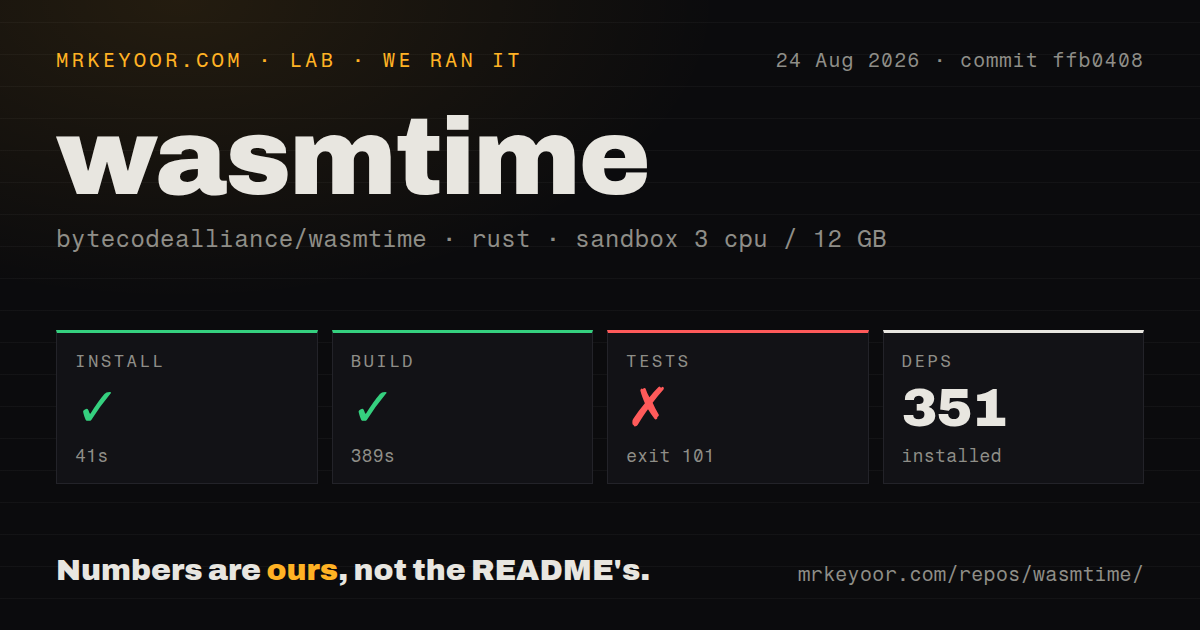
Our sandbox installed 351 Rust packages in 41 seconds and built commit ffb0408 in 389 seconds. The run used an unprivileged container with 3 CPUs and 12 GB of RAM. A successful build shows that the checked-out workspace compiled under that toolchain. It does not establish runtime throughput, memory isolation, WASI policy, or compatibility with a private component.
The test command failed with exit code 101 after 286 seconds. Rust reported error E0463 while compiling wasip1, noted that wasm32-unknown-unknown may not be installed, and suggested adding it through rustup. A build script at crates/test-programs/artifacts/build.rs then panicked because a child status was unsuccessful. The log supports a target-related failure; it does not support inventing a test count or blaming a Wasmtime runtime defect.
Security depends on the host capabilities you grant
Wasmtime documents code review, an RFC process, continuous fuzzing through OSS-Fuzz, a security response policy, Spectre mitigations, and formal-verification work on parts of Wasmtime and Cranelift. That is the right posture for a runtime executing code supplied by someone else. It is still not a promise that any embedding is safe. The host decides which WASI resources and custom functions a component can reach.
A useful trial should begin with no ambient authority and add only the files, sockets, clocks, environment variables, or application calls the component needs. Resource limits matter too. The README points to configuration for CPU and memory control, but those settings must be selected and tested by the embedder. WebAssembly memory isolation cannot protect a secret that the host deliberately passes through a capability or custom import.
v48.0.1 fixed 2 concrete component and HTTP faults
Wasmtime v48.0.1 was published August 24, 2026. The patch notes list 2 fixes: context-slot management in component compositions and the default Host header for HTTP requests sent with WASIp2. Small patch notes can be a positive release signal because they name the affected behavior, but consumers still need the support policy to decide which series receives fixes and how quickly an embedding must upgrade.
GitHub reported 18,569 stars, 851 combined open issues and pull requests, and a last push on August 26, 2026. The most recently updated items included component host-call optimization, UEFI compilation, s390x musl build work, Cranelift cleanup, stream forwarding, and stack-limit changes. The dated activity and v48.0.1 release together show current maintenance. The combined open count is not a count of confirmed security or runtime bugs.
Stability tiers require feature-by-feature decisions
Wasmtime implements the official WebAssembly test suite, C API, WASI, and some future proposals. Future proposal support is useful for teams building components ahead of broad adoption, but it should not be read as one uniform compatibility promise. The documentation assigns stability tiers and identifies currently supported versions. An embedder should check the tier for every proposal, WASI interface, and host API it intends to expose.
The same discipline applies to language bindings. Bytecode Alliance support across 7 host-language families is broad, but package versions and release timing may differ. Pin the runtime and binding, record enabled features, compile representative components, and test host permissions. A CLI hello-world proves the instruction pipeline; it does not prove component composition, asynchronous host calls, or a production security policy.
Adopt it for a runtime platform, not a quick script
Wasmtime has the governance, documentation, and current activity expected from infrastructure that may sit on a security boundary. The source-build cost is real: our install plus build took 430 seconds, and the suite ran another 286 seconds before the target failure. Application teams using a release binary will avoid much of that contributor cost.
Choose Wasmtime when your system needs configurable server-side WebAssembly, WASI, or supported embedding APIs. Compare WAMR on constrained devices and Wasmer or WasmEdge where their packaging matches the deployment better. Before shipping, add the required Rust targets, rerun the full suite, define capabilities explicitly, and test adversarial components against the exact host configuration. Our run supports the build, but it does not yet provide a clean test result.