Twenty examples teach effects instead of imposing one template
Vintage LaTeX is a shelf of 20 small, standalone examples for old scientific-paper aesthetics. Ten are pure LuaLaTeX pages, 4 are standalone MetaPost figures using fiziko, and 6 place fiziko drawings inside LuaLaTeX through luamplib. The gallery covers an early-modern page, Victorian newspaper, natural-history catalogue, star chart, snow crystals, patent sheet, telescope plate, mechanics primer, knots, and phases of the moon.
That structure is more useful than a monolithic theme if you need one effect. You can lift the asymmetric margins from example 1, study deterministic hatching in example 2, or reuse the computed log table in example 10 without adopting the rest of the visual system.
What happened when we ran it
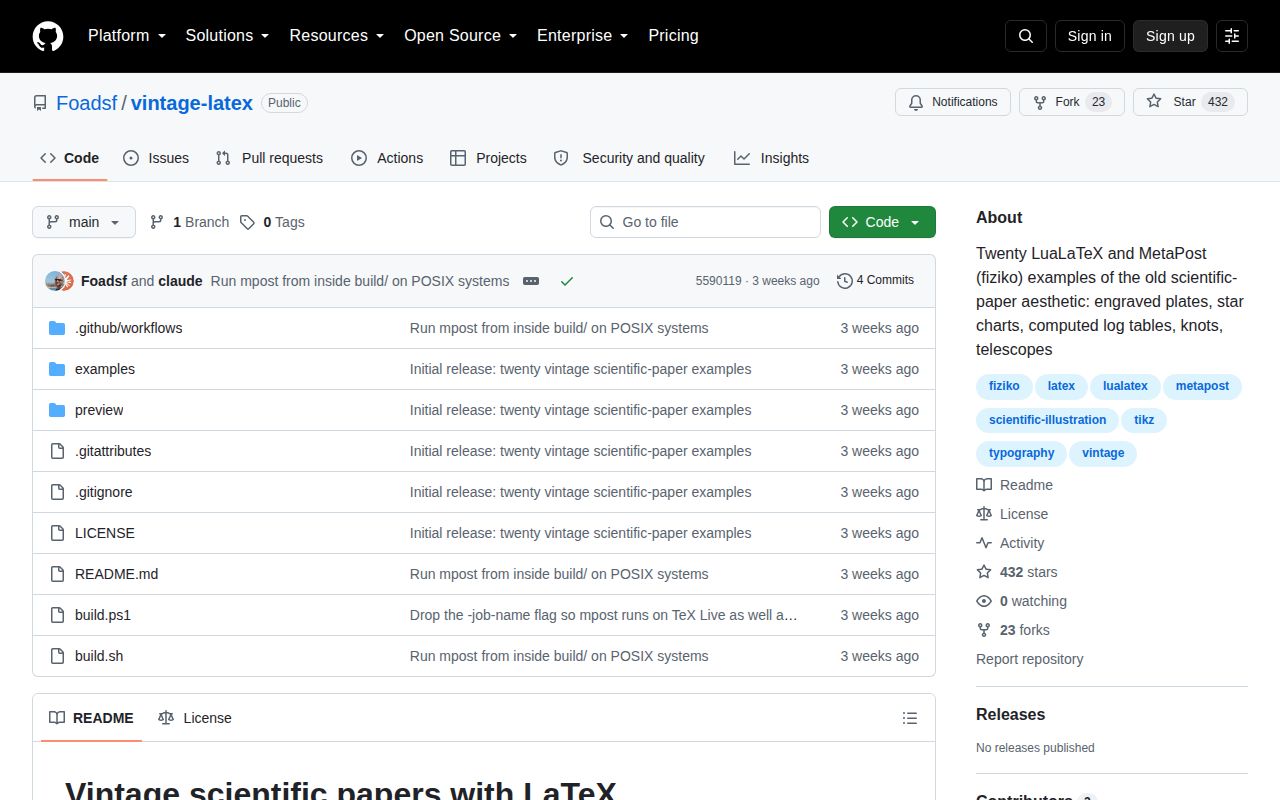
Our harness did not execute commit 5590119. It classified the repository's primary language as PowerShell, which is outside the supported ecosystems, and found no Dockerfile to provide a runnable path. We therefore have no lab install time, build result, test count, dependency size, or vulnerability audit for this project. Source inspection cannot replace a compile.
The assigned sandbox had 3 CPUs and 8 GB of RAM, but those resources never became relevant because execution stopped at ecosystem detection. The repository does include a POSIX build.sh, a PowerShell 7 script, and 1 GitHub Actions workflow. The upstream workflow checks out fiziko, compiles all 20 examples in a TeX Live container, converts MetaPost EPS files to PDF, and succeeded at commit 5590119.
There is no test directory or release artifact. The public workflow does not judge visual faithfulness, accessibility, or whether a copied snippet still works after you replace its fonts and packages. Your own PDF inspection remains part of adoption.
Ten examples work without fiziko, and ten need it
The lighter half needs LuaLaTeX, EB Garamond, and a list of familiar packages including fontspec, geometry, microtype, TikZ, pgfplots, luacode, and array. The source deliberately rejects pdfLaTeX because the examples depend on OpenType font controls. If your publishing system is fixed to pdfLaTeX, this repository is reference material rather than a drop-in source library.
Examples 3, 7, 8, and 9 are standalone fiziko MetaPost programs. Examples 15 through 20 load fiziko inside LuaLaTeX with luamplib. The build scripts skip those 10 files when a fiziko checkout or MPINPUTS is missing, so a successful partial build can mean only the pure examples compiled. To reproduce the whole gallery, clone jemmybutton/fiziko separately and preserve the trailing path separator in MPINPUTS.
The split keeps GPL-3.0 fiziko out of the repository and makes the dependency visible. It also means this is not a single-folder archive that rebuilds every image offline. A long-lived publishing pipeline should pin the fiziko commit rather than cloning whatever its default branch contains on a future build.
TeX Live and MiKTeX require different fixes
The README records an unusually specific MetaPost difference. MiKTeX mpost 3.00 needs a -job-name argument for examples with btex labels, while TeX Live rejects that spelling and works without it. The PowerShell script detects MiKTeX and adds the flag. The POSIX script runs MetaPost from inside build/ because TeX Live could not read its generated MPX file when an output-directory flag was used.
Mixed LuaLaTeX and fiziko pages add another distribution problem. The checked MiKTeX luamplib 2.42.8 package included the style file but lacked the Lua module it requires. The README explains how to extract both files from the CTAN source and add them to a TEXMF root. That is useful troubleshooting, but it raises the setup cost well beyond copying one .tex file. TeX Live is the easier documented route.
The examples simulate print history without claiming facsimile accuracy
The design notes draw a responsible boundary. Warm paper, softened ink, line jitter, hatching, long-s characters, and old-style figures can suggest an era, yet none is a universal historical rule. The star chart uses rounded epoch-2000 coordinates. The cooling curve is generated by a formula, the telescope radii were chosen for a legible plate, and enlarged source artwork does not gain missing detail.
A fictional report, classroom handout, or exhibition graphic can borrow the visual vocabulary. An archive reconstruction needs research into the specific press, year, language, stock, and reproduction method. The README also recommends high body-text contrast, text labels, and vector output. It does not claim the 20 samples have undergone a formal accessibility audit.
CC BY-SA applies to every adapted example
The source, prose, and generated examples use CC BY-SA 4.0. Commercial use is allowed, but an adaptation must credit the project, link the license, identify changes, and use the same license. That is workable for teaching material and open publications. It can conflict with a proprietary template pack whose modified source must remain under a different license.
Fiziko keeps its separate GPL-3.0 terms. The repository does not vendor or relicense it. Read both licenses when distributing mixed examples, especially if you modify the MetaPost library itself. The page sources and external drawing dependency do not collapse into one permissive package merely because one build script compiles them together.
One successful workflow does not create a maintenance history
The repository was created and last pushed on September 9, 2026. Its 4 commits arrived within about 17 minutes, moving the TeX Live workflow from failed attempts to a successful build. GitHub showed 432 stars, 23 forks, and 0 open issues or pull requests on October 1. That is strong attention for a small gallery, but there is no release and no visible community issue history yet.
Use Vintage LaTeX for what it is: 20 inspectable lessons with excellent notes about their compromises. Copy narrowly, keep the attribution, and compile under the same TeX distribution you plan to ship. If you need a full document system, Tufte-LaTeX is the clearer starting point. If you mainly need reusable physics drawings, go directly to fiziko.