PLANKA focuses on boards, lists, and cards
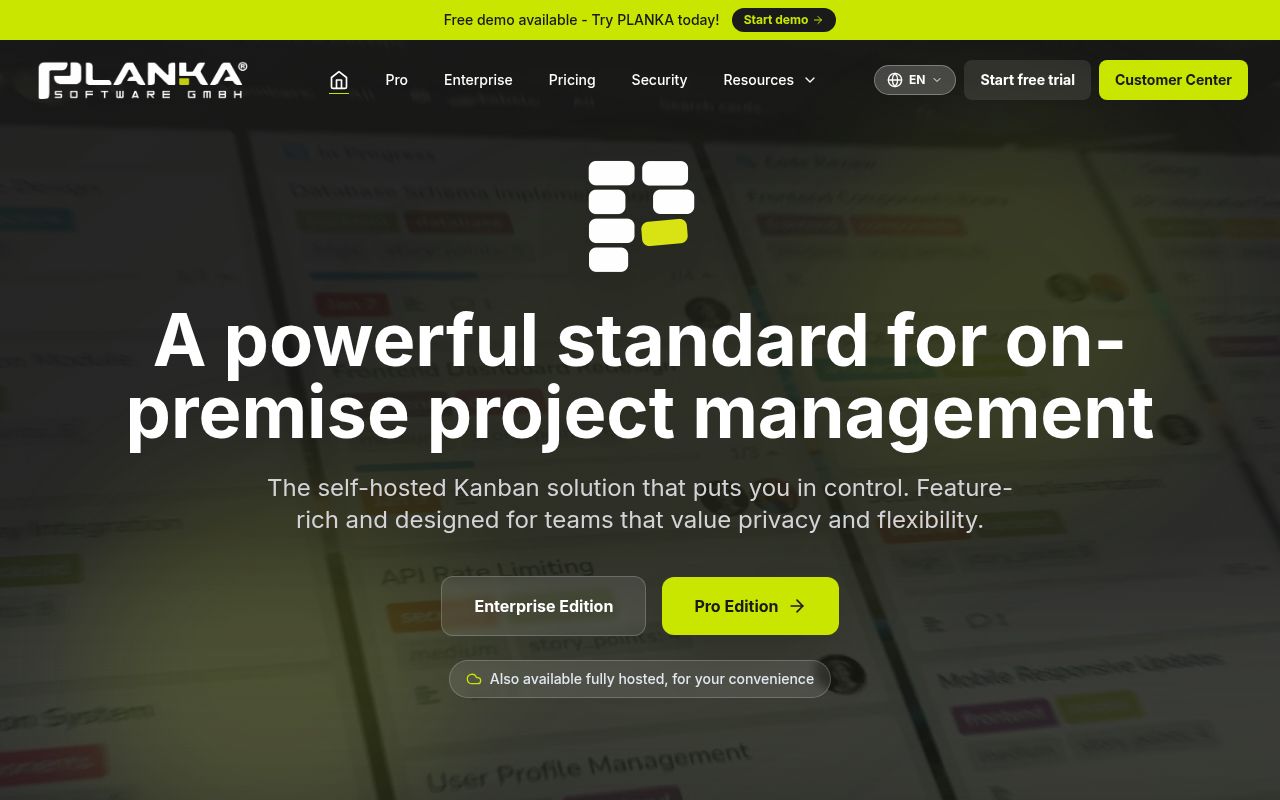
PLANKA gives teams the familiar structure of projects, boards, lists, and cards. Members can drag cards through a workflow, write Markdown descriptions, discuss work, attach files, and see changes arrive in real time. Notifications can be routed through more than 100 providers, and the interface supports multiple languages. The product looks and behaves closer to a hosted commercial board than many self-hosted admin tools.
That focus is a virtue. PLANKA is not trying to combine documents, chat, spreadsheets, and issue tracking in one screen. It is best when the work can be represented as cards moving across columns. An internal editorial calendar, support queue, hiring pipeline, or small development board fits naturally. Teams that need dependencies, portfolio planning, several task views, or deep reporting should compare it with a broader project-management system before migrating.
Community licensing excludes some client-facing commercial use
PLANKA calls itself fair-code and source-available. Its Community license permits personal, educational, non-profit, and internal organizational use, including modification and private internal integrations. It is not an OSI-approved open-source license, a distinction the project's own guide states plainly.
The important restriction concerns outside users and commercial gain. The guide says an agency cannot give a paying client an account on its Community instance as part of that relationship. Hosting PLANKA for customers, white-labeling it for money, or using its API as the operational engine of a paid external service also needs a commercial agreement. Internal business use remains free, and companies may sell consulting that helps another organization run its own internal instance.
This line is easy to miss because self-hosting normally suggests freedom to invite whomever the operator chooses. A software team serving only coworkers may never hit it. An agency board shared with clients can cross it immediately. Decide who will log in and which legal entities they belong to before installation, not after the workspace contains years of cards. If the answer is unclear, get written guidance from PLANKA or choose an alternative with a standard open-source license.
What happened when we ran it
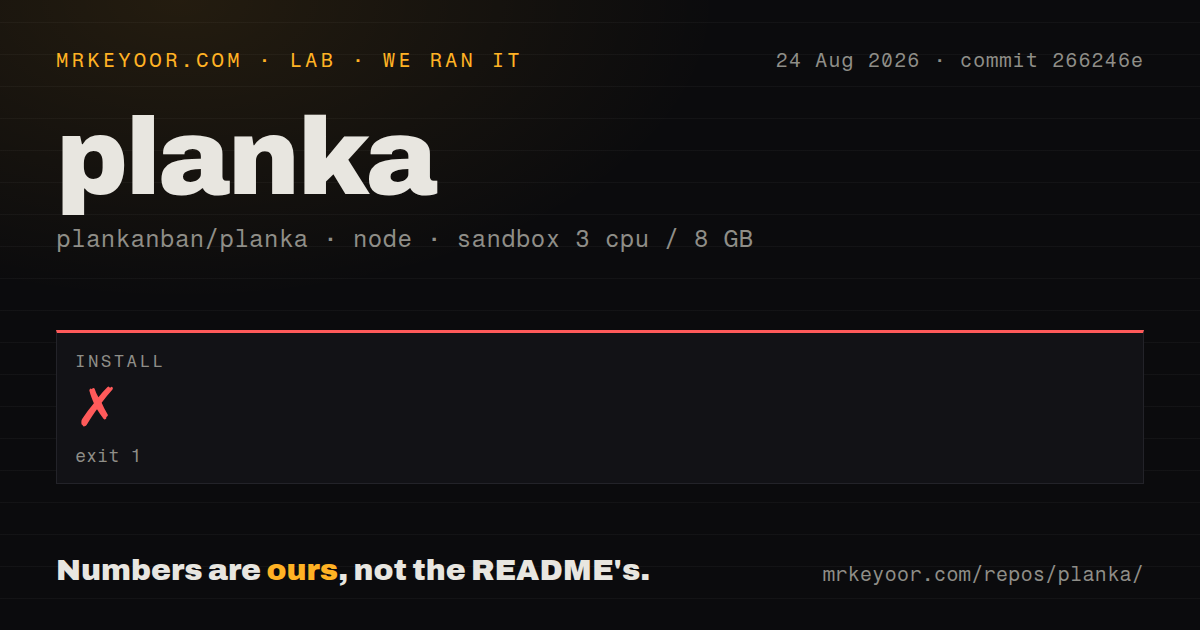
Our run started the npm installation for commit 266246e, then exited 1 after 39 seconds. Because installation failed, we did not run a build or tests. The checkout contained 1,602 files, about 119,203 source lines, and 12.4 MB before dependencies.
The final log shows the root install invoking separate server and client installs. Inside the server, its postinstall command ran patch-package followed by npm run setup-python. The failure points at /work/repo/server/.venv/bin/python3, tells the user to recreate the virtual environment, and then returns npm error code 1. The supplied tail does not show the earlier Python message, so it does not prove why that environment was invalid.
Our sandbox was a fresh unprivileged Debian container with 3 CPUs, 8 GB of RAM, Node 22, and no secrets. PLANKA has a Dockerfile and Compose configuration but no tests directory in the measured checkout. The failure shows that source installation expects a working Python virtual environment in addition to npm; it says nothing about the published container's runtime behavior.
Docker deployment still needs PostgreSQL, HTTPS, and backups
The production Compose path runs PLANKA beside PostgreSQL and keeps database and uploads in persistent volumes. Operators must replace the base URL and secret, create an administrator, add database authentication, terminate HTTPS, and proxy Socket.IO correctly. SMTP is needed for mail, while avatars, backgrounds, and attachments need durable local or S3-compatible storage.
Backup scripts cover PostgreSQL and uploaded files in one archive. Send those archives off the host, monitor the jobs, and rehearse a restore. A failed source install can be retried; a missing board history after a volume or migration error is harder to repair.
Version 2.2 changes authentication and fixes a file-read flaw
Release 2.2.0 removed OIDC and SSO from Community and moved them to Pro. Its notes warn that SSO-only accounts are deactivated after the update because those users lack password credentials. If the only administrator signs in through SSO, the operator can lock themselves out unless another administrator is created first. That is a major edition change for teams that selected PLANKA partly for identity-provider integration.
One day later, 2.2.1 shipped as an emergency security release. It fixed path traversal in JWT-protected local-file routes that could let an authenticated user read files available to the PLANKA process. S3-backed storage was not affected. The fast disclosure and patch are good signs, but every local-storage installation on an older version should update promptly.
Older deployments also need more than a blind image pull. Issue 1623 reports an upgrade from 1.26.2 failing when a migration encounters an attachment without a stored size. The normal update guide is only stop, pull, and restart, so a staging copy is the right place to discover data-specific migration failures. Version 2.2 also requires Node.js 24 for source or manual installs, while Docker users are unaffected.
Current deletion and pagination reports affect daily work
Issue 1764 reports that deleting a project on v2.2.1 can leave project-manager and board-membership rows behind, causing the home view to crash into a blank screen. Issue 1761 reports the endless-list pagination API returning HTTP 500 when both timestamp and ID cursor fields are supplied. Both reports include reproduction details, making them suitable upgrade checks on a staging copy.
Anonymous public boards remain an open request, and issue 335 still asks for forgotten-password recovery. Those gaps matter to teams moving from Trello because the interface otherwise feels familiar. Administrators have server-side account tools, but casual outside viewers and locked-out users should not be assumed to have a polished self-service path.
PLANKA was pushed on August 10, 2026, when v2.2.1 was released. GitHub listed 448 combined issues and pull requests, with issue updates continuing through August 26. That is active use around an established product and a large triage queue. Trial the exact board size, notification rules, deletion flow, backup restore, and account lifecycle your team will depend on before importing its history.