v7.24.9 puts several proxy cores behind one GUI
v2rayN v7.24.9 is a desktop control surface for Xray, sing-box, mihomo, and other proxy engines. It imports individual links or subscriptions, keeps profiles in a server list, changes the operating system's proxy settings, and generates routing and DNS configuration for the selected core. That saves users from maintaining several configuration formats. It also means v2rayN sits in the middle of a chain: the app, its generated configuration, the chosen core, and the remote endpoint all have to agree.
The system-proxy modes cover clearing the current setting, applying a proxy automatically, leaving the setting alone, and using PAC rules on Windows. Routing can send selected traffic directly while proxying the rest. The wiki also documents policy groups, chained proxies, custom DNS, and full configuration templates. Those controls make the client useful to someone who knows why a route should change. A buyer seeking one large connect button will meet more vocabulary and more ways to produce a bad configuration.
What happened when we ran it
Our 2026-09-07 sandbox did not run v2rayN at commit 3d50d9f. The repository's primary language is C#, and our lab harness had no supported ecosystem for this desktop project. The checkout also had no Dockerfile, so there was no project-supplied container route to use instead. The sandbox was an unprivileged Debian container with 3 CPUs and 8 GB of RAM. It produced no install time, build result, test count, dependency count, or vulnerability result, and we will not substitute numbers from the README or another machine.
That outcome says nothing about whether the published desktop packages open successfully. It says our usual evidence is absent. We can assess the documented package paths, release record, and current issue reports, but we cannot tell you that commit 3d50d9f compiled or passed its tests in our environment. For a network client that changes system proxy and routing state, that missing check should lower confidence rather than be hidden behind the project's popularity.
Windows 10+ has the simplest documented package path
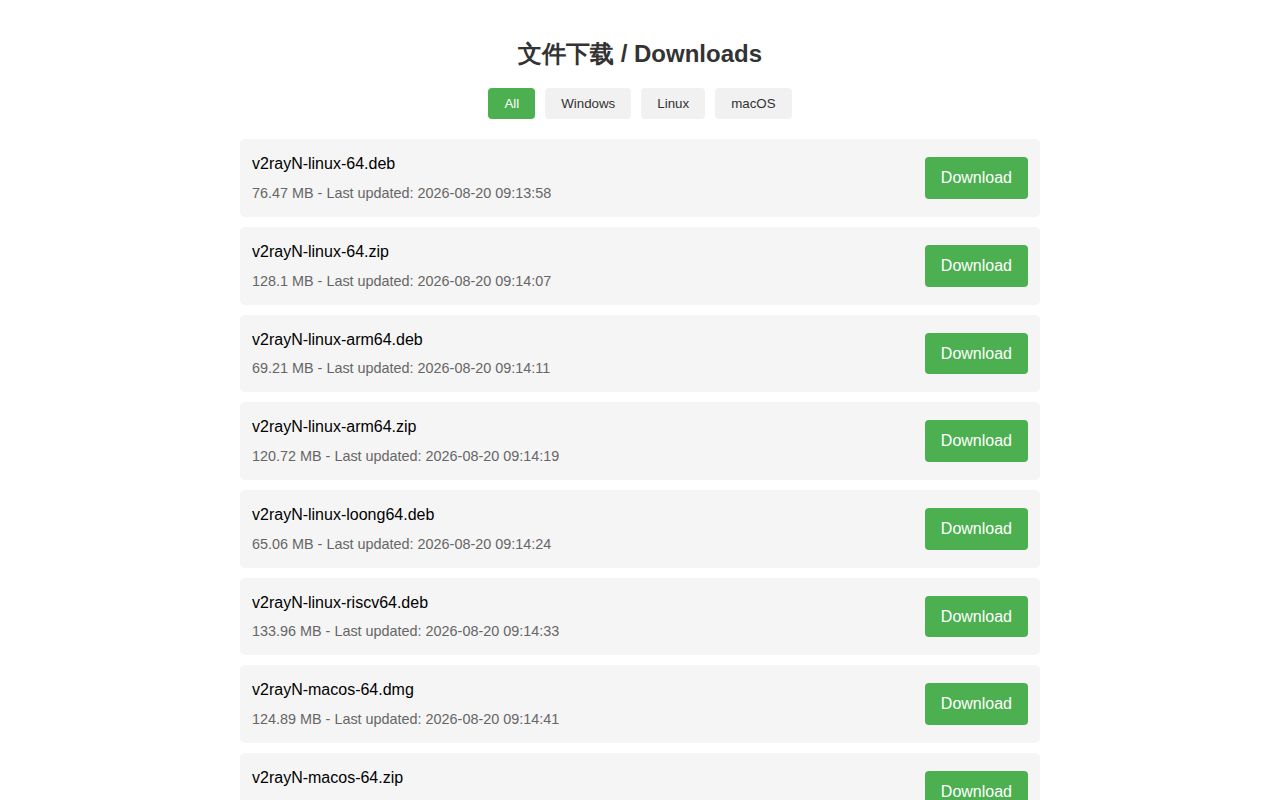
Windows 10 or newer gets x64, x86, and Arm64 downloads, with separate WPF and Avalonia desktop archives. Linux packages cover Debian 12+, Ubuntu 22.04+, Fedora 36+, and Red Hat 9+, while the portable Linux ZIP runs after chmod +x v2rayN. macOS 12+ has Intel and Arm64 builds. Its DMG is not signed, so the guide warns that macOS may call the app damaged and tells users to run xattr -cr /Applications/v2rayN.app. That is a meaningful trust and support step for less technical Mac users.
ZIP packages store their data beside the executable, which makes independent portable copies possible. The FAQ says multiple copies can run with different local listening ports. Installed Linux and macOS packages use the operating system's normal user-data location instead. Some cores come in the release package, specifically Xray, sing-box, and mihomo, while the longer supported-core list includes engines that users must fetch themselves. Package choice therefore changes both where settings live and how much core maintenance remains yours.
Nine subscription formats still require your own endpoint
The subscription guide lists 9 accepted types: VMess, Shadowsocks, SOCKS, VLESS, Trojan, Hy2, TUIC, WireGuard, and AnyTLS. v2rayN can parse those links and its own backup format, but it does not provide the remote proxy account or server. You need a working subscription URL or profile containing the address, port, identity, and protocol settings. That distinction matters because installing the client alone cannot create a usable route. It also makes subscription provenance important, since imported material influences the configuration passed to a network-facing core.
sing-box 1.14 and Linux TUN reports deserve a pre-upgrade test
Open issue 10121 reports that v2rayN v7.24.9 generated DNS settings rejected by sing-box 1.14.0, leaving the core unable to start; the reporter's workaround was switching to Xray. Issue 10051 describes TUN mode no longer proxying traffic on CachyOS after an upgrade to v7.24.8. A separate v7.24.9 report on Ubuntu 24.04 says the log pane stays blank until the settings dialog is confirmed, even though Xray starts. These reports cover named configurations and do not prove every installation fails. Each still touches the diagnostics or routing path users rely on when something breaks.
Release 7.24.9 fixed a downloader security flaw in old builds
Release 7.24.9 was published on 2026-08-29 as an urgent security update. Its notes say the downloader in older versions could permit a man-in-the-middle attack and retrieve a malicious file, and they tell all users to upgrade. The same release moved the desktop interface to Avalonia 12, removed Xray's allowInsecure setting, and added routing, DNS, TUN, and WireGuard changes. The README says release files are GPG-signed and publishes the fingerprint, giving users a way to verify the archive before running a network client downloaded through an untrusted path.
115,661 stars come with active maintenance
GitHub showed 115,661 stars, 28 open issues, and 8 open pull requests when we fetched the project. The last push was 2026-09-07, one day before our review, and 133 issues had activity since 2026-08-01. That is current maintainer and user traffic, not a claim that the open reports are fixed. The latest tagged release was 7.24.9 from 2026-08-29, while newer commits and reports continued after it. Health looks active by both code and issue activity; the fast-moving core dependencies still create compatibility work between releases.
Choose v2rayN when several cores matter more than a managed service
Release v7.24.9 ships some Xray, sing-box, and mihomo core files and exposes more engines through manual downloads. That breadth is v2rayN's best reason to exist. It suits a technical desktop user who already has profiles, understands system proxy versus TUN routing, and wants to move among cores without living in raw JSON. People who need an included VPN service, English-first support, a signed macOS installer, or a headless container should choose a narrower fit. Existing users should take the security update, then test the exact core, protocol, and routing mode before making it their daily connection path.