V 0.5.2 is still a language for willing early adopters
V presents a tempting package: familiar syntax, native executables, a compiler that emits human-readable C, and a large set of tools maintained together. The repository includes the language implementation, standard library, formatter, package manager, documentation generator, REPL, web framework, ORM, graphics support, and C translation work. That gives a newcomer one obvious place to learn how the pieces fit. It also ties application code to a young compiler and library set whose edges are still moving.
The README says the language is relatively stable, then makes the important qualification: breaking changes can happen before 1.0, and core APIs such as os may receive minor changes. Version 0.5.2 was released on July 12, 2026. Its notes include a new ownership experiment behind a flag, another garbage collector, an early V2 backend, a new MCP module, syntax additions, and removal of the deprecated vweb framework. That is active language design, not a frozen production contract.
The C backend is practical and carries C's operational baggage
V's main backend translates programs into C, which makes interoperation and inspection approachable for developers who already understand C toolchains. Production builds recommend Clang, GCC, or Microsoft Visual C++. The bundled Tiny C Compiler is intended for quick development and performs little optimization. V can also disable garbage collection, use arena allocation, or try its experimental automatic-freeing mode, so memory behavior is a design choice rather than one fixed runtime model.
Those options require judgment. A team must decide which compiler, garbage collector, and build flags become its supported configuration. Cross-compilation can reduce deployment friction, and the Alpine container recipe demonstrates statically linked Linux binaries, but operating-system differences still appear throughout the installation notes. FreeBSD needs Boehm GC and GNU Make, OpenBSD adds OpenSSL, and Termux lists several libraries. A language that looks self-contained at the syntax level still depends on platform tooling underneath.
What happened when we ran it
We did not run commit 4ddbd6c because our sandbox runner does not support the V language ecosystem. The checkout does contain a Dockerfile, but the generic lab path did not use it. We have no first-party result for installation time, build success, test success, dependency size, or vulnerability scanning. Any claim that V built quickly on our box would be false.
That gap matters because the README's preferred installation is a source build: clone the repository and run make, or makev.bat on Windows. Ubuntu and Debian users may first need Git, build-essential, and Make. The build can download a compatible Tiny C Compiler into the repository. These are clear instructions, but clarity is not execution evidence. Prospective adopters should repeat the build, self-compilation check, test suite, and a production compiler build on every target they intend to support.
Safety promises still include a work-in-progress label
The feature list advertises no null values, no globals, immutable variables by default, and no undefined behavior. The last claim is followed by “wip” in the README. That label should control the buying decision. V may help programmers avoid several common mistakes, but the project itself does not present undefined behavior elimination as finished. Teams working on cryptography, parsers exposed to hostile input, or safety-critical systems need guarantees established by tools and tests, not a bullet point under development.
Release 0.5.2 shows why caution is warranted. Its compiler-fix list spans generics, pointers, arrays, interfaces, smart casts, memory access, and platform-specific code generation. Fixing these bugs is healthy maintenance, yet the breadth reveals the burden of implementing a language across several backends and operating systems. An open report, issue 26961, tracks a compiler slowdown and compares behavior across commits. Fast compilation is central to V's pitch, so teams should measure their own project rather than repeat the headline claim.
Current activity is strong, ecosystem depth is the open question
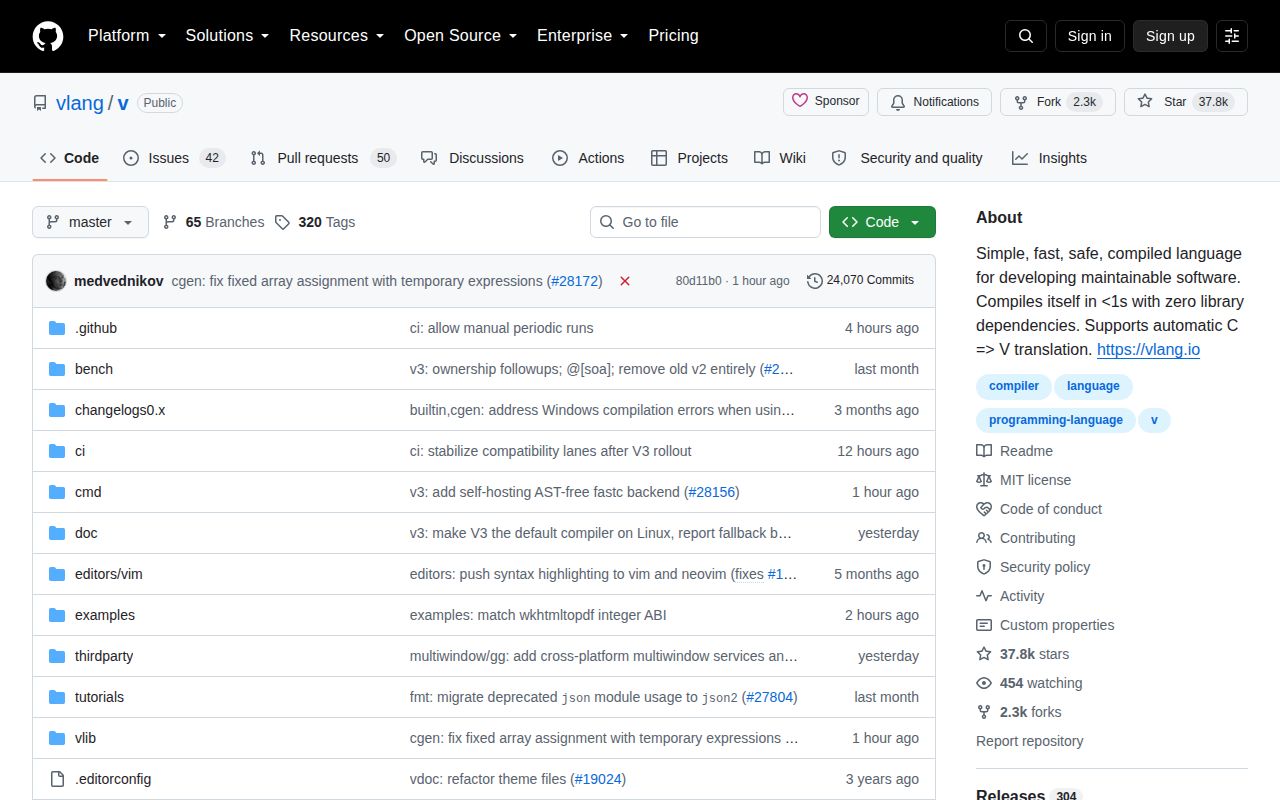
The repository was pushed on August 25, 2026, and the recently updated queue includes compiler fixes, networking work, ORM changes, and HTTP/3 development. GitHub reported 92 open issues and pull requests combined. This is lively maintenance, with contributors working on both the compiler and bundled libraries. The MIT license is also uncomplicated for most commercial use.
Documentation covers far more than a toy language page. The README links a full language manual, changelog, compiler design notes, modules, installation discussions, editor integrations, and platform-specific instructions. Still, built-in breadth does not guarantee the depth of mature third-party ecosystems. Before choosing V, inspect the exact database driver, protocol client, observability library, and deployment target your product needs. A built-in web framework cannot substitute for years of production use in every surrounding library.
V is easy to admire and harder to recommend as an organizational default. Its unified tooling and readable C output make small utilities, experiments, and internal services sensible evaluation targets. Pin the compiler commit, keep upgrade work explicit, test every supported platform, and retain the generated C when diagnosing failures. If those conditions feel excessive, Go, Zig, or Rust offers a clearer trade depending on whether the priority is stability, low-level control, or compile-time safety.