Confirm the device before choosing a binding
Uzu's application interface is worth evaluating if you need model downloads and chat sessions on Apple devices, but this sandbox run did not establish a working integration. The public FAQ says only Apple Silicon on iOS and macOS is supported. Start by checking that your intended device fits that guidance.
Swift, Python, and TypeScript examples do not establish additional hardware support. The supplied evidence does not resolve deployment on Intel Macs, Windows, or Linux. Teams requiring those targets need further primary-source confirmation before choosing uzu.
What happened when we ran it
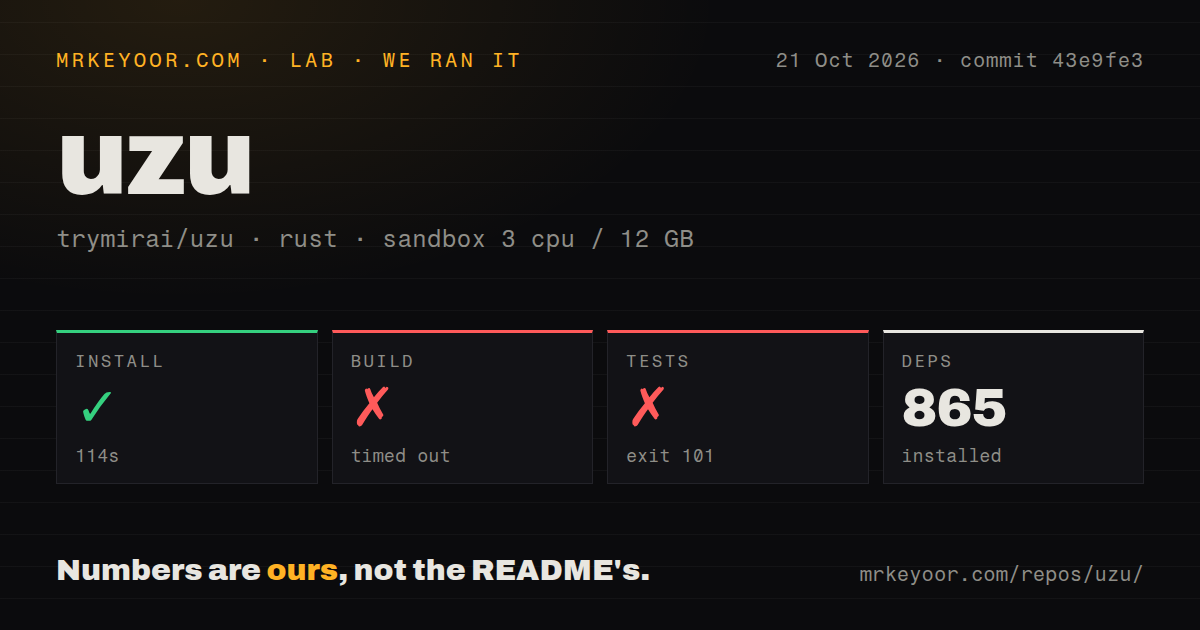
Our sandbox installed uzu commit 43e9fe3 in 114 seconds on 2026-10-21, recording 865 dependencies. Our uzu build timed out after 900 seconds. That establishes that the build did not finish within the allotted window; it does not establish whether a longer run would succeed.
The test step failed with exit code 101 after 779 seconds. Its tail reports that mirai-gui could not compile due to four previous errors. Those diagnostics are missing, so the supplied evidence cannot identify the cause. The unused rangemap dependency warning in uzu-engine is separate from the reported compilation failure.
The recorded configuration had 3 CPUs, 12g RAM, and image label lab-rust:1. The image label establishes neither the operating system nor the Rust version. The checkout contained 2,015 files, approximately 170,520 source lines, and 19.5 MB. The scan found six CI workflow files, no Dockerfile, and no tests directory. The absence of that directory does not establish the absence of tests alongside Rust source files.
No passing-test total or inference-speed measurement is supplied. The result leaves source validation unresolved and does not demonstrate that an application using a supported binding on Apple hardware is broken.
Check the model and memory requirements
The README examples look up a model, download it, create a chat session, and request a reply. They document the application workflow, but this run did not verify their output.
The README says uzu uses its own model format and directs developers to lalamo for export. Check the intended model before committing to the engine. A listed model is a starting point; conversion of an existing model collection needs its own validation. No conversion result is supplied here.
The README says a loaded ChatSession can serve multiple requests. It warns that each model may consume significant RAM and recommends keeping only one session loaded at a time. For iOS apps, it recommends the Increased Memory Capability entitlement. The sandbox's dependency count does not measure model memory on a device.
The local examples do not supply an OpenAI API key. The separate cloud-chat example does. Select the intended path when deciding which credentials the application needs and where inference happens. Network behavior in a running application was not measured here.
What the documentation establishes
Contributor setup recommends cargo tools setup to install missing dependencies, including Rust targets and the Metal toolchain. The README also lists examples for local chat, shared instances, structured output, and tool calls. Those examples provide evaluation routes; they are not successful lab results.
Documentation receives 3 out of 5 on this editorial onboarding rubric: 1 means no usable entry instructions, 3 means a documented starting workflow with important verification still outstanding, and 5 means a complete onboarding route whose prerequisites and examples this review has verified. The supplied README provides dependency instructions, chat examples, a model-format warning, and memory guidance. This review has not verified those examples or a complete device setup, so it does not award the higher score.
The supplied release record identifies version 0.6.11 on 2026-10-20. The sandbox tested commit 43e9fe3; its result should not be presented as a successful validation of that release. Repository metadata records a last push on 2026-10-21 and 24 open issues and pull requests combined. Those facts describe activity, not support quality or integration reliability.
Choose alternatives by the job
llama.cpp documents CUDA for NVIDIA GPUs and Metal for Apple Silicon. Consider it when those backend choices matter to your deployment. This review supplies no shared performance comparison with uzu.
MLX LM is a Python package for text generation and language-model fine-tuning on Apple silicon. Consider it for that Python workflow rather than treating it as an equivalent application-binding choice.
For an Apple app evaluation, confirm the device, select a compatible model, and reproduce one reply on the intended hardware. Retain the full compiler diagnostics if compilation fails. The supplied run leaves that integration check unfinished.