The current branch uses commercial terms
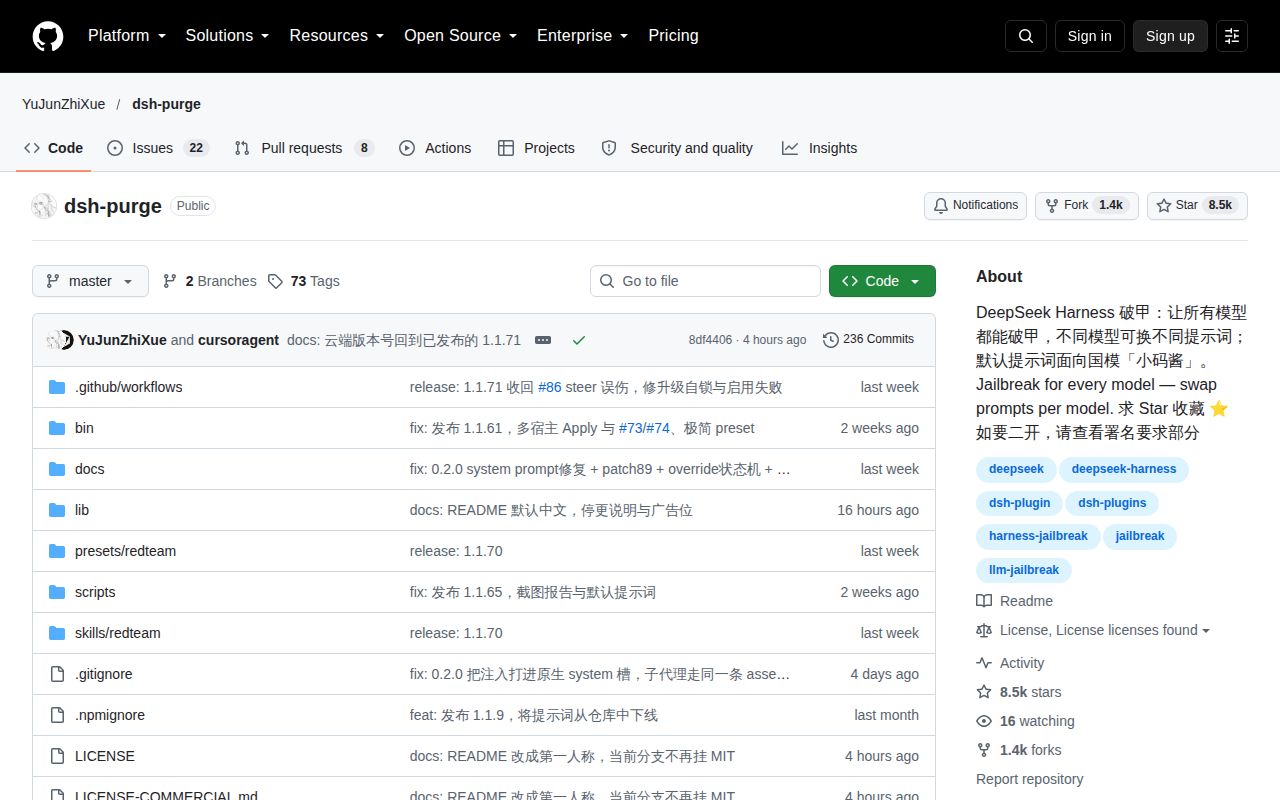
Before adding dsh-purge to DeepSeek Harness, decide whether its current license fits your use. The plugin changes local host policy and prompts for controlled security evaluation, and its current branch uses a proprietary commercial license. A public checkout should not be treated as permission to reuse it under MIT.
The author's current notice also says GitHub releases will stop from October 27, 2026, with later builds distributed through a Telegram channel. October 27 is an announced cutoff, still ahead of this October 19 review. For a team choosing a dependency, the combination of current commercial terms and a stated release-channel cutoff deserves attention before the small package footprint does.
What happened when we ran it
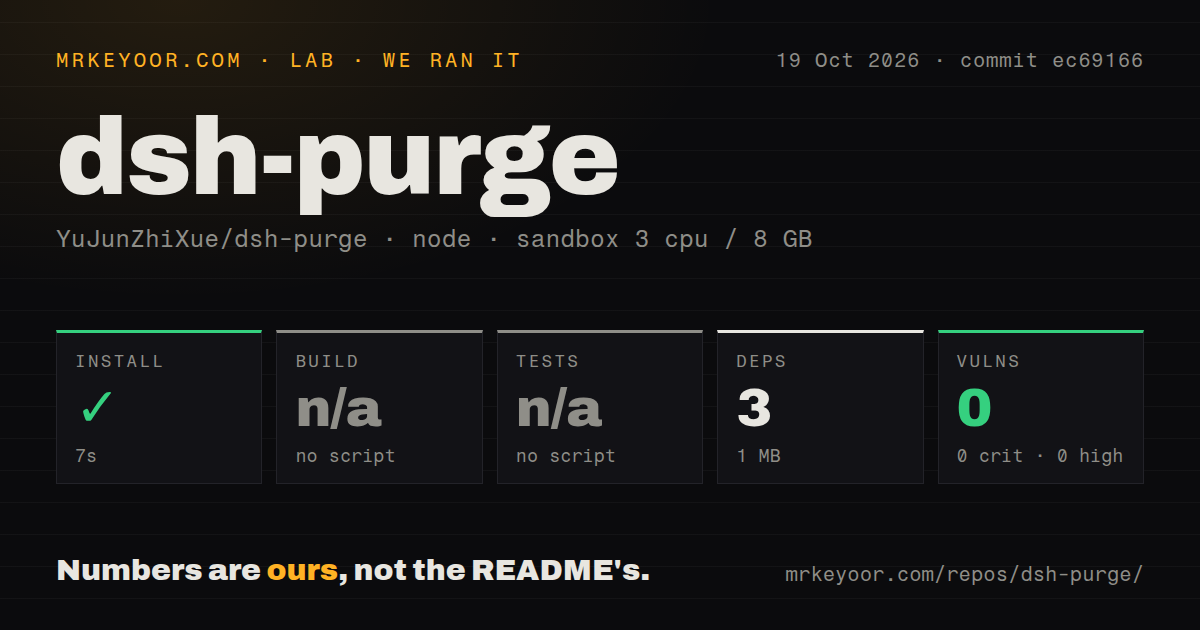
Our sandbox installed dsh-purge in 7 seconds, recording 3 dependencies and 1 MB on disk. At commit ec69166 on October 19, 2026, the lab recorded no build script or target and skipped the build step. It likewise recorded no test script or target and skipped tests. Npm audit reported 0 known vulnerabilities, with 0 critical, high, moderate, or low findings.
The checkout contained 118 files and about 49,212 source lines, occupying 4.2 MB. The scan recorded one CI workflow file, no Dockerfile, and no tests directory. Our configuration specified 3 CPUs, 8 GB RAM, and the image label lab-node:22. That label alone does not establish the Node.js version actually used.
Installation succeeded, but the supplied run contains no result for loading the plugin into DeepSeek Harness, applying a patch, or restoring the host. The dependency audit also does not assess whether changed approval behavior suits your environment. Our evidence supports a small installation footprint. It leaves the plugin's defining runtime behavior unverified.
Host patching adds a compatibility boundary
The English README targets official DeepSeek Harness Web and desktop hosts on the dsh 0.2 line. It tells users to keep the two profiles separate. Adding the plugin to a profile does not itself patch the host: changes are written by its Apply action, with a restart and a new conversation needed for the documented session behavior.
That distinction matters when evaluating a prompt change. The project describes both host-policy patches and session prompt injection. A result obtained with those changes combines model behavior with a modified Harness environment. If your question is whether the unmodified host permits an action, this plugin changes the thing you are trying to assess. Keep the baseline host and modified host distinguishable in any evaluation record.
Compatibility is a present concern. Open issue 142 reports an unsuccessful application on Harness 0.2.1-rc.2, with a message saying changes did not reach all hosts and the restart was cancelled. This is a user's report, not a failure reproduced by our sandbox. It concerns the plugin's advertised Apply path, so it is directly relevant to adoption. The report does not establish a cause or show that every installation fails.
Approval changes disqualify it from some agent environments
The README describes modifications to permission policy and tool limits, alongside a prompt editor and rule sets. That is a reason to keep dsh-purge away from an environment whose purpose is to preserve the official host's default approval behavior. Teams evaluating their own policy need to know which layer produced an outcome, especially when a tool can act on the same machine that hosts the interface.
The stated scope is local official Harness software and controlled evaluation. The README says community Desktop is not maintained, and older Harness lines need matching older plugin versions. A team using an unofficial desktop wrapper or automatically tracking host releases should choose another approach unless it can own the compatibility work. Our package installation supplies no evidence that those combinations work.
Personal use and redistribution need different decisions
The current license permits personal installation of a copy already obtained, while describing restrictions on resale, courses, white-label distribution, and public source redistribution. These are the author's published terms. The English README separately distinguishes earlier MIT tags from the current branch. Do not assume the current archive carries the same terms as an older copy just because both use the dsh-purge name.
For a company building a product around the plugin, that distinction is enough to stop automatic adoption and review the exact artifact's license. The announced October 27 distribution change also affects how you would pin and retrieve future versions. Continued personal use of an existing copy and a dependable public release process are separate requirements. The author's notice addresses the former without promising the latter.
Promptfoo and garak fit evaluations outside this host
Promptfoo is a CLI and library for evaluating and red-teaming LLM-based applications. Choose it when your main need is an evaluation workflow across application prompts and model configurations. Garak is an LLM vulnerability scanner that probes for unwanted behavior, including data leakage and prompt injection. It fits an evaluation centered on model or dialogue-system responses.
These alternatives address related evaluation work. Neither is presented here as a replacement implementation of dsh-purge's local Harness patches. We have no comparative effectiveness result. If you specifically need to inspect modified Harness behavior, evaluate that narrow requirement with a disposable host and recorded configuration. If you simply need an LLM evaluation tool, start with the project built around that job.
October activity precedes an announced GitHub cutoff
GitHub recorded the last push on October 19, 2026, and issue 142 was updated that day. The repository is active, with a current compatibility report and an explicit notice about future distribution. Calling it abandoned would miss those facts. Calling it a stable open-source dependency would also mislead a reader.
I would reserve dsh-purge for engineers investigating their own supported Harness installation who accept its current terms. For a new shared evaluation pipeline, choose a tool whose release and licensing model you can keep using. Resolve host compatibility and retrieval of the exact artifact before spending time on the prompt editor.