mrkeyoor.com_
Mon 19 Oct 14:08 UTC
LLM Toolsevaluationupdated 19 Oct 2026

AIStudio2API review

AIStudio2API is a Go proxy that translates Google AI Studio's web protocol into OpenAI, Responses, Anthropic and Gemini-compatible APIs. Its documentation describes account import, saved Google login state and a management interface. These are documented capabilities; the supplied sandbox run measured installation, build and test outcomes.

Verdict

AIStudio2API is a candidate for a controlled trial when an AI Studio web-protocol bridge is specifically required. commit a784c51 built in 6 seconds, but its test command failed after 60 seconds, with 6 passed and 4 failed in the supplied summary. The v0.2.13 release page identifies the same commit. Adoption still requires checking account-policy fit, investigating the failures and validating the intended authenticated client conversation. Build chat also requires accepting the upstream coding assistant's system prompt.

We ran it

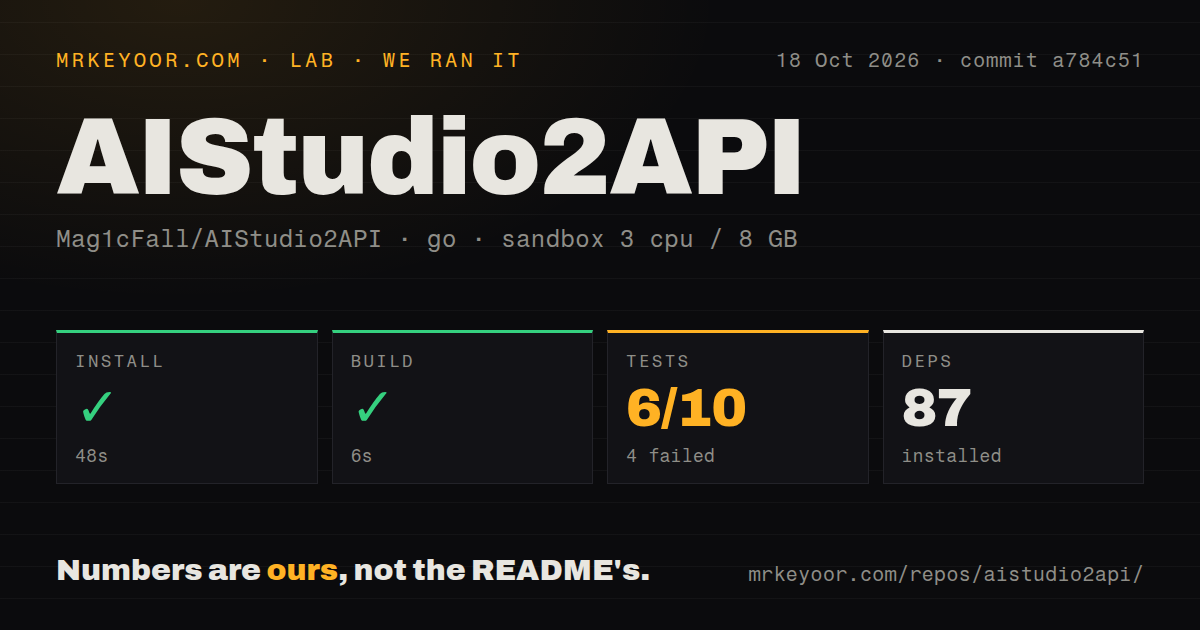
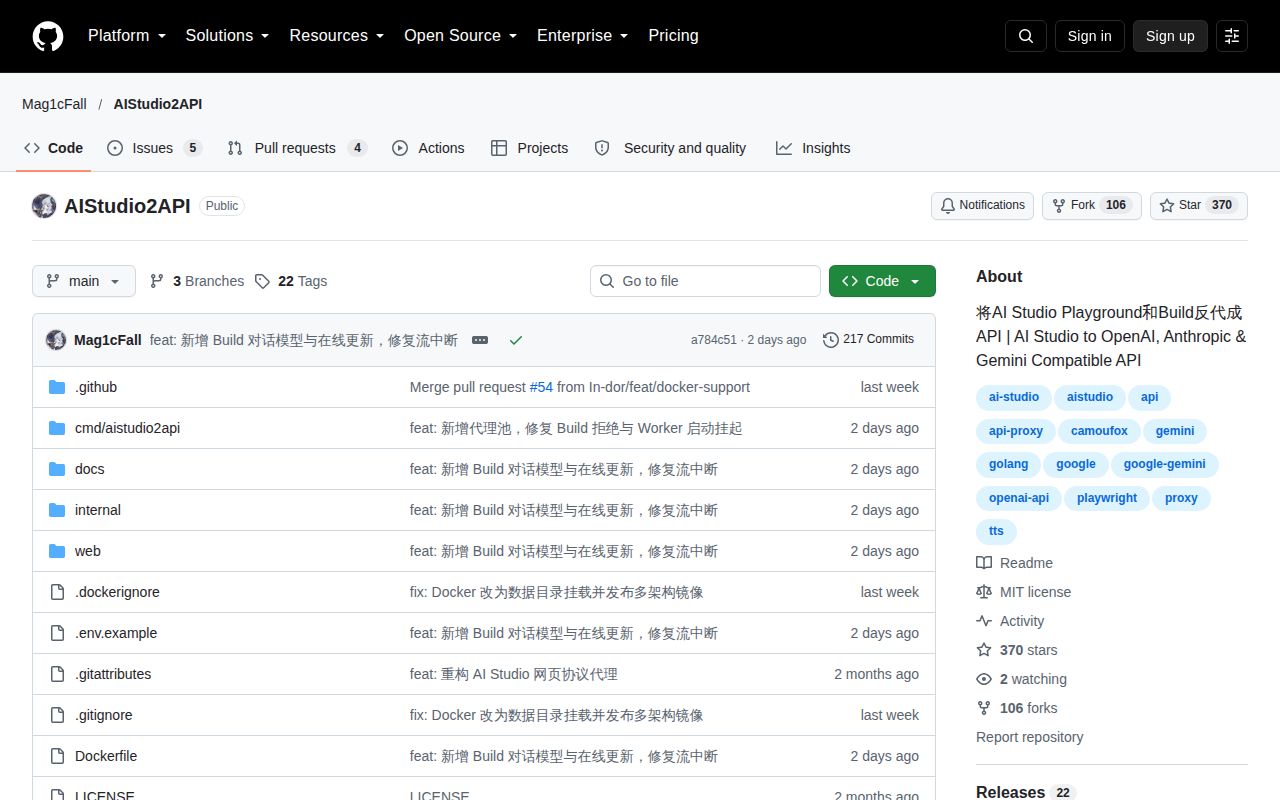
Lab card: what happened when we ran AIStudio2APIScreenshot of AIStudio2API (github.com/Mag1cFall/AIStudio2API)
Install✓ · 48s87 packages
Build✓ · 6s
Tests✗ · 60s6 passed · 4 failed of 10 (go test)
Repo389 files~129,002 lines of source · 9.6 MB · 1 CI workflows · Dockerfile

Answers from our run

Does AIStudio2API build from source?

Dependencies installed in 48 seconds (87 packages), and the build succeeded in 6 seconds. We cloned commit a784c51 into a clean Debian container with 3 CPUs and no project-specific setup.

Do AIStudio2API's tests pass?

No. The project's own test command finished in 60 seconds and reported 6 passed, 4 failed (go test).

Who should not use AIStudio2API?

Teams whose account policies prohibit the documented Google Drive authorization or saved Google login state.

What are the alternatives to AIStudio2API?

LiteLLM, CLIProxyAPI. AIStudio2API is a candidate for a controlled trial when an AI Studio web-protocol bridge is specifically required.

SetupN/AInstallation and build succeeded, but account onboarding was not reproduced and the test command failed; a complete setup-ease rating is unsupported.
DocsN/AThe supplied README supports specific setup instructions, but their completeness and correctness across documented installation routes were not verified.
CommunityN/ARepository and issue metadata do not establish support responsiveness or contributor capacity, so a numerical community rating is unsupported.
MaturityN/AThe recorded suite failure is a concrete limitation, but authenticated operation, upgrade reliability and production behavior were not assessed.

Who it’s for

Developers who specifically need an AI Studio web-protocol bridge for an existing model client.
Operators prepared to manage saved Google account state and configure administrator and API access separately.
Agent-client users willing to check their intended model, channel and tool conversation before adoption.

Who it’s NOT for

Teams whose account policies prohibit the documented Google Drive authorization or saved Google login state.
Applications requiring sole control over the system prompt when using Build chat models.
Operators expecting the pure-Go runtime option to establish that browser-based account onboarding is unnecessary.
Evaluations requiring a passing complete test command: the measured checkout did not meet that requirement.

Setup reality

The supplied sandbox run installed commit a784c51 in 48 seconds, recording 87 dependencies, and built it in 6 seconds. The test command failed with exit 1 after 60 seconds. Its summary reports 6 passed and 4 failed out of 10. The log tail names internal/app and internal/webui setup failures and TestUserCacheRootWithoutEnvironment, without the details needed to diagnose their causes.

The README documents saved Google account state and Google Drive authorization during login. Its Docker instructions require PROXY_API_KEY when the port is reachable from other machines, and ADMIN_AUTH_ENABLED=true plus a console password for management access from outside the container. Source setup includes frontend and Go build steps; release packages include the management interface.

Camoufox is the documented default backend. The pure-Go option avoids downloading or launching a browser at runtime, while the documented Linux and macOS login route uses isolated Camoufox. The supplied v0.2.13 release page identifies a784c51, matching the measured checkout. The run does not establish release-package behavior or successful authenticated client conversations.

AIStudio2API's Build chat models carry the upstream coding assistant's system prompt. The English README says that prompt shapes the answer's style, format and persona. If your application needs control over those behaviors, this is an adoption constraint even when the request format matches your client.

What the proxy connects

AIStudio2API's English README describes a Go service that converts Google AI Studio's web protocol into OpenAI Chat Completions, OpenAI Responses, Anthropic Messages and Gemini GenerateContent interfaces. It also documents streaming, tool calls and agent clients including Claude Code. Those are project claims, rather than authenticated compatibility results from the supplied run.

This review is for developers who already want AI Studio as their upstream. The decision involves more than selecting an API format: the documented setup saves Google account state, and Build chat introduces an upstream prompt that your application does not solely control.

What happened when we ran it

The supplied sandbox run installed AIStudio2API commit a784c51 in 48 seconds and built it in 6 seconds on October 18, 2026. Installation recorded 87 dependencies. The test command failed with exit 1 after 60 seconds; the supplied summary reports 6 passed and 4 failed out of 10.

The log tail names setup failures in internal/app and internal/webui, plus TestUserCacheRootWithoutEnvironment under internal/aistudio. It also includes successful package results for internal/api, internal/camoufoxnative, internal/config, internal/proxydial, internal/requestdb and internal/setup. The summary does not establish ten individual test assertions. The excerpt omits the underlying setup errors and the cache test's assertion details, so it cannot establish their causes.

The recorded sandbox configuration was 3 CPUs, 8g RAM and the golang:1.24-bookworm image label. The label does not establish the actual toolchain or operating-system version. The checkout contained 389 files, approximately 129,002 source lines and 9.6 MB. The scan found one CI workflow, a Dockerfile and a Compose file, with no tests directory; the test log nevertheless shows tests in internal packages. Installed disk footprint and vulnerability results were not measured in the supplied record.

Account setup and access controls

The documented login reads the Google email from AI Studio, authorizes Google Drive and saves the account under the path configured by AISTUDIO_AUTH_STATES. Organizations should check whether that account access and persistence fit their policies before onboarding an account. Treat the saved state as a credential.

For Docker, the README says to set PROXY_API_KEY when the port is reachable from other machines. Opening the console from outside the container requires ADMIN_AUTH_ENABLED=true and a console password; the documented default username is admin. These instructions distinguish access to the proxy API from access to account management. They do not establish a passwordless management default.

The browser boundary depends on the operation

The README names Camoufox as the default backend. With WAA_BACKEND=go, it says no browser is downloaded or launched at runtime. Its Linux and macOS account-setup instructions still use an isolated Camoufox login. Windows also has a documented local Chrome account-import route. Choose an onboarding route separately from the runtime backend.

Source installation includes frontend dependencies, a frontend build and a Go build. The README lists Go 1.26.0+ and Node.js 22.13+ or 24+ for source builds. These documented requirements should not be confused with the sandbox image label or treated as toolchain versions verified by the run.

Build chat limits prompt control

Build chat models include the upstream coding assistant's system prompt. The README explicitly warns that it affects answer style, format and persona. Applications with strict output or identity requirements should evaluate the selected Build chat model against those requirements.

The supplied v0.2.13 release page identifies a784c51, matching the measured checkout. It therefore provides no basis for treating that release as a later fix for the observed test failure. Release packaging and authenticated operation were not tested in the supplied run.

When to consider another proxy

LiteLLM provides a Python SDK and an AI gateway. Consider it when your requirement is direct library integration or a centralized gateway across model providers.

CLIProxyAPI provides compatible API interfaces for multiple CLI accounts. Consider it when you need an endpoint serving several account-backed CLI integrations. Neither alternative was measured in this sandbox run, so this comparison concerns documented scope rather than tested reliability or performance.

For an AIStudio2API trial, first review the account permissions and investigate the recorded test failures. Then check one complete conversation through your intended client, account, model and channel, including a tool call and its continuation. That is a proposed next check, not a result established here.

Alternatives

ProjectWhat it isPick it when
LiteLLM gh↗A Python SDK and AI gateway for model-provider integrations.Consider LiteLLM when you need direct Python integration or a centralized gateway across model providers. Its reliability and performance were not assessed in this run.
CLIProxyAPI gh↗A proxy providing compatible API interfaces for multiple CLI accounts.Consider CLIProxyAPI when you need several account-backed CLI integrations behind an endpoint. Its reliability and performance were not assessed in this run.

What people are saying

  1. [github-trending] Mag1cFall/AIStudio2API

Sources

  1. AIStudio2API English README
  2. AIStudio2API repository metadata
  3. AIStudio2API v0.2.13 release
  4. AIStudio2API recent issues and PRs
  5. LiteLLM README
  6. CLIProxyAPI README

More llm tools reviews

GLM-5.3-Flash-EXL3-2x-DGX-Sparks-TensorFold · livenerf · scion · opencode2api · IQuest-Q1 · iCode · the whole board →