A guide, not an AI learning application
Up began in 2017 as a Chinese guide to learning English. It now covers a much wider brief: lifelong learning, using AI without handing over judgment, completing small projects, entrepreneurship, personal review, and recovery after difficult periods. The author, Han Xiankai, mixes researched guidance with his own work and life history, and labels the repository as an open-content project rather than OSI-approved open-source software.
That identity matters. Nothing here will remember your lessons, grade an answer, or select a course automatically. The main mechanism is a written loop: find a problem, learn, use AI, finish a real task, save evidence, then review what transfers. The repository supplies essays and templates that help a reader run the loop. You supply the goal, the work, and the judgment.
The primary material is Chinese. An English edition of the main guide exists and covers the same broad method, including its disclosure of the author's company role and its boundary between research, experience, and hypotheses. English readers should expect rough navigation and less dependable coverage beyond that main entry point.
What happened when we ran it
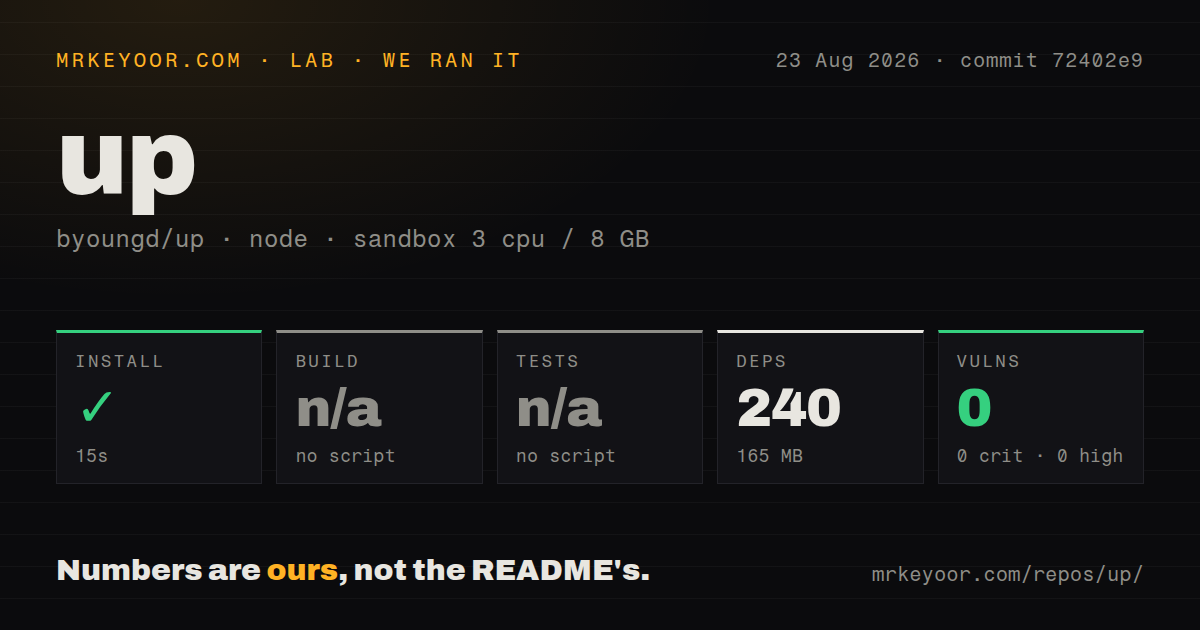
Our sandbox cloned commit 72402e9 into an unprivileged Debian container with 3 CPUs, 8 GB of RAM, no secrets, and the Node 22 Bookworm image. The checkout had 158 files, about 844 lines of source, and occupied 5.8 MB.
Npm installed 240 packages in 15 seconds and used 165 MB on disk. Npm audit found 0 known vulnerabilities: 0 critical, high, moderate, or low. The harness found no standard build script or target, so it skipped the build. It also found no standard test script or target and skipped tests. The repository does contain a tests directory and three CI workflow files, but those signals are not substitutes for a test result.
There is a platform mismatch worth separating from the measurement. The current package file declares Node 24, while our container used Node 22. Installation success therefore shows that npm resolved and placed dependencies; it does not prove the supported local documentation site runs correctly on that older runtime.
The learning-state template earns its place
The strongest page is a plain Markdown template. It asks for a real setting, a 12-week outcome, the current week's focus, and a definition of done. Below that sit the current baseline, completed work with evidence, an error table, methods that have worked under stated conditions, hypotheses to test, and one next task. This is mundane in the best way. A learner can copy it into private notes and use it tomorrow.
A companion prompt tells an AI assistant to summarize that saved state, flag conflicts, and design one exercise around the next small task. It explicitly says the assistant should not pretend to remember prior conversations. At the end, the assistant produces four updates that can be pasted back into the file. This is a sensible answer to the context-window problem raised in issue #190: keep durable state under the learner's control instead of trusting one ever-growing chat.
The guide also warns against storing passwords, identity documents, exact addresses, medical details, or another person's private information in the learning file. That advice is easy to overlook when an AI chat becomes a diary. Here it is placed beside the template rather than buried in a policy page.
Breadth helps some readers and loses others
English learning remains the most course-like area, with pages on CEFR goals, vocabulary, listening, reading, speaking, writing, and AI-assisted study. The newer material is less linear. It moves through project work, model access, business validation, failed software, relationships, health disruption, and rebuilding daily routines. Readers who connect with the author's experience may find the mix honest and useful. Someone seeking a neutral syllabus may find it distracting.
The recovery writing is careful about its limits. It recommends shrinking the day to manageable actions and asking trusted people for help, then directs persistent hopelessness or dangerous thoughts toward qualified local care. It does not present an inspirational story as treatment. Still, this is one person's account, not a clinical resource.
The entrepreneurship material has a similar boundary. The author names his company relationship and says product or revenue claims need evidence. The repository's licensing page also separates the work cleanly: prose and original media use CC BY-NC 4.0, site code uses MIT, and third-party material keeps its original rights. Commercial training teams should review that noncommercial content license before adapting pages.
English access is the weak spot
On August 24, 2026, the project's scheduled external-link checker opened issue #193. Its report included missing local English routes and a 404 for byoungd.github.io/up/en/. Some reported failures were external sites rejecting automated checks, which is different from a broken source. The missing English pages and project-owned 404 are direct maintenance problems.
The English Markdown remains readable inside GitHub, so the material is not absent. The failure mainly damages navigation and confidence in the hosted edition. A reader following links from the English overview may land on paths that do not exist. For a guide built around evidence and repeatable work, fixing those first-party links should outrank adding another reflective section.
Activity is current. The repository was pushed on August 24, 2026, and issue #190 received replies during August. GitHub listed 31 open issues and pull requests combined. There is no latest GitHub release, so consumers cannot use release tags to identify a settled edition.
Up works best as a set of prompts and templates to borrow selectively. Start with the learning-state page, try it for one week, and keep only the parts that improve your actual output. Choose OSSU, The Odin Project, or Microsoft's AI curriculum when you need someone else to define the subject and lesson order.