Two agent products share one 192,860-line repository
Agent TARS and UI-TARS Desktop solve related but different problems. Agent TARS runs through a CLI or Web UI and combines vision, browser control, shell-like tools, an event stream, and MCP servers. UI-TARS Desktop is an Electron application tied to UI-TARS and Seed vision-language models for local computer and browser operation. The shared repository makes components reusable, but buyers should pick a product first. Installing the whole monorepo to discover which one was intended is the expensive route.
Agent TARS is the broader development stack. Its browser agent can use visual grounding, the DOM, or a hybrid approach, and its kernel is built around MCP while allowing extra MCP servers. The CLI requires Node 22 or newer and accepts provider, model, and API-key settings. UI-TARS Desktop provides the native control surface. It needs a provider mode whose action parser matches the chosen model, plus a base URL ending in the documented form, a model name, and usually a key.
One monitor and privileged input define the desktop limit
The desktop guide says UI-TARS currently supports only a single monitor and warns that multiple monitors may cause tasks to fail. On macOS, it also requires Accessibility and Screen Recording permissions. Those are powerful grants: the application can observe the screen and operate mouse and keyboard input. A model mistake can therefore act inside whatever account and applications the user exposes. Start with a separate operating-system profile, test accounts, and no stored payment or administrator credentials.
Browser Operator requires Chrome, Edge, or Firefox. The old Remote Operator path is no longer a shortcut: the quick start says its hosted service was discontinued on 2025-08-20 and directs users toward self-hosting or Volcano Engine services. The README's older announcement still describes remote operation as free and configuration-free, so the dated quick-start notice is the fact to follow. Local use also means arranging a UI-TARS-compatible vision endpoint through Hugging Face, VolcEngine, or another documented deployment.
What happened when we ran it
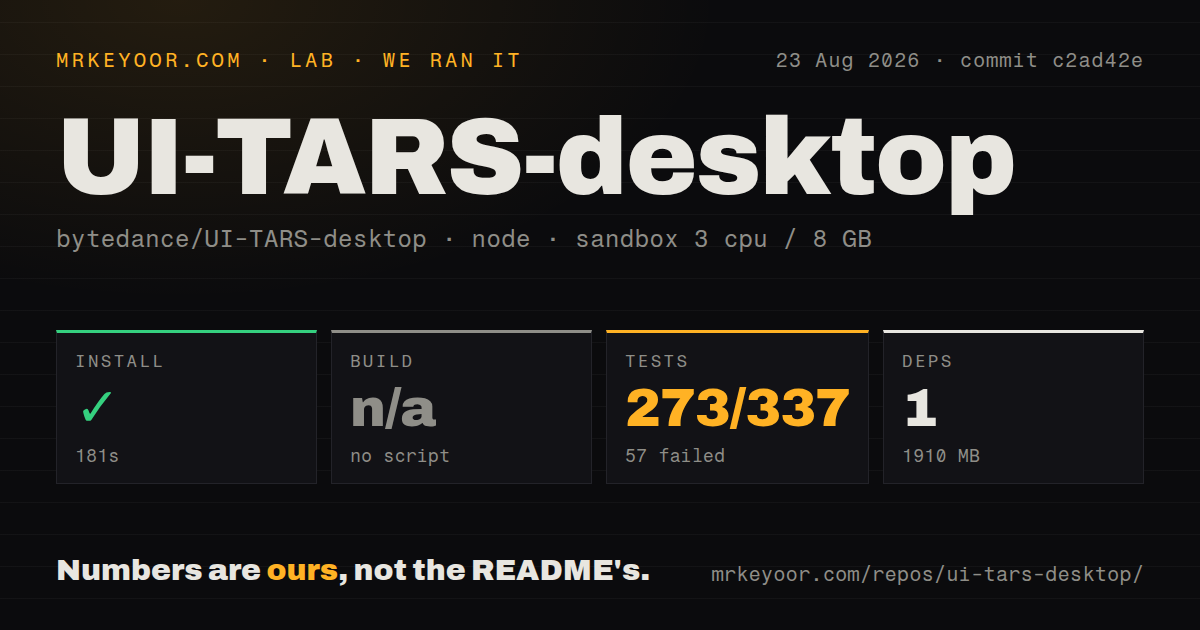
Our pnpm install at commit c2ad42e took 181 seconds. The installer reported 1 package installed, while the workspace consumed 1,910 MB on disk. The checkout contained 2,491 files and about 192,860 lines of source, organized as a monorepo with workspaces. The root package had no build script or target, so the lab skipped build rather than selecting one application on the project's behalf. It had 8 CI workflow files and no Dockerfile or root tests directory.
Vitest ran for 16 seconds and exited with code 1. It reported 273 passed, 57 failed, and 7 skipped out of 337 tests, spread across 10 failed and 24 passed test files. The displayed final assertion expected page content to contain Tab Management Test Home; the actual value is outside the supplied tail. The log ends with ELIFECYCLE Test failed. We cannot tell from that excerpt how many failures share that cause or whether external services were expected.
Fifty-seven failures rule out unattended trust
A GUI agent must do more than return plausible text. It must know whether an asynchronous click finished, whether a browser tab contains the intended page, and whether a tool call partly succeeded. Open issue #1952 says the ADB operator can report success before asynchronous actions finish. Issue #1951 describes a streaming startup failure leaving the exclusive agent server busy. A separate Windows issue reports a crash with a custom API endpoint. These are concrete control-loop failures, not cosmetic roughness.
The security history deserves attention too. Release v0.3.0 included a fix removing a development setting that omitted MCP authentication and was described as an RCE vulnerability. Open pull requests in August 2026 address request-body injection into agent constructor options and HTML previews escaping their iframe sandbox. A fix in a pull request is not necessarily in the release a user downloaded. Keep the agent server private, authenticate tool endpoints, and verify the exact commit or release containing any required security patch.
v0.3.0 is active, but the desktop guide lags
The latest GitHub release is v0.3.0 from 2025-11-04, while the repository was pushed on 2026-08-05. GitHub showed 426 open issues and pull requests combined. August activity includes browser search limits, streaming tool calls, Windows endpoint handling, data uploads, and security fixes. This is active work across a very broad stack. The backlog and fast-moving packages make release pinning and task-specific regression tests more meaningful than the star count.
UI-TARS-desktop is compelling research software because it joins perception, planning, browser state, and physical input in one public codebase. It is a harder operational purchase. The 57 failed tests, 1,910 MB workspace, single-monitor restriction, discontinued hosted operator, and open control-loop bugs all point the same way: evaluate it inside a low-value environment. For production browser automation with a narrow workflow, a browser-only project is easier to constrain.