This script provisions accounts, not a local AI service
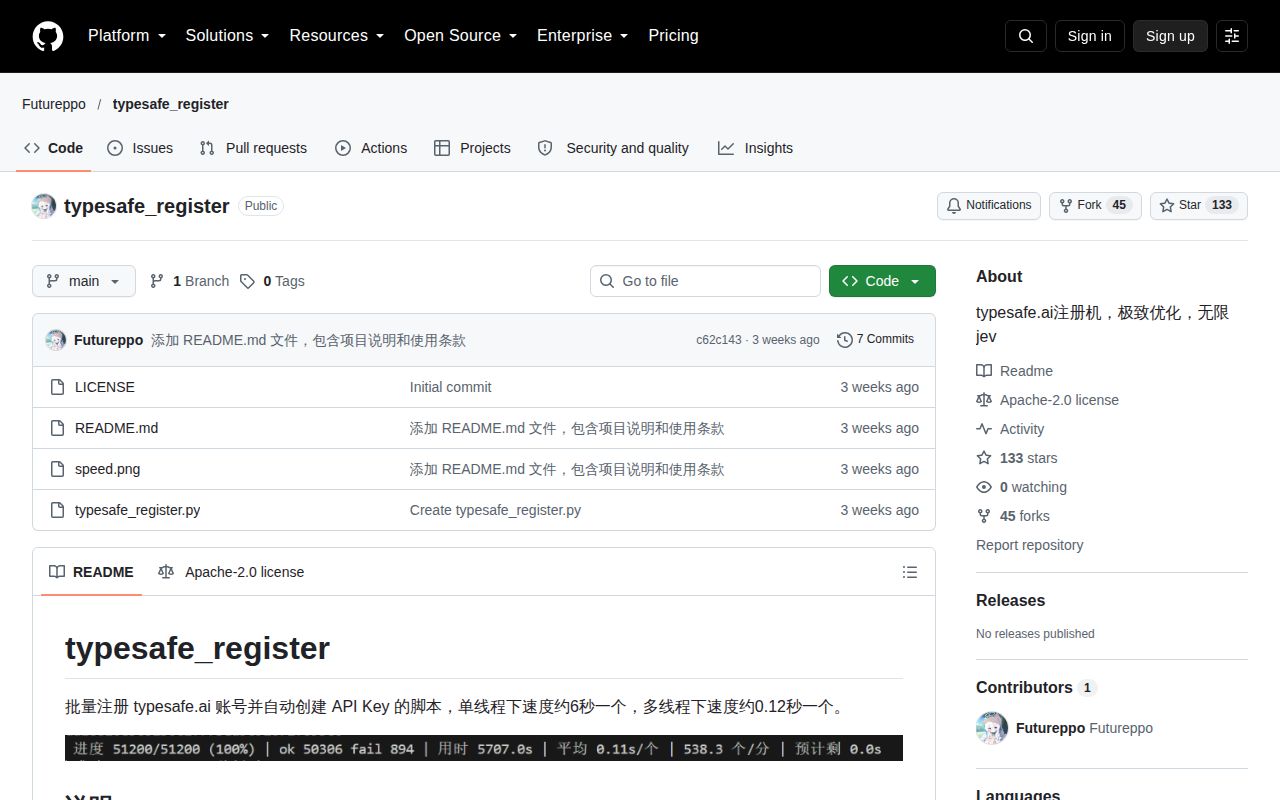
Installing typesafe_register does not give you a model to run. The script creates accounts on typesafe.ai and requests API keys for them. Its README is in Chinese, with no English guide in the measured checkout. Anyone arriving from an assistant project that uses Jev should distinguish access provisioning from inference: this repository handles the former, while the useful model still lives behind an external service.
The checkout contained 4 files and about 381 source lines. That makes inspection feasible, but the README offers little help beyond its purpose, a warning about changing login parameters, and an Apache-2.0 license. I'd approach it as code to examine for an authorized research task. It isn't a sensible default for obtaining ordinary production access to a model provider.
What happened when we ran it
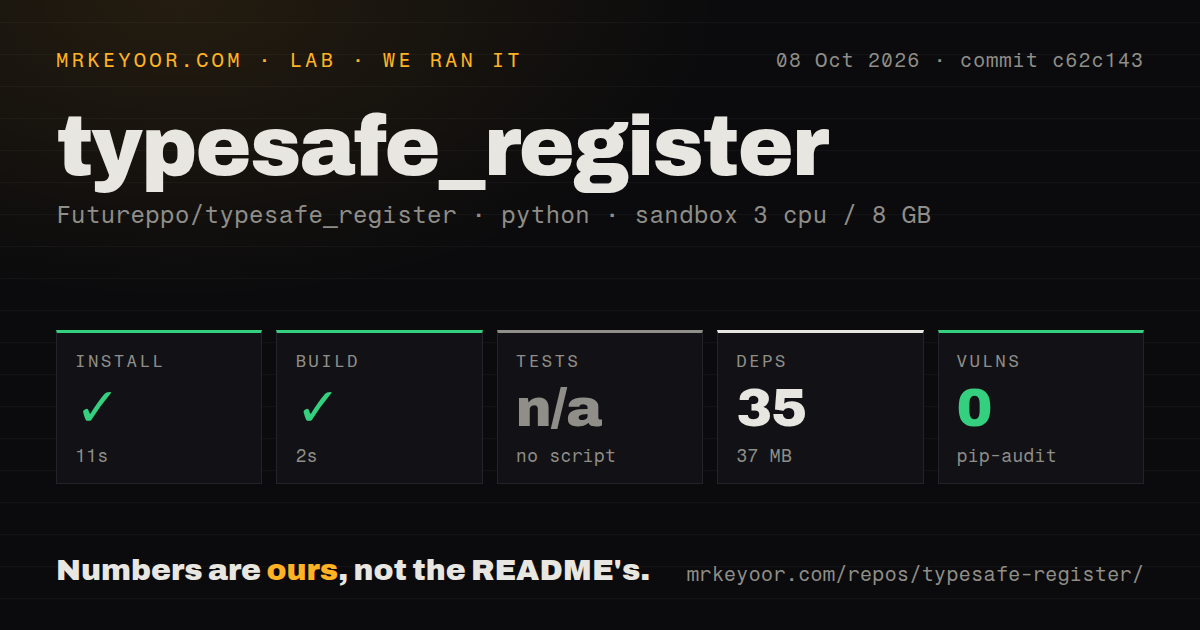
Our sandbox installed typesafe_register at commit c62c143 in 11 seconds, adding 35 packages and using 37 MB on disk. The build succeeded in 2 seconds. We used Python 3.12 on Debian on October 8, 2026, with 3 CPUs, 8 GB of RAM, no secrets, and no elevated privileges. These results establish that the harness could prepare and build the checkout.
Tests were skipped because the repo provided no test script or target. Pip-audit reported 0 known vulnerabilities, and the lab found no CI workflows, Dockerfile, or tests directory. Nothing in those results establishes that registration or API-key creation completed against the live service. The supplied measurements also contain no account-throughput result, so the README's speed claims don't enter our recommendation.
The missing mail configuration is the first practical obstacle
An 11-second install leaves the operational configuration unfinished. The source has blank settings for a temporary-mail service URL and its administrator token. It expects a particular mailbox API and mail response shape, then follows a login email before requesting a key. The README does not identify a ready-to-use mail service or explain how to supply one that matches those assumptions.
That omission changes the effort involved. A developer must understand the mail contract and the provider's login flow before the script can do its advertised job. A familiar Python environment is only the starting point. If your goal is to get a credential for an application, handling service access directly is easier to explain and maintain than taking responsibility for an undocumented mailbox dependency.
The login parser depends on a moving website
The 2-second build checks a different boundary from the one most likely to matter during use. The README warns that changes to encrypted login-page action parameters require capturing the requests again and updating the script. This is an explicit dependency on a web console's implementation, rather than a documented provisioning interface that an operator can treat as stable.
That warning is enough to reject it for unattended onboarding. A successful local build cannot detect a changed login form, a delayed email, or a service decision about account creation. An operator would need a way to recognize partial completion and decide whether another attempt is appropriate. The project supplies a script tied to the current flow, leaving the continuing relationship with that external service to you.
Account records contain usable credentials
The measured environment occupied 37 MB, but the more consequential local artifact is accounts.json. The source stores API keys and session cookies in account records and prints successful keys in console output. Those are inspectable code behaviors, not leak findings from our sandbox. Copying a terminal transcript or backing up the output directory would therefore require care with the credentials it contains.
The output is convenient for a researcher who needs to inspect what happened. It is a poor fit for a shared build runner or a workflow expecting a secret manager to own credential delivery. I wouldn't send this script's ordinary output into team logs unchanged. The lab's 0 known vulnerabilities describes the dependency audit, which cannot decide whether storing and displaying a credential matches your operating requirements.
There is no regression suite behind the passing build
Our run installed 35 packages successfully, yet no tests ran because no target was provided. That leaves a buyer without project-supplied evidence for error handling or compatibility with the mail and login services. The missing CI workflows reinforce that limitation. For code whose outcome is a usable external credential, the quality question starts after Python has accepted the source.
You can inspect the compact file and supply checks of your own, but that work belongs in the adoption cost. A partially successful batch needs a policy for keeping or removing accounts and protecting the records it leaves behind. The README also restricts its stated purpose to learning and research and asks users to follow the target service's terms. An open-source license does not promise permission to automate someone else's signup flow.
September activity gives little evidence of ongoing support
GitHub recorded the last push on September 21, 2026, and showed no open issues or PRs when fetched. The recent issue list contained a closed question about how to use registered accounts, without explanatory text. The latest-release endpoint returned no release. These facts describe a small support footprint, not proof of abandonment or proof that every user has succeeded.
For onboarding automation you control, Playwright for Python and Selenium are better foundations to consider. Both automate real browsers and let you write the workflow around your own application's contract. They do not supply TypeSafe signup as a ready-made feature. If you only need model access, use the provider's normal account and key controls. Take this repo on only when studying this particular flow is the task itself.