The server owns the shell, so the window can disappear
Closing tty7 does not have to kill the work inside it. A background server owns each shell and pane, while the desktop window reconnects to them. Supported coding-agent sessions can resume after a reboot. That is the useful distinction from a normal terminal with extra panels: persistence is part of tty7's process model, and the GUI is one client of that state.
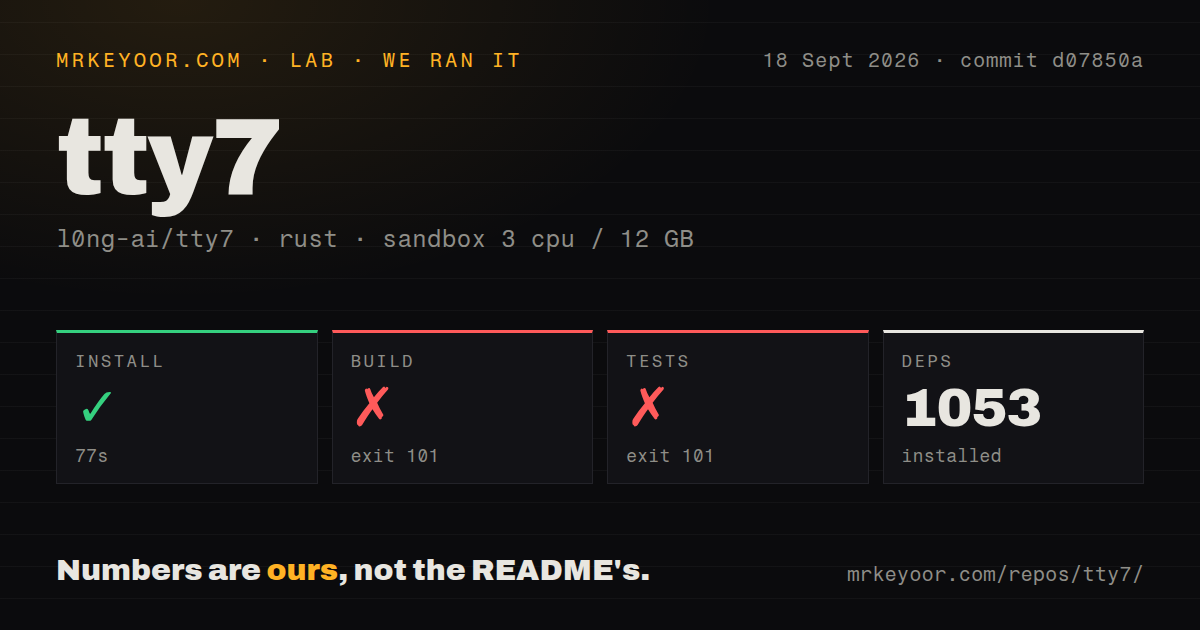
The scope is much larger than a terminal renderer. commit d07850a occupied 19.3 MB and contained 457 files with roughly 249,677 source lines. The app combines a GPUI desktop client, an Alacritty-derived terminal core, a CLI, and a server. Its repository had 3 CI workflow files, though our scan found no Dockerfile or tests directory. This is a young desktop system with several operating parts, not a small Rust utility.
Twenty-two agent CLIs get detection, while live status needs hooks
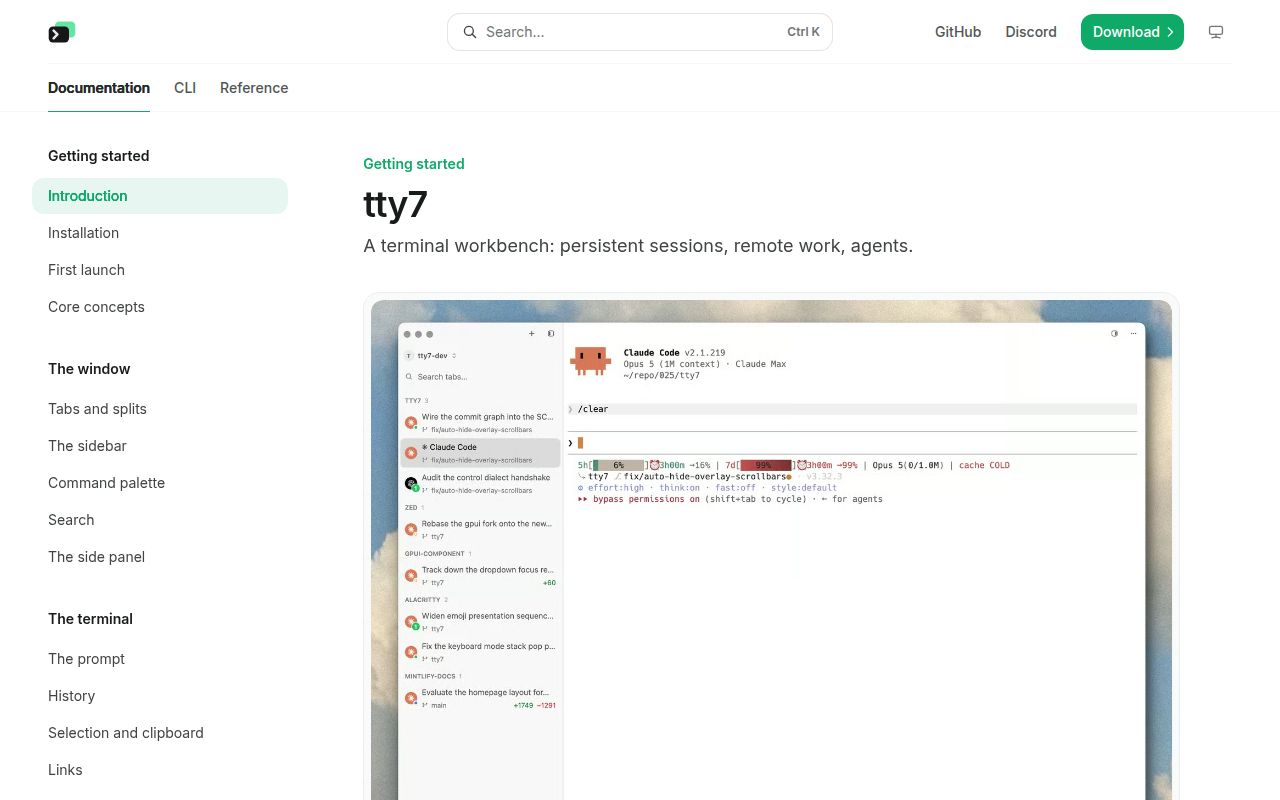
The README lists 22 recognized agents, including Claude Code, Codex, Gemini, Aider, OpenCode, and several newer CLIs. Basic detection reads the process in a pane and adds its name, repository, branch, and diff to the sidebar. tty7 does not proxy the agent. Each tool keeps its own terminal interface, which reduces the risk of an extra wrapper changing prompts or command behavior.
Working, waiting, and done states require a hook installed from Settings for each supported agent. That state feeds desktop notifications, the tray icon, and tty7 wait. The bundled CLI can split a pane, send a task, wait for a state change, and capture plain output. Those commands make agent handoffs scriptable, but they also add configuration outside tty7 itself. Against a checkout with 1,053 installed packages, hook ownership and upgrade behavior deserve the same attention as the GUI.
What happened when we ran it
Our sandbox installed 1,053 packages in 77 seconds. The build continued for 637 seconds before exiting 101. rust-lld reported that it could not find -lxkbcommon-x11, followed by a compiler error for the tty7-app binary. The log also recorded 25 warnings. We did not get a working binary from commit d07850a in this fresh, unprivileged Debian container.
Tests reached the same link boundary after 200 seconds and exited 101. The failing target was tty7-app in test mode, and the tail again names the missing xkbcommon-x11 library. It also shows 13 warnings. The log does not say why the library was unavailable, and it does not report completed test cases, so the defensible finding is limited: both build and test commands stopped at linking in our stated environment.
Prebuilt Linux packages avoid the source-build dependency list
The installation docs tell Linux source builders to install libxkbcommon-x11-dev alongside pkg-config, cmake, clang, X11, Wayland, font, SSL, zstd, and Kerberos development packages. That documentation is direct, and it names the library our linker could not find. Our run does not establish whether a listed package was missing, misconfigured, or unavailable to the build. It does show that a 637-second compile can end at a host-library check.
Release v26.9.2 supplies signed macOS disk images, Windows installers and ZIPs, plus a Linux AppImage and tarball. The AppImage bundles its X11, Wayland, xkb, and font libraries, so trying the released app is a different proposition from compiling the 249,677-line checkout. Source builds also do not self-update or replace the installed server, a detail that matters if both versions live on one machine.
Native SSH integrates well, with less OpenSSH compatibility
tty7 uses the Rust russh stack instead of launching the system ssh. That enables keychain-backed credentials, SFTP, jump hosts, port forwarding, and remote workspaces whose files and Git state remain on the remote host. The tradeoff is compatibility: the docs call support for ~/.ssh/config best effort, exclude Match, Canonicalize*, and GSSAPI directives, and say there is no system-client fallback.
Current defects touch the workflows tty7 sells most strongly. Issue 894 says Shift+Enter and Ctrl+J are ignored by native Codex on Windows v26.9.2, though it documents a Ctrl+Enter workaround. Issue 899 reports that a macOS pane lacks the editable Accessibility API role expected by dictation tools. Another remote-workspace report describes a server startup timeout after 15 seconds. In a project with 457 files and several platform paths, test your own shell, agent, and remote host before moving daily sessions.
September fixes show speed, while 51 open issues show breadth
GitHub recorded a September 15, 2026 push and 1,001 stars when checked. The tracker held 51 open issues and 2 open pull requests. Release v26.9.2 shipped on September 10 with sidebar groups, path-link handling, remote port work, and fixes for terminal input and display behavior. Recent issue-to-fix pairs also show maintainers closing reported keymap, cursor, theme, and notification defects within days.
That pace is reassuring, though the project was created only in July 2026 and its open reports span Windows input, macOS accessibility, SSH, remote recovery, and terminal rendering. Our 77-second install proves the Rust dependency graph resolves; the 637-second failed build says source readiness is host-sensitive. Try the prebuilt release beside your present terminal first. Move persistent work only after suspend, reboot, agent hooks, and SSH reconnection behave correctly on your machines.