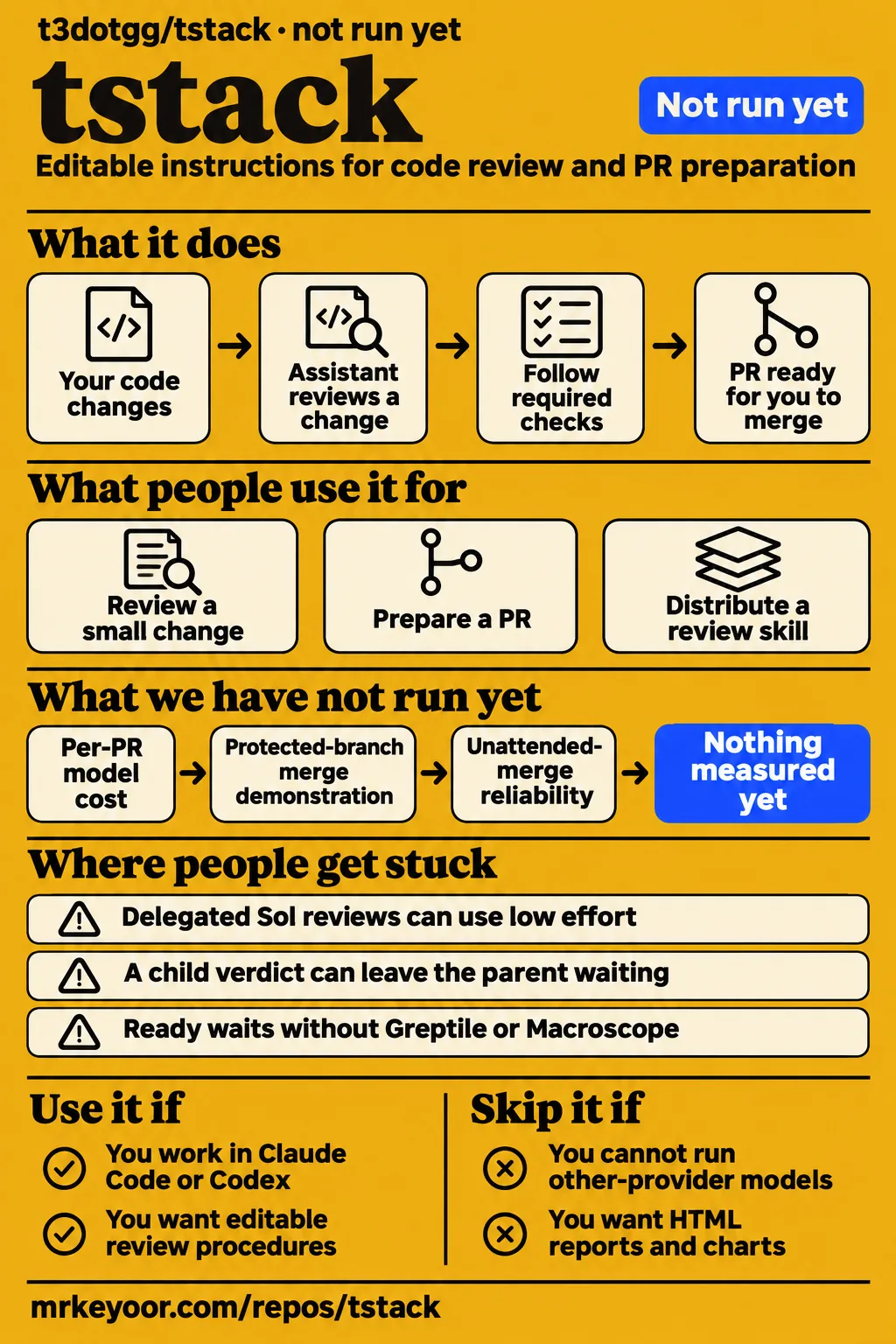
t3dotgg/tstack gives Claude Code and Codex editable instructions for reviewing changes and moving pull requests through CI to a merge. Use it when you want to maintain the procedure your existing assistant follows. Choose full-stop when a person owns the final merge decision. Reviewing a diff, preparing a PR and merging a branch grant different responsibilities, even when the workflows share instructions. That choice of authority is the main reason to inspect the individual skills before installing and invoking them.
Full-stop leaves the merge with a person
The README says full-stop follows full-send's workflow but stops when the PR is ready for you to merge. That endpoint suits maintainers who want help preparing a change while retaining the final decision. The collection also contains smaller tasks: sol-loop reviews a change with GPT Sol, council requests reviews from three models from different providers, and file-pr writes a short PR description that leads with the problem. tstack README and skill catalog
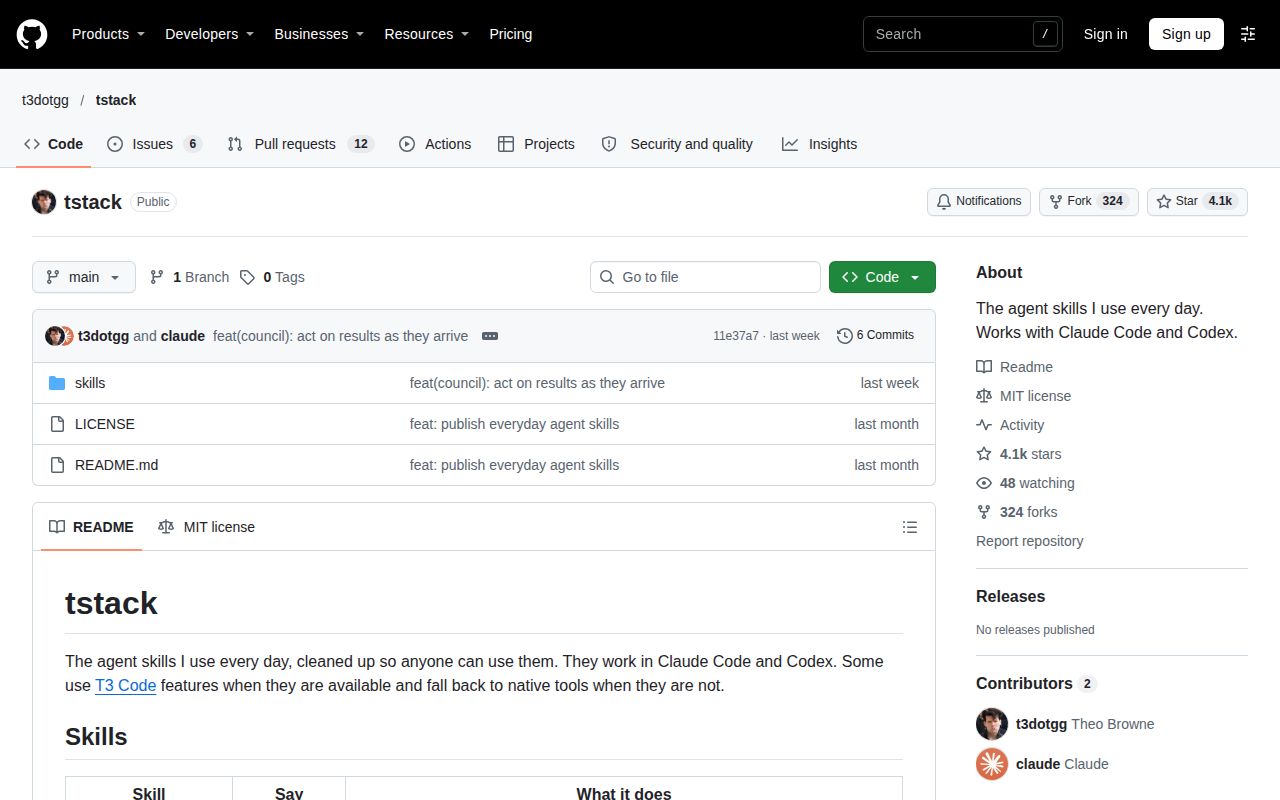
This review covers Theo's t3dotgg/tstack, whose files instruct coding assistants. The Next.js starter documented at doc.tstack.dev points to bity-labs/tstack, a separate repository. Its application setup commands belong to that project. Compare the repository owner when following a search result: the shared name can otherwise lead a reader from assistant instructions to a SaaS starter with an entirely different installation procedure. Separate bity-labs/tstack setup
What people use tstack for
Deduped reports that AI Code With used sol-loop for two review rounds in both Codex and Claude Code, and both caught an integer division bug. The supplied synthesis also describes selective installation in a shared repository and Theo's use while developing T3 Code. These examples illustrate three adoption choices: add a review pass, distribute a skill across assistants, or use the broader PR workflow. Deduped's usage reports
| Who used it | What they did | Reported outcome |
|---|---|---|
| AI Code With, reported by Deduped | Ran two sol-loop review rounds in Codex and Claude Code | Both caught an integer division bug. Deduped reports 62 seconds in Codex and 70 seconds in Claude Code after adding a Sol subagent. Two-round review report |
| GitHub maintainer @tyk-swe, reported by Deduped | Installed only sol-loop in .agents/skills with Claude Code and Devin symlinks | Made the skill discoverable by Codex, OpenCode, Claude Code and Devin, with a Reviewed with sol-loop note for pushed PRs. Shared-directory report |
| Theo, in the supplied walkthrough synthesis | Used sol-loop, full-send and full-stop while developing T3 Code | Reports that almost half his T3 Code threads use one of these skills. Theo's usage account |
The calculation example suggests a useful first exercise: request a review of a small change whose expected result you already understand. The shared-directory example shows how a maintainer selected one skill instead of adopting the whole collection. Both help answer a practical setup question: which procedure do you want your assistant to follow first? Starting with review gives you a concrete output to inspect before choosing a workflow with branch and merge authority.
What happened when we ran it
Our November 17, 2026 sandbox attempt at commit 11e37a7 stopped before executing tstack because the harness found no supported ecosystem and no Dockerfile. Our run recorded 3 CPUs, 8 GB RAM and image n/a, with Python as the language classification. The separate safety step failed its Compose prerequisite, and teardown recorded ok.
| Recorded item | Result | Meaning for this review |
|---|---|---|
| Execution | NOT RUN: no supported ecosystem, language classified as Python; no Dockerfile | The harness stopped before installation, build or tests |
| Sandbox configuration | 3 CPUs, 8 GB RAM, image n/a | These are the recorded sandbox settings |
| Hands-on safety step | FAILED: no compose.yaml, compose.yml, docker-compose.yaml or docker-compose.yml | The deployment runner required a Compose file and stopped |
| Cleanup | teardown: ok | The cleanup step completed |
The safety record labels the repository unsafe because its rule requires a Compose file. The explicit failure names the four missing filenames. The README describes a different setup procedure: copying skill folders into an assistant. The recorded outcome is therefore a failed runner prerequisite. It supplies a precise account of where the attempt stopped, rather than an observed security defect in the assistant instructions.
A separate hands-on entry says t3dotgg/tstack was deployed through its own Docker Compose on the lab server on November 17, 2026, with every port bound to 127.0.0.1. That entry contradicts the explicit missing-Compose failure and the harness's NOT RUN outcome. The execution result above follows those explicit failure records; the deployment entry remains identified as contradictory evidence.
Setup means configuring the assistant and its reviewers
The README requires an authenticated GitHub CLI and python3 for babysit-pr's pr-wait script. sol-loop and council also require subagents using other providers' models. T3 Code supplies that capability through delegate_task; another harness needs a way to run those models. The skill folders supply instructions, while the CLI, Python and model delegation supply tools the assistant uses to carry out those instructions. README requirements
The following commands are the README's documented installation example. Choose the destination for your assistant and inspect existing skill folders before copying. The dependency list matters when selecting a subset: full-stop uses full-send, and full-send uses sol-loop, file-pr and babysit-pr. Installing the top-level workflow therefore includes reading and supplying the skills it calls. README installation and dependencies
git clone https://github.com/t3dotgg/tstack
cp -R tstack/skills/* ~/.claude/skills/   # Claude Code
cp -R tstack/skills/* ~/.codex/skills/    # Codex
The README also lists dependencies for takeover, modernize and comment formatting. It recommends putting personal settings, such as council model choices, in CLAUDE.md or AGENTS.md so updates to the shared skills preserve those settings. This gives a maintainer two places to inspect: the shared procedure and the repository or personal instructions that configure its use. Read both when deciding which models and permissions the assistant will receive.
Where people get stuck: effort, waiting and bot selection
Issues #5, #8 and #7 report three distinct conditions: inherited model effort, an unfinished child turn and a watcher tied to particular bots. Diagnose the reported condition before changing configuration. A review using low effort, a visible verdict whose turn stays open and a ready condition waiting for a particular bot concern different parts of the workflow. Effort issue #5, waiting issue #8, watcher issue #7
| Report | What the reporter says | Workaround or proposed change | Status in the supplied record |
|---|---|---|---|
| Issue #5 | Claude Code delegating Sol review inside T3 can use the model's low default effort | Reporter suggests global instructions explicitly passing reasoningEffort: "high" | Open; reporter workaround |
| Issue #8 | A child prints a verdict but never ends its turn, leaving the parent waiting | Reporter proposes timed waits, reading the verdict, cancellation and a bounded retry | Open; proposed recovery procedure |
| Issue #7 | Default ready mode waits for Greptile or Macroscope | Reporter says --until green works when neither bot is installed | Open; automatic fallback proposed |
The #5 reporter describes gpt-6.1-sol's catalog default as low, compared with medium for gpt-6-sol. The report says T3 inherits options only for the same provider instance and model, so a Claude parent's effort does not carry into the Codex child. Its suggested workaround explicitly requests high effort through global instructions. This is the reporter's advice for the described delegation path. Issue #5 effort explanation
Issue #8 describes sol-loop at 7de017b, unchanged on 92e38e2, starting an asynchronous child and waiting for its completion notice. The reporter describes waits of 9 to 10 hours, five times in one night, when a child kept compacting after printing its verdict. The proposal uses 10-minute waits, reads the child for a verdict, and cancels after finding one. After 30 minutes without a verdict, it proposes one fresh round, then stopping and reporting. Issue #8 waiting report
Issue #7 reports both prolonged waiting and premature readiness. Without Greptile or Macroscope, the default ready condition can keep waiting; the reporter says --until green works. Reviews from other bots, including Codex and Copilot, do not control that condition, so ready can fire before they review the current head. The suggested changes are automatic fallback, discovering bots from review history or accepting a --bots flag. Issue #7 bot-selection report
Merge permission needs a separate decision
full-send explicitly authorizes merging after its merge gate passes and force-pushing the PR's own branch with --force-with-lease after a rebase. Choose full-stop when a person must make the final merge decision. Under an authenticated GitHub account, that difference determines whether the assistant prepares the work for a maintainer or continues through merging it. Read the permission grant before invoking the workflow. Full-send permission rules
The written gate requires proof covering every change, green required checks, finished bot reviews, addressed findings, no outstanding human change requests and an up-to-date mergeable branch. It instructs the agent to follow configured branch protection and forbids admin bypasses. It also permits ignoring an automated request for human review when confidence is high. Teams requiring human approval for every merge should therefore choose full-stop rather than full-send.
Repeated review uses additional model access
council requests reviews from three models from different providers, while sol-loop repeats review rounds with GPT Sol. Those documented procedures make reviewer access part of setup alongside the authenticated GitHub CLI. Before making repeated review the default, decide which models your harness can call and where their configuration belongs. The README recommends keeping personal model choices in CLAUDE.md or AGENTS.md. README model requirements and customization
The skills are MIT licensed. For an adoption exercise, record the rounds requested, the verdict produced and whether the parent continued after receiving it. Issue #8 gives a concrete reason to track that last event: a printed verdict and an ended child turn are separate events in the reported failure. Those records would help distinguish the quality of a review from the completion of the surrounding procedure. README licence, child-turn report
tstack vs CodeRabbit, GitHub Copilot and Qodo
tstack supplies editable assistant procedures; CodeRabbit documents automated PR reviews, and Qodo describes review and governance with shared engineering rules. Choose which job you want to delegate before comparing the names. Maintaining instructions inside an existing assistant and evaluating a review platform are different purchasing and configuration decisions. The supplied product descriptions support that distinction. tstack README, CodeRabbit documentation, Qodo platform description
| Choice | What the evidence supports | When to consider it |
|---|---|---|
| tstack | Editable instructions for review, PR preparation and merging inside an existing assistant | You want to maintain the procedure your Claude Code or Codex agent follows |
| CodeRabbit | Its documentation describes automated PR reviews and IDE and CLI review tools | You want to evaluate a review product. CodeRabbit documentation |
| GitHub Copilot | RepoPicks names it in a replacement claim | Separate your assistant choice from your tstack workflow choice. RepoPicks comparison |
| Qodo | Its site describes code review, governance and shared engineering rules | You want to evaluate a product around team review standards. Qodo platform description |
Issue #2 concerns another job: presenting HTML reports and charts. Commenters point the requester toward T3 Code's html_render capability and Postplan's html_communication skill. Those comments describe rendering and sharing options, while the tstack README catalogs review and PR procedures. Keep the presentation decision separate from selecting the instructions that review a change, follow its checks or merge its branch. Issue #2 HTML discussion
What the other reviews get wrong
The AI Loadout describes full-send's intended unattended merge sequence; issues #8 and #7 report conditions that interrupt completion. Read the feature description beside the reported child-turn wait and bot-selection behavior. That pairing gives a maintainer a more useful adoption question than the sequence alone: can the configured assistant complete the review and watcher steps required to reach the merge decision? The AI Loadout description, waiting report, watcher report
RepoPicks says tstack can replace CodeRabbit, GitHub Copilot and Qodo, yet also says it is for developers already using an AI coding assistant. The README supports the latter description: these files supply procedures to Claude Code or Codex. Treat the replacement statement as RepoPicks' claim. The Independent AI attributes the 27-of-32 autonomous-merge figure to a dashboard in Theo's walkthrough; keep that attribution attached to the figure. RepoPicks comparison, dashboard attribution
FAQ
t3dotgg/tstack is Theo's collection of review and PR skills for Claude Code and Codex. The README provides copy commands, workflow dependencies and model requirements. For a first installation, the consequential choices are which review models the assistant can call and whether the requested procedure ends with a prepared PR or a merged one. These answers focus on those choices. tstack README
How do I install tstack for Claude Code or Codex?
Clone t3dotgg/tstack and copy its skill folders into ~/.claude/skills/ or ~/.codex/skills/, following the commands in the setup section. Include the dependencies listed for your chosen workflow. Keep personal model settings in CLAUDE.md or AGENTS.md as the README recommends. This lets you select a workflow while retaining the shared instructions it calls. README installation instructions
What tools and model access do I need to run tstack?
The README requires an authenticated gh CLI, python3 for babysit-pr and other-provider model subagents for sol-loop and council. T3 Code provides delegation through delegate_task; another harness needs corresponding model-running capability. Choose your first skill after checking those requirements, because copying a folder supplies the procedure while the harness supplies the tools that carry it out. README requirements
What is the difference between full-send and full-stop?
full-stop stops when the PR is ready for you to merge; full-send continues toward merging under its written permission grant and merge gate. Choose full-stop when approval belongs to a person. The full-send source also instructs the agent to respect configured branch protection and forbids --admin or other bypasses. Read that grant against your team's approval policy. README workflow definitions, full-send merge rules
Is low reasoning effort intended for sol-loop reviews, and how can I request high effort?
Issue #5 asks whether low effort is intentional and suggests explicitly passing reasoningEffort: "high" through global agent instructions. The report concerns Claude Code delegating to Sol inside T3, where effort does not carry across a different provider instance and model. Inspect the option sent to the reviewer when investigating that configuration path. Issue #5 effort discussion
Why does sol-loop wait indefinitely after Sol has printed a verdict?
Issue #8 says the parent waits for the child's run to end, and printing a verdict alone does not end that run. The reporter describes continued compaction and proposes timed waits, reading the child, cancellation and a bounded retry. The distinction tells you which event to inspect when an answer is visible but the parent has not continued. Issue #8 completion discussion
What we have not tested yet
Our sandbox did not run the skills at commit 11e37a7, and there are no completed install, build or test results. The installation commands are documented examples, not commands executed in this review. Actual runtime versions require raw toolchain logs. The 3 CPUs and 8 GB RAM describe the sandbox rather than application requirements. The contradictory Compose entry supplies no accepted deployment result beyond the failed prerequisite and successful cleanup recorded above.
Deduped's 62-second and 70-second figures belong to its attributed two-round exercise, which stopped before full-send merged a real PR. We have no measured per-PR model cost, protected-branch merge demonstration, unattended-merge reliability result or comparative performance ranking against CodeRabbit, Copilot or Qodo. The shared-directory example describes discoverability rather than equivalent execution across assistants. Cursor execution and the other-harness fallback path also lack completed tests in these records.
The issue statuses describe the supplied snapshot. No retest establishes which reports affect commit 11e37a7, and the proposed effort, timeout and bot-selection changes are not confirmed upstream fixes. The HTML comments are community suggestions rather than proof that the requested skill ships in this collection. Theo's usage account and dashboard are author evidence rather than an independent reproduction or productivity measurement. The supplied video-2 excerpt also does not establish which workflow AI Code With selected.
The host metadata snapshot observed on November 18, 2026 records 4,133 stars, 18 open issues and PRs combined, an MIT licence and a last push of 2026-11-11T11:33:03Z. Those figures do not measure support responsiveness or workflow reliability. The null latest-release lookup does not prove that no release exists. The supplied README and full-send extracts use main URLs rather than commit-pinned URLs. Rendered layout, related links, recommendation modules and template content were outside this supplied-text review. GitHub metadata snapshot