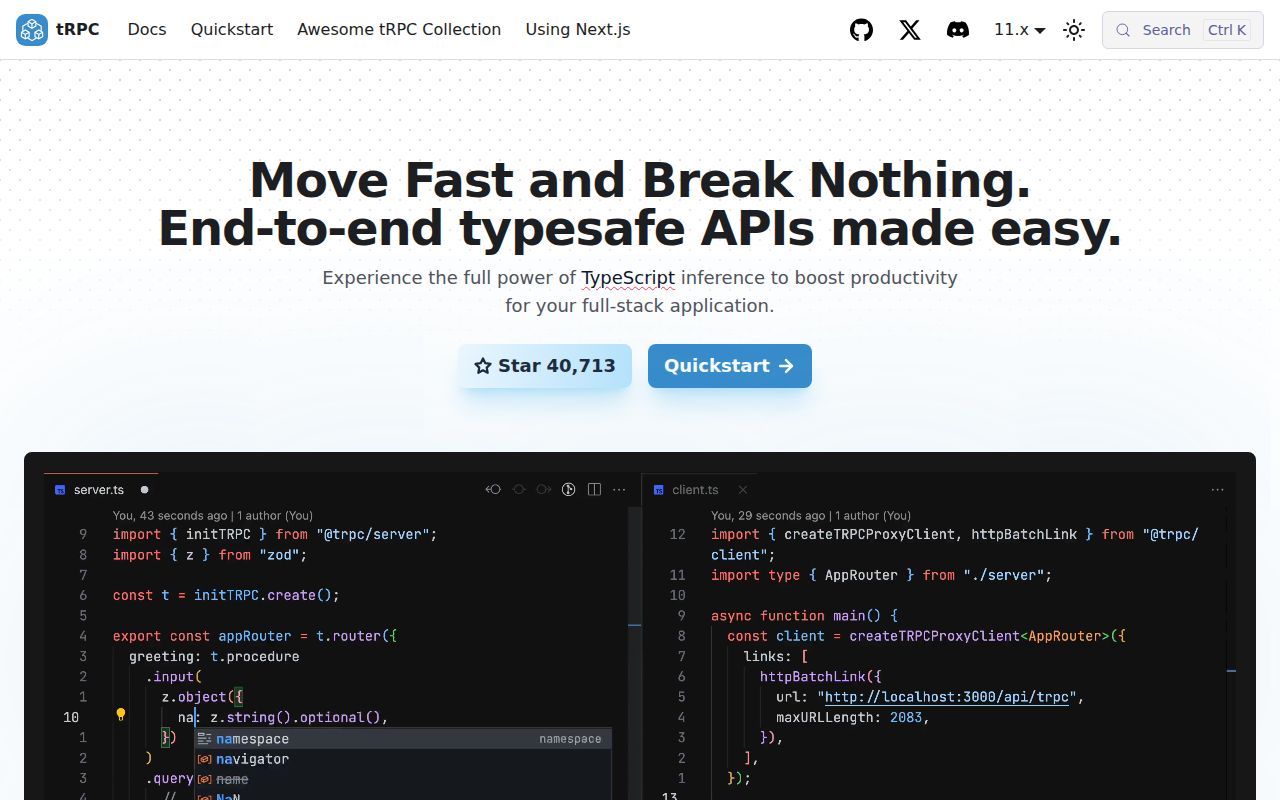
Change a server procedure's input, and tRPC can tell your TypeScript client that its call no longer matches. You get that feedback through a shared router type, without generating a client from a separate API description. For a team changing an application on both sides of the network, that is a useful reason to adopt it.
The ownership question comes first. If your team controls the TypeScript client and server, sharing that type can remove repeated contract work. If other teams consume the service in different languages or release on their own schedules, decide how they will obtain and maintain a usable contract before committing to tRPC. Editor feedback cannot make those organisational decisions for you.
The client imports a router type, not the server implementation
The tRPC quickstart exports an AppRouter type from the server and supplies it to createTRPCClient on the client. Its type-only import disappears during compilation. That distinction answers a reasonable concern: the documented pattern shares information about the API without putting the server's implementation into the browser.
The example defines userList, userById, and userCreate procedures, then calls them through the typed client. Inputs and return values flow from the router definition, which is easier to keep consistent than manually copying matching interfaces. The value is clearest when a feature changes both the data returned by a procedure and the screen consuming it. Your editor can expose the mismatch while you still have both changes in hand.
There is still a coordination cost. A shared type describes the server code the client was compiled against. It cannot guarantee that the deployed endpoint matches that code. Keep compatibility between deployed clients and servers in your rollout plan, especially when an older browser session may continue calling after the server changes. This is a consequence of the shared-type approach, not a failure observed in our sandbox.
What happened when we ran it
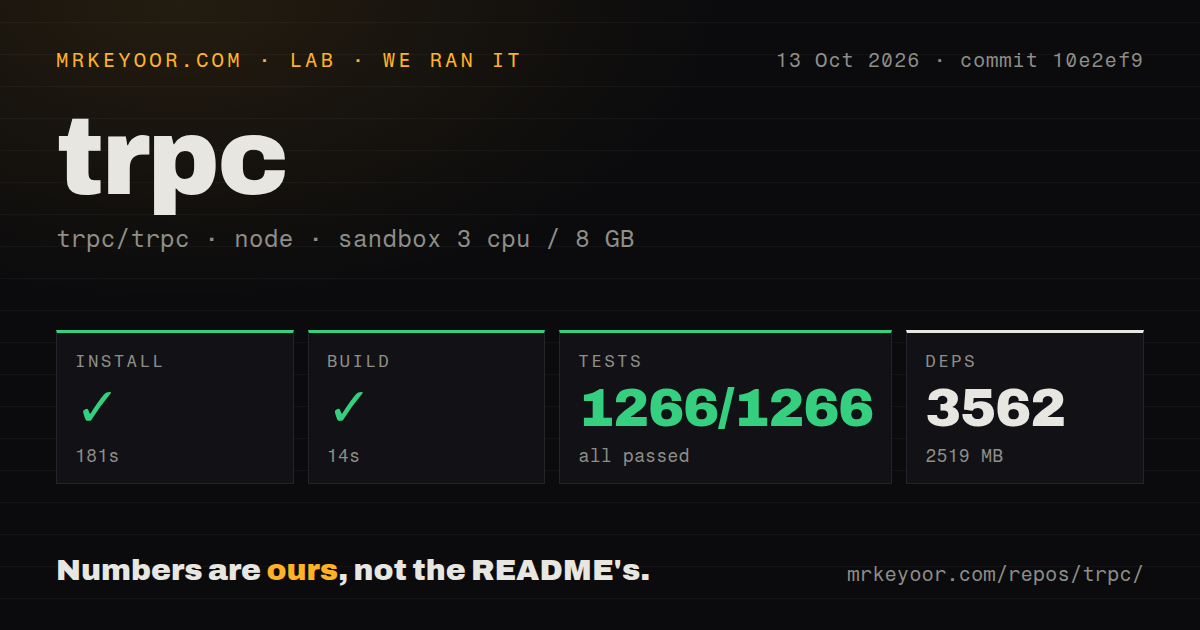
Our tRPC sandbox install succeeded in 181 seconds at commit 10e2ef9 on October 13, 2026, recording 3,562 dependencies and 2,519 MB on disk. The build succeeded in 14 seconds. The test step succeeded in 194 seconds, with Vitest reporting 1,266 passed and 0 failed out of 1,266. Those results support a working contributor checkout along the path we ran.
The source checkout was 7.5 MB across 1,638 files, with about 128,942 source lines. Our scan recorded monorepo workspaces and 12 CI workflow files, without a Dockerfile or tests directory. The directory signal does not contradict the passing Vitest result. It describes what the scan found, rather than where every check lives.
The sandbox configuration supplied 3 CPUs and 8 GB of RAM with an image labelled lab-node:22. Actual runtime and operating-system versions require the raw toolchain logs. We did not measure application request latency, browser bundle size, or behaviour under production traffic. The installed monorepo footprint also cannot establish the cost of adding selected tRPC packages to an existing application.
Our setup score is 3/5 on a scale where 1 means setup remains blocked, 3 means the checkout passes with substantial local costs, and 5 requires a passing checkout with little local overhead. The 2,519 MB footprint is the cost behind that judgment. It is a rating of the measured repository path, not the package-only adoption path.
Input parsers still decide what requests are valid
The quickstart explicitly accepts procedure input as unknown and validates it before the resolver runs. It supports a custom parser or a validation library such as Zod. That is work you still need to do: TypeScript inference helps callers write matching code, while an incoming request can contain something else. Review the parser for each externally supplied input.
The documented starter uses public procedures and a standalone HTTP server. It does not require a hosted tRPC account or an API credential. Your application chooses its persistence and authentication arrangements. A useful first adoption exercise is to connect a read-only procedure to your existing client, validate its input, and inspect its error behaviour before moving a write operation.
The current quickstart requires TypeScript >=5.7.2 and says non-strict mode is not officially supported. Those are documented requirements, not runtime versions established by our run. Teams tied to an older compiler or non-strict configuration should resolve that mismatch before choosing tRPC. The introduction also describes adding new endpoints first, so an existing backend need not be migrated all at once.
Recent repository work needs to be read in its branch context
GitHub recorded a tRPC push on October 19, 2026. The recent issue and pull-request feed included pull requests opened that day for SSE handling and client changes. Together, the push and review activity show ongoing repository work. An open proposal does not establish a feature in the released package or in our earlier measured commit.
Choose gRPC for several languages, Hono for HTTP routes
gRPC lists language-specific runtimes, including Python, Go, and Java. Choose it for service calls that need supported clients across those languages. That is a different requirement from sharing a TypeScript router type with an application client, and this review supplies no comparative speed measurement.
Hono is a web framework built on Web Standards. Its README starts with an HTTP route returning a response. Choose it when you want to design HTTP endpoints and manage their client contract separately. If the immediate job is one TypeScript application whose team owns both ends, try tRPC on an existing read path and make a deliberate contract change. Check whether the client feedback helps your workflow before widening its role.