A .proto file gives callers and servers a shared interface
Define a request in a .proto file before you write the calling code. gRPC uses that service description to generate interfaces for callers and servers, with Protocol Buffers as the default message format. A Python service and C++ caller can share the contract, which helps teams keep independently written clients in agreement.
Our gRPC checkout occupied 730.5 MB and contained 56,547 files, with about 6,094,666 source lines counted by the lab. The repository holds a shared C++ core and several language implementations. Calling it a Python project would misdescribe the product, even though our harness selected the Python path. Application developers should follow the README's language-specific runtime links before deciding they need to work inside this entire tree.
What happened when we ran it
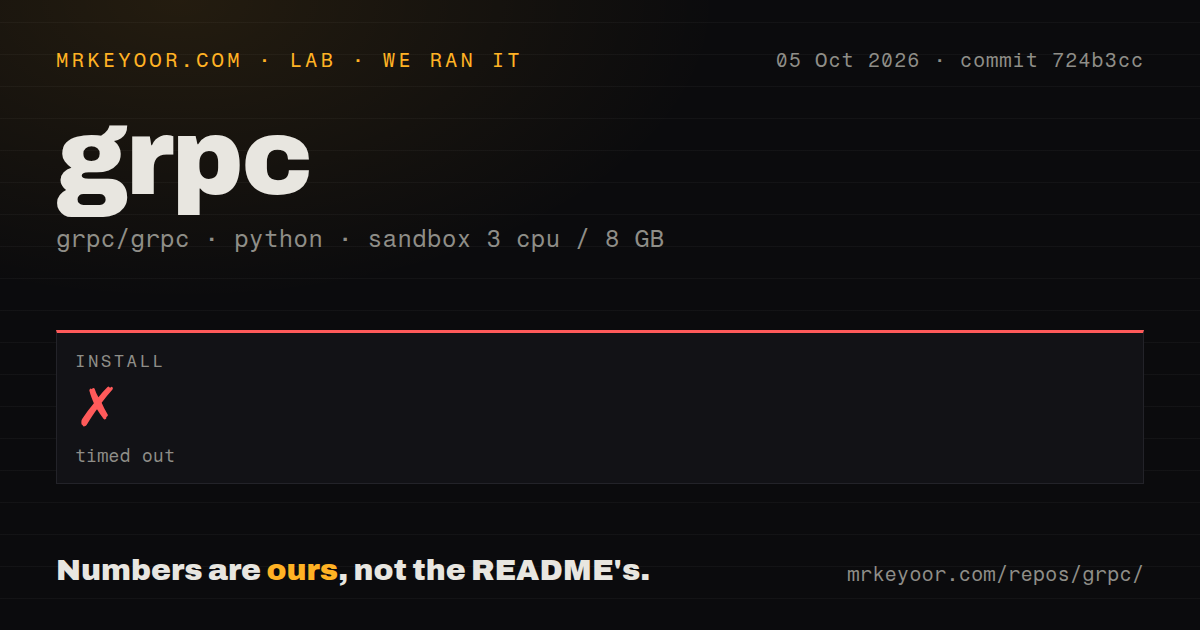
Our sandbox's gRPC install timed out after 900 seconds at commit 724b3cc. We ran it on October 5, 2026, using ghcr.io/astral-sh/uv:python3.12-bookworm in an unprivileged Debian container with 3 CPUs, 8 GB of RAM, and no secrets. The installation did not complete within that cap. The supplied measurement contains no error-log tail, so we can't identify the operation that held it up.
The lab found 7 CI workflow files and a tests directory, with no Dockerfile detected. The supplied result provides no completed build or test result, dependency count, or vulnerability audit. The source-checkout path failed to produce a completed environment within our install window, without establishing a compiler problem or missing system package. It doesn't measure a running service's latency.
Packaged runtimes avoid making every user a core contributor
The README's runtime table directs Python users to grpcio, while Go, Java, and Node implementations have separate repositories. Python's own README distinguishes PyPI packages from source work, documents Python headers and submodules for the latter, and says Windows source installation is unsupported. Follow that platform guidance if you need custom native code. The C++ build guide likewise describes itself as guidance for contributors and power users.
The 900-second timeout belongs to our checkout experiment, not a separately measured PyPI wheel installation. For a service, you still need generated interfaces, an address callers can reach, and server code implementing the methods. There is no mandatory hosted gRPC account. Certificate and authentication choices come from the system you're building, rather than a vendor credential required by the library.
A deadline can expire after the server changes data
The deadline guide says gRPC does not set a deadline by default. Set one deliberately so a caller doesn't wait indefinitely. The server must also handle cancellation of work it started. A generated method can look like an ordinary local function, but the network leaves room for the caller and server to disagree about whether the request succeeded. That changes how you design a write operation.
Cancellation doesn't roll back changes already made, according to the core concepts documentation. A retry of a payment or job submission therefore needs an application rule for recognizing duplicate work. Our 3-CPU sandbox never reached a completed installation, so these are documented behaviors and design recommendations, not findings from a running transaction experiment. Before adoption, decide what a caller should do when the response disappears after the server accepts the request.
The official browser client cannot stream requests both ways
The gRPC-Web README says client-side and bidirectional streaming are currently unsupported. It supports unary requests and server streaming, with the latter restricted to its text mode. Browser clients also connect through a special proxy, using Envoy by default. A backend that already uses bidirectional gRPC cannot expose that exact interaction to the official browser client just by generating JavaScript interfaces. That limitation can decide the architecture.
The 730.5 MB source tree we inspected is also a poor proxy for the footprint of a browser application or a packaged runtime. Its size tells a core contributor what they'll be checking out. For a browser-facing Go API, I'd compare Connect's Go implementation first: it uses Go's HTTP facilities and supports gRPC, gRPC-Web, and its own protocol. You still own schema changes, but its HTTP integration may fit the application you already operate.
Choose another RPC stack when its contract fits better
Connect suits a Go service that needs browser access alongside gRPC compatibility. Apache Thrift is a sensible comparison when your organization already uses its service definitions and generated clients. Changing an existing Thrift contract needs a concrete reason. For Rust-only services, tarpc defines the schema in Rust code, avoiding a separate interface language. That gives up gRPC's cross-language .proto workflow.
Our 900-second install cap makes source reproducibility a question to settle before committing to custom core patches. It doesn't decide among those alternatives on throughput, memory use, or message size, because none of that was measured. I'd choose gRPC when cross-language contracts or backend streaming solve an existing problem. For a public interface whose consumers expect ordinary JSON requests, require a clear benefit before adding generators and a separate browser access path.
October maintenance includes work on the native core
The last push was October 10, 2026. GitHub listed 45,366 stars and 1,364 open issues and PRs, while recent activity included OpenTelemetry integration work and an open EventEngine scheduling request. The combined issue count isn't a bug count. Those threads and the recent push show ongoing maintenance, though they cannot make our incomplete installation successful or establish that every language binding has the same support quality.
Release v1.84.0, published September 11, 2026, includes Python asynchronous reference-cycle fixes and a proxy hostname-matching correction. Our checkout's roughly 6,094,666 source lines make narrowing your runtime choice worthwhile. Choose the runtime for your language, then exercise a write request whose caller cancels while the server is working. If you can't explain whether that write happened and how a retry will behave, generated client code hasn't finished the job for you.