The browser runs GPT-2 from 63 local model chunks
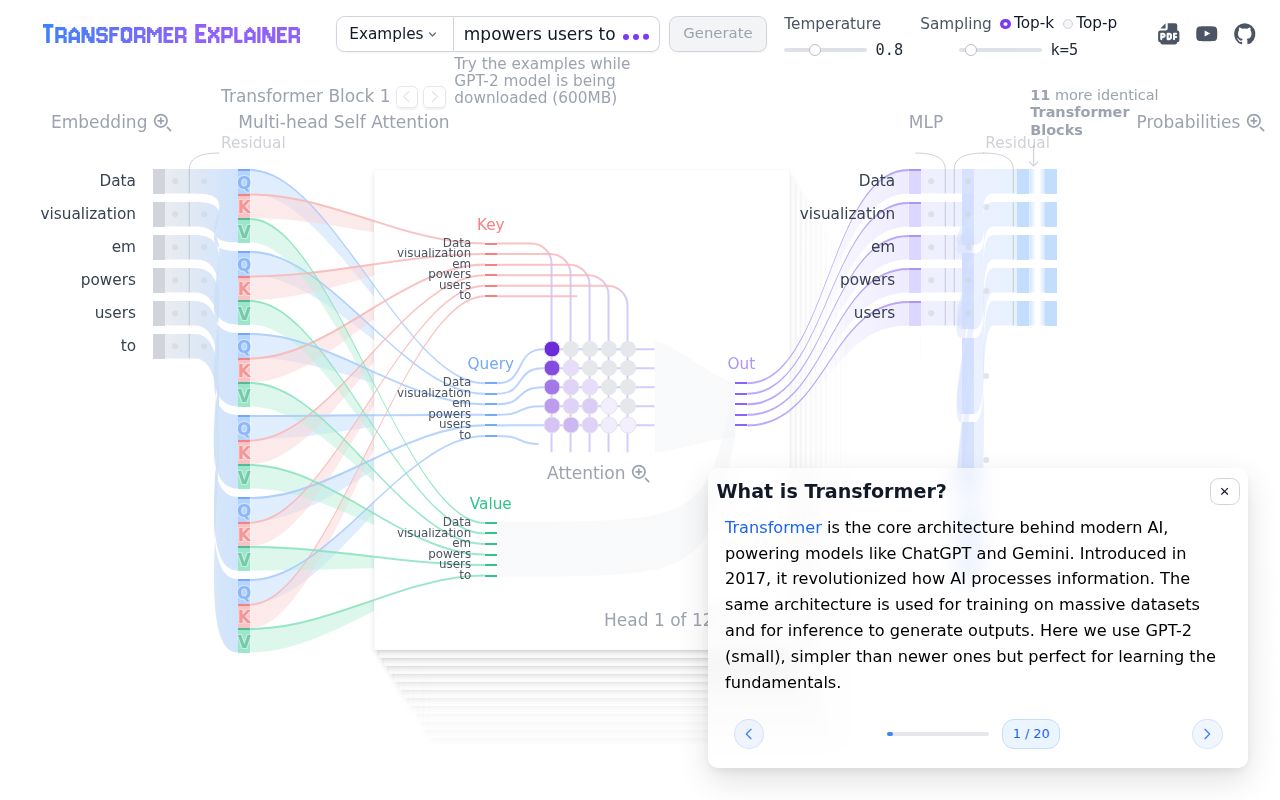
Transformer Explainer joins 63 ONNX chunks in the browser, then lets you type a short prompt and follow GPT-2 from token embeddings through attention, the multilayer perceptron, later blocks, logits, and softmax. The browser produces a next-token prediction, so the diagram reacts to the text you supply. That makes the project most useful at the point where a learner understands the words "attention" and "token" but still cannot picture what the model does between input and output.
The interaction goes beyond clicking labels. You can select an attention head, move through Transformer blocks, adjust temperature, and switch between top-k and top-p sampling. A guided textbook panel can call attention to the relevant part of the diagram while it explains the step. The repository also includes 5 prepared examples, which keep the lesson usable while the full browser model is loading. This is the right kind of interactivity for teaching because every control changes the same visible prediction path.
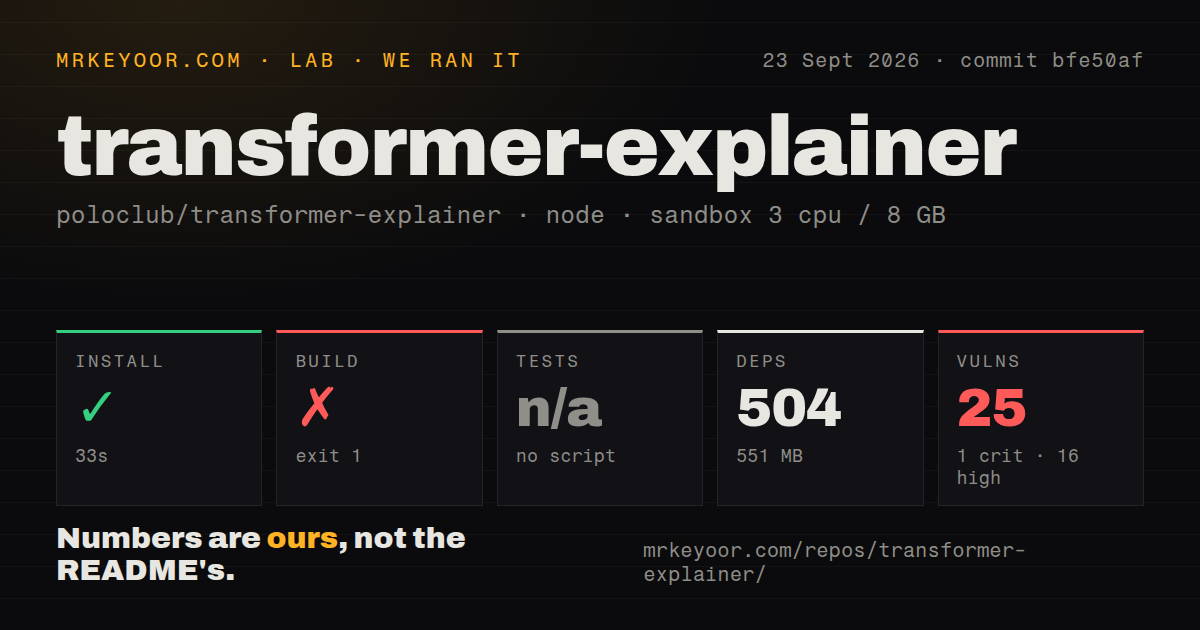
A 4-second build failure separates the demo from the codebase
Our fresh Debian sandbox installed 504 npm packages in 33 seconds and occupied 551 MB. The production build then failed after 4 seconds, before Vite transformed a single module. The reported error came from vite-plugin-svelte while it tried to load src/routes/+layout.svelte: it attempted to read a missing config value. The log does not prove which package or configuration is responsible, so we would not pin the failure on one dependency without another controlled run.
The failure matters because the README presents local setup as four short commands: clone, change directory, install, and start the development server. An install that exits successfully does not establish that a deployable bundle exists. Open issue 74 reports a separate npm dependency-resolution failure, while pull request 85 proposes a Vite 6 and Sass path update. Those records show that other users are also working around the current Svelte and Vite combination, though neither one explains our exact stack trace on its own.
What happened when we ran it
Our run used commit bfe50af in an unprivileged container with 3 CPUs and 8 GB of RAM. The 670 MB checkout contained 167 files and roughly 168,657 lines of source. Installation succeeded in 33 seconds, adding 504 packages and leaving 551 MB of dependencies on disk. The build failed with exit code 1 after 4 seconds at the Svelte layout load. That result makes the hosted site easier to recommend than a fresh self-hosted copy.
There was no tests script or target, so we did not invent a substitute and call it the project test suite. The checkout had no tests directory, one CI workflow, and no Dockerfile. Npm audit found 25 known vulnerabilities: 1 critical, 16 high, 6 moderate, and 2 low. The measurement says nothing about whether the hosted GitHub Pages deployment is exposed to every advisory. It does say this dependency tree needs review before someone puts a fork into a classroom or company deployment.
The 670 MB checkout teaches one decoder-only model
GPT-2 gives Transformer Explainer a narrow, sensible teaching subject. The project connects a token to its embedding, query-key-value work, attention weights, residual path, MLP, and output probabilities without asking a beginner to compare several architectures at once. The browser caches the 63 ONNX chunks and uses prepared data until the model session is ready. No prompt has to travel to a third-party inference API.
That focus also defines what the project cannot teach. GPT-2 is a decoder-only model, so this is not a tour of encoder-only systems such as BERT or encoder-decoder systems used for other sequence tasks. Open issue 71 asks why the attention output projection present in the Python model code is absent from the drawing. Issue 89, filed on September 22, 2026, notes that step 3 uses the abbreviation MLP without expanding it. Both reports concern explanation accuracy, which matters more here than a cosmetic defect would.
Current discussion has moved beyond the lone v0.0.1 release
GitHub showed 8,721 stars and 22 open issues and pull requests when we fetched the repository. The latest tagged release is v0.0.1 from June 2024, but the last repository push was June 6, 2026. An explanation issue arrived on September 22, and open work includes dependency updates, localization, and a draft KV-cache route. That combination looks like a research project receiving useful maintenance and outside contributions, rather than a regularly packaged application release.
The hosted lesson returned successfully when checked, and it remains the easiest way to use the work. Forking the code is a different decision. A self-hoster inherits a 551 MB install, a build that failed in our sandbox, 25 audit findings, and no project test target. Use Transformer Explainer when you want one memorable class session about how GPT-2 predicts a token. Wait for a clean production build, or budget engineering time, before treating the repository as maintained web infrastructure.