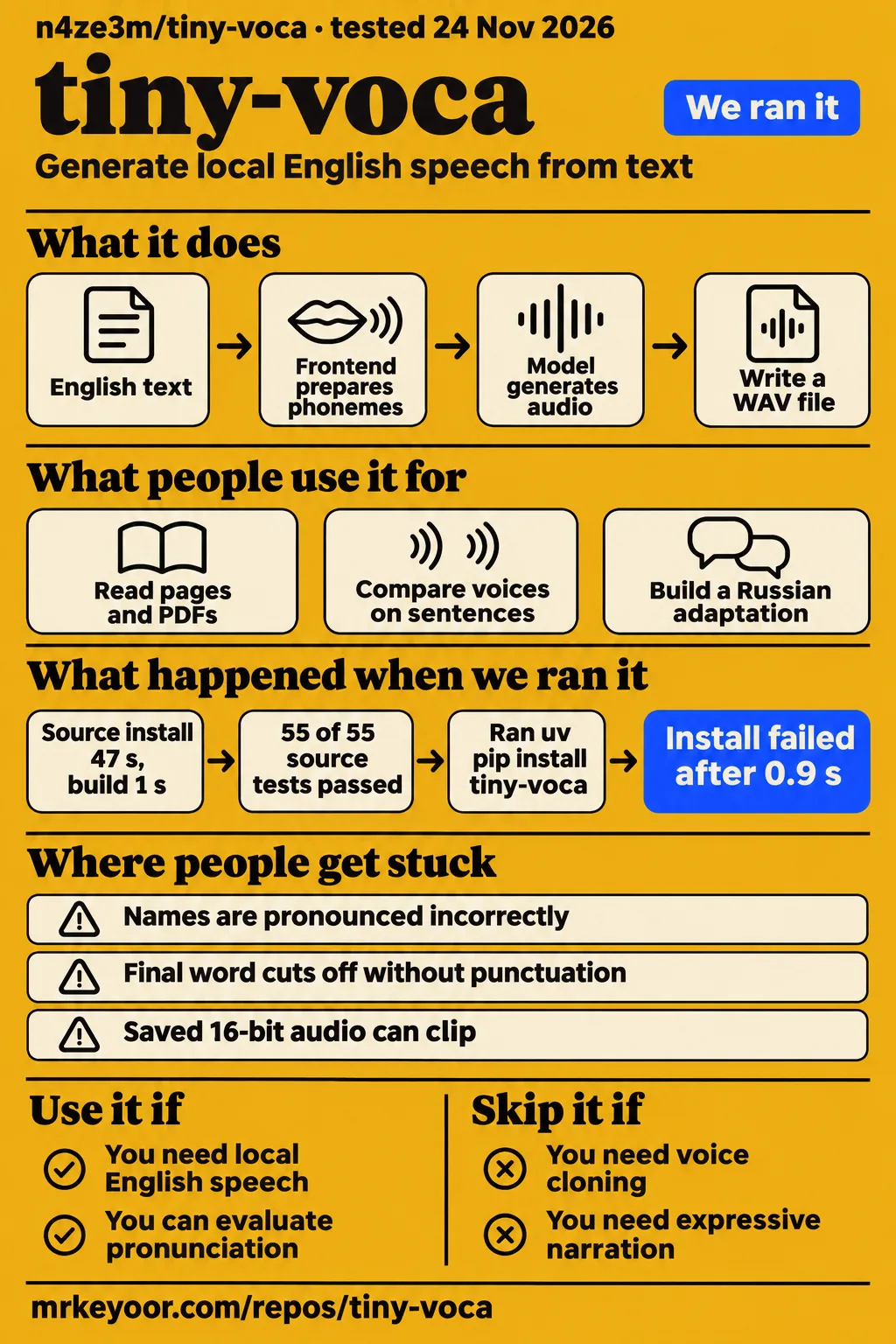
Short answer: use it for local English application speech
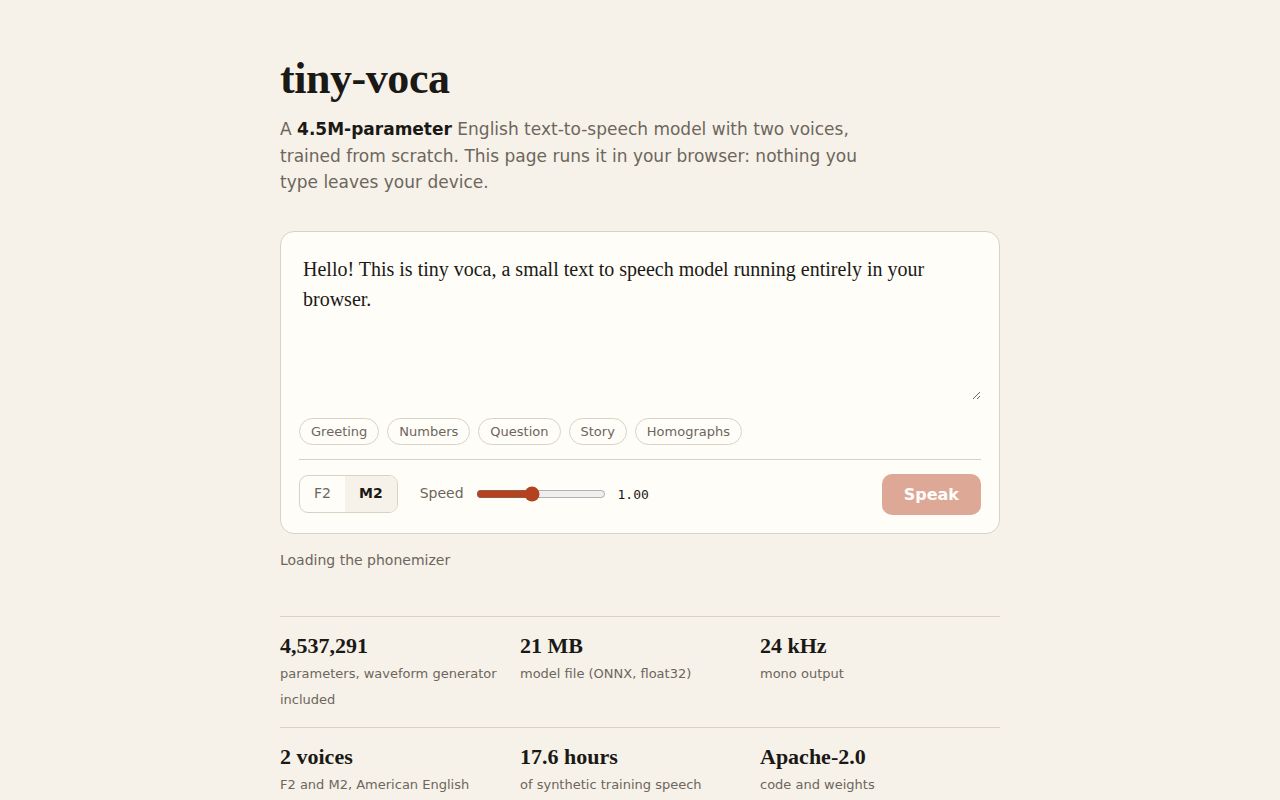
tiny-voca has two fixed English voices and runs on a CPU or in a browser, according to the upstream README. Use it for an application whose vocabulary and voice requirements you can assess directly. Choose another engine for voice cloning or expressive narration: the original checkpoint has two fixed voices, and the model card describes slightly synthetic delivery. The decision rests on what your application needs to say and how it should sound.
The README exposes speaking rate, pitch shift and pitch movement controls. It also publishes a training recipe for developers making separate models. Those are different uses: embedding the English checkpoint means choosing a runtime and preparing text, while adapting the recipe means building the language frontend and training assets as well. This review connects those choices to our installation results, named community projects and reported pronunciation errors.
What people use tiny-voca for
Tiny Reader reads pages and PDFs, language developers have published separate adaptations, and ngxson reports an ESP32-S3 port. These projects show distinct uses of the model and recipe. The README's community section separates languages and voices from ports and applications, which is a useful distinction when choosing an implementation: a reader interface, an inference port and a newly trained language model each solve a different part of the job.
| Person or project | What they did | Reported outcome |
|---|---|---|
| GitThisJoel, Tiny Reader | Built a Firefox reader for pages and PDFs with sentence and word highlighting | The author reports browser inference with ONNX Runtime Web and says no text leaves the computer; the maintainer added it to the community list. Tiny Reader issue #13 |
| GitHub AI repo, Mac comparison | Compared tiny-voca's two voices with Kokoro on 24 sentences | Reported faster ONNX generation and perfect everyday-sentence transcription for all three voices. Mac comparison video |
| ngxson, ESP32-S3 port | Ran speech generation on a microcontroller | Reported generation faster than real time, with most delay attributed to phonemization. ngxson's port report |
| yilbegan, Russian adaptation | Published a model, dataset, browser demo and Russian text frontend | Reported male and female voices with two stress providers; the maintainer added the project to the list. Russian adaptation issue #8 |
The installation walkthrough demonstrates both voices, an approximately 300-word article read from a file, ONNX export, exported-model inference and a browser demo served on port 8,788. Its creator reports six minutes of setup, about 430 MB RAM and 1.2 GB disk. ONNX export initially failed because packages were missing; the creator installed ONNX and ONNX Runtime manually. A separate listening-check tool hit a PyAV keyword-argument error, then used FFmpeg conversion to 16 kHz and passed samples to Whisper as an array. That crash belonged to the checking tool.
What happened when we ran it
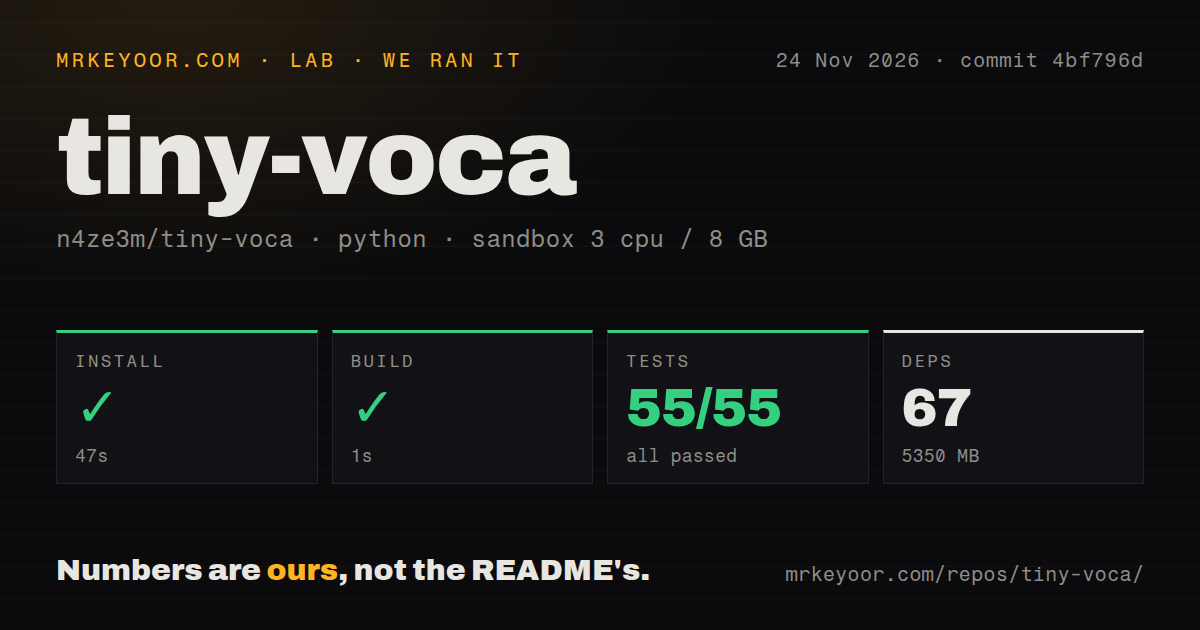
Our run at commit 4bf796d installed in 47 seconds and recorded 5,350 MB on disk on November 24, 2026. The sandbox measurement also records a successful build and test step. Its configured resources were 3 CPUs and 8 GB RAM, with image label ghcr.io/astral-sh/uv:python3.12-bookworm. The source checkout occupied 0.7 MB, so the installed Python environment and repository size describe substantially different deployment costs.
| Recorded step or observation | Our result |
|---|---|
| Install | Succeeded in 47 seconds |
| Dependencies and installed disk | 67 dependencies; 5,350 MB on disk |
| Build | Succeeded in 1 second |
| Tests | Succeeded in 59 seconds; pytest reported 55 passed, 0 failed and 27 skipped |
| Checkout | 76 files, about 10,644 source lines, 0.7 MB |
| Repository signals | Tests directory present; 0 CI workflow files detected; no Dockerfile detected |
The test summary reports 55 passed, 0 failed and 27 skipped while separately recording a total of 55. Those are the measurement's reported fields; adding them into a new total would alter the record. Installation, build and the test command all exited successfully. The useful deployment result is the measured environment footprint, which includes more than the downloaded model file and gives a concrete budget for this particular Python installation.
The earlier quickstart record names commit 4bf796d29ea7 and a separate 2-CPU, 4-GB container configuration. Its clone step took 1 second. The next command, uv pip install tiny-voca, failed in 0.9 seconds with exit 1. Its log identifies a Python 3.12.12 environment and says tiny-voca was absent from the package registry. The install-failed finding records unsatisfiable requirements, and teardown completed successfully. The later source installation supplies the successful setup result.
Where people get stuck: pronunciation and direct model calls
The author acknowledged names, medical words, "well-read" and European number formatting as problem areas in the r/LocalLLaMA pronunciation discussion. PrestigiousBag2994 reported dropped and added syllables, including problems with Emmaleigh, Hermione and the male voice's reading of counterrevolutionaries. The response distinguishes dictionary coverage from frontend bugs and promises to add the examples to a fix list. Those strings make a more useful application acceptance list than a general claim about clear speech.
| Symptom | What to change | Status and source |
|---|---|---|
| Incorrect names, medical vocabulary or European numbers | Retain the exact input and selected voice in a bug report | The author acknowledged weaknesses and added examples to a fix list. Pronunciation discussion |
| Last word cuts off in a direct model call | End the utterance with punctuation | The Python command adds a full stop automatically. Model-call instructions |
| Saved 16-bit audio clips | Scale the waveform before saving | The documented command caps saved peaks at 0.99. README audio handling |
| A long passage exceeds a single model call | Split it into sentences; the Python speak_text helper performs that step | A call supports up to 512 tokens and 32 seconds. Per-call limits |
The model card says raw audio can peak above 1.0 in about one sentence in twenty, which explains its instruction to scale before saving 16-bit samples. Sentence splitting and terminal punctuation address separate input problems. The documented Python helper combines those protections, while a direct graph integration must implement the surrounding text and audio handling. A pronunciation dictionary error enters earlier in the pipeline, before the waveform generator receives its input.
The checkpoint and the installed environment have different sizes
The model card lists an 18.2 MB PyTorch checkpoint, a 21.4 MB ONNX export and 5.4 MB of phonemizer data as separate artifacts. The complete model includes its waveform generator within 4.5 million parameters. The README rounds the model-file figure to 18 MB. These numbers describe model assets, while our installation table describes the Python environment on disk; they answer different questions about what an application must distribute.
The ONNX interface takes phoneme IDs, stress and speaking controls, then returns audio and durations. Spelling-to-sound preparation happens outside that graph. A browser integration therefore needs a text frontend as well as an inference runtime. The README also describes a separate plain-JavaScript experiment that reads one 8 MB file in a browser, Node or Bun. Selecting a deployment route comes before deciding which asset sizes belong in the application's download budget.
Privacy depends on the speech engine your interface calls
Tiny Reader's author says its inference stays in the browser, while the Studio application source describes both device-side synthesis and server speech functions. The Tiny Reader issue names ONNX Runtime Web and says no text leaves the computer. The Studio source describes an on-device engine alongside a speak API and workflow functions. An interface's appearance in a browser therefore does not identify where its selected synthesis path runs.
The Studio source also documents a startup-order repair: mounting a workflow before a temporary registration launch could leave jobs accepted on port 7860 without running. It mounts that workflow after the registration launch. Separately, the README licenses code and weights under Apache-2.0 and the dataset under CC BY 4.0. The model card identifies separate notices for pronunciation data. Distribution terms and execution location each need attention when packaging a reader for private documents.
Language ports are separate projects with separate frontends
The original checkpoint speaks English, while Russian, Sinhala and Luganda projects supply separate models or adaptations with their own text preparation. The English model card specifies two fixed voices. The community issues show what developers changed and what the maintainer acknowledged: addition to a directory of projects. That distinction helps a developer find an adaptation without treating the upstream checkpoint as a multilingual model.
| Adaptation | What its author supplied | Maintainer response |
|---|---|---|
| Russian, yilbegan | Model, dataset, demo and frontend with two stress providers | Confirmed community-list addition in issue #8 |
| Sinhala, Emindu | Two voices, notebooks, browser demo and eSpeak NG frontend fixes; identifies a GPL-3.0 source dataset | Confirmed community-list addition in issue #11 |
| Luganda, henryhale | Fine-tuned weights, rule-based frontend, ONNX export and demo | Confirmed community-list addition in issue #15 |
The Sinhala author reports changing alignment gates because the pretrained aligner was not trained on Sinhala; the resulting gates retain 94% of clips. The same report describes fixes for specific Sinhala characters. Russian's two stress providers address another language-specific preparation task. The current README also lists Hindi projects, including Browser Voice and tiny-voca-hindi. Repository metadata records an upstream push on November 23, 2026, and the sampled issues show the maintainer adding submitted projects.
tiny-voca vs Kokoro, Pocket TTS and ElevenLabs
The Mac comparison reports about 118x real-time ONNX generation for tiny-voca, 41x with PyTorch and 3.7x for Kokoro. Its creator says each timing used four M1 Pro threads and ran three times. Runtime choice changes the result substantially within that comparison. The same video reports 182 correctly transcribed everyday words for both tiny-voca voices and Kokoro, with a few difficult-sentence errors on each side.
| Alternative or route | Evidence that helps you choose | Pick it when |
|---|---|---|
| Kokoro | Its repository documents an 82-million-parameter model; the Mac comparison reports perfect everyday-sentence transcription for both engines | Compare representative voice samples when delivery determines the choice. Kokoro README |
| Pocket TTS | Its README documents CPU inference, streaming and voice cloning | Streaming or cloning is a requirement. Pocket TTS README |
| ElevenLabs or another hosted speech service | The installation video demonstrates local text-to-WAV tasks and asks about partial replacement | Compare the demonstrated local tasks with the work your narration workflow requires. Installation walkthrough |
| tiny-voca ONNX instead of PyTorch | The Mac comparison reports 118x versus 41x real-time generation | Evaluate the runtime route that produced the faster generation result on that Mac. Runtime comparison |
Kokoro is an open-weight TTS model with 82 million parameters. Its repository documents Apache-licensed weights. Pocket TTS documents CPU inference, audio streaming and voice cloning. Its README also lists English models down to 1.9 million parameters, so a comparison based on every alternative being larger would be wrong. Generation throughput, model size and available features are separate reasons to choose an engine; the comparison table keeps those reasons attached to their sources.
What the other reviews get wrong
Hermes-AI repeats the November 16 leaderboard ranks, while the model card identifies a November 20 snapshot with changed evaluation coverage. Hermes-AI's summary gives M2 eighth and F2 thirteenth among fifty models. The November 20 model card places F2 fifth and M2 seventh among forty-five after adding ZTTS2-Mini-clean to the evaluation mix. AlphaSignal's summary repeats the older ranks too. The dates belong to evaluation snapshots; a changed rank does not itself show changed weights.
The video claiming a word-error advantage over Kokoro conflicts with the November 20 table: Kokoro has 0.66% average WER, F2 0.74% and M2 0.76%. AIJedis' absence claim about independent comparison also needs updating because the Mac video reports repeated timings and transcription checks. The Facebook zero-latency wording overstates generation speed: ngxson specifically reports phonemization delay on the ESP32-S3.
The explainer video's complete-package figure of 18.2 MB describes the checkpoint rather than the whole deployment. Dishant's article places real recordings at the alignment stage, while the model card says Qwen3-TTS generated the recordings and the aligner only labels them. Finally, Andrew's same-text, same-speech description should mean fixed prosody: the primary model card explicitly excludes runtime-generated random noise from its waveform-parity statement.
FAQ
tiny-voca's documented installation starts with a source checkout, editable extras, downloaded weights and a phonemizer-data path. The README's command sequence answers the installation question directly and differs from the registry command that failed in our earlier quickstart. The questions below come from the recorded discussions, videos and community issues. They separate running the English model from choosing a frontend or adapting the training recipe.
How do I install tiny-voca and generate a WAV file?
The README installs the repository with its own-frontend extras and invokes tiny_voca.infer to write hello.wav. It downloads model assets from Hugging Face and points DIZIONE_DATA at the pronunciation files. The following upstream command sequence uses F2 and includes terminal punctuation in the example text. It is documentation for the source-checkout route, with the recorded execution scope described in the final section.
git clone https://github.com/n4ze3m/tiny-voca.git
cd tiny-voca
pip install -e ".[own]"
hf download n4ze3m/tiny-voca --local-dir weights
export DIZIONE_DATA=weights/phonemizer
python -m tiny_voca.infer --checkpoint weights/tiny-voca.pt --voice F2 --text "Hello! This is tiny voca." --output hello.wav
Why does tiny-voca need a phonemizer?
The author says the model is too small to learn English spelling itself and therefore needs phonemes. In the r/TextToSpeech answer, the author also explains wanting to avoid eSpeak's GPL dependency and improve handling of numbers, money and dates. That explains the choice of dizione for the original model. Community adaptations make their own frontend choices, including the eSpeak NG frontend documented by the Sinhala author.
Has tiny-voca been evaluated for naturalness rather than just word error rate?
The November 20 model card includes automated UTMOS22 scores alongside word error rates. The evaluation table gives each tiny-voca voice its own row, rather than combining them into one result. The Mac video's creator separately describes its test as measuring speed and clarity. Those labels identify what the published numbers represent and keep automated scoring distinct from the listening-study gap described in the final section.
How does tiny-voca handle context-dependent abbreviations such as Dr. and St.?
The spelling-to-sound frontend prepares abbreviations before the speech model receives phonemes. A user asked specifically about contextual readings of Dr. and St. in the r/LocalLLM discussion. The model card identifies dizione as the input frontend. These exact strings belong in an application's pronunciation examples because the question concerns text preparation, alongside numbers and names, rather than waveform-generation speed.
How are Qwen-generated audio and phonemized text turned into tiny-voca's training data?
Qwen3-TTS VoiceDesign creates the voice designs, and Qwen3-TTS 1.7B Base generates recordings. The model card's training account says forced alignment supplies phoneme durations. The pretrained wav2vec2 aligner labels those training recordings and contributes no weights to the released speech model. This separates the audio generator, duration labeler and final model instead of treating every pretrained component as part of the shipped checkpoint.
Can my language port or application be added to tiny-voca's community list?
The README invites developers to open an issue, and the Russian, Sinhala and Luganda submissions received confirmation of addition. Issue #8 links Russian assets and a demo; issue #11 describes Sinhala notebooks and frontend changes; issue #15 describes Luganda's rule-based frontend and ONNX export. Those completed requests show the listing process and the implementation details their authors chose to include.
What we have not tested yet
Our successful checks cover installation, build and a test command at commit 4bf796d; they do not measure speech quality or application reliability. The displayed README commands were not executed as a new test for this correction, and the README extract is not a commit-pinned proof of every command at 4bf796d. Actual runtime versions for the successful run require raw toolchain logs; its image label records configuration. The earlier registry attempt produced no speech task, screenshots or known-answer listening results.
Our run did not measure speech throughput, cold-start latency, synthesis RAM, browser network traffic, security defaults or concurrent requests. The Mac comparison's generation rates exclude a demonstrated end-to-end latency result, and its creator limits the comparison to speed and clarity. The model card reports no formal listening test. Sustained narration, listener preference and whether listeners can distinguish Kokoro from tiny-voca therefore need separate evidence, including assessment of the younger-than-intended F2 voice.
The pronunciation discussion records acknowledged bugs and a fix-list promise, rather than completed corrections. A dated regression run should replay the reported names, medical vocabulary, homographs, European numbers and contextual abbreviations with both voices. The abbreviation thread contains no author demonstration resolving Dr. and St. The latest-release lookup is null; that result does not establish whether a release exists. Recent push activity and community-list responses answer narrower questions about source activity and maintainer participation.
Community adaptations need separate checks of checkpoint availability, frontend size and licensing, browser behavior and native-speaker output. We have not tested the Hindi demo, GGUF conversion, a complete llama-tts invocation, conversion quality, the JavaScript experiment or Pinokio. The Pinokio README requires matching checkpoint, phonemizer and package versions and excludes Intel Macs; that restriction belongs to the launcher. Studio's startup-order repair is source evidence rather than a concurrency result. Application logging, retention and access controls also require checks beyond identifying the synthesis engine.