
Short answer: explore the controls before choosing a writing tool
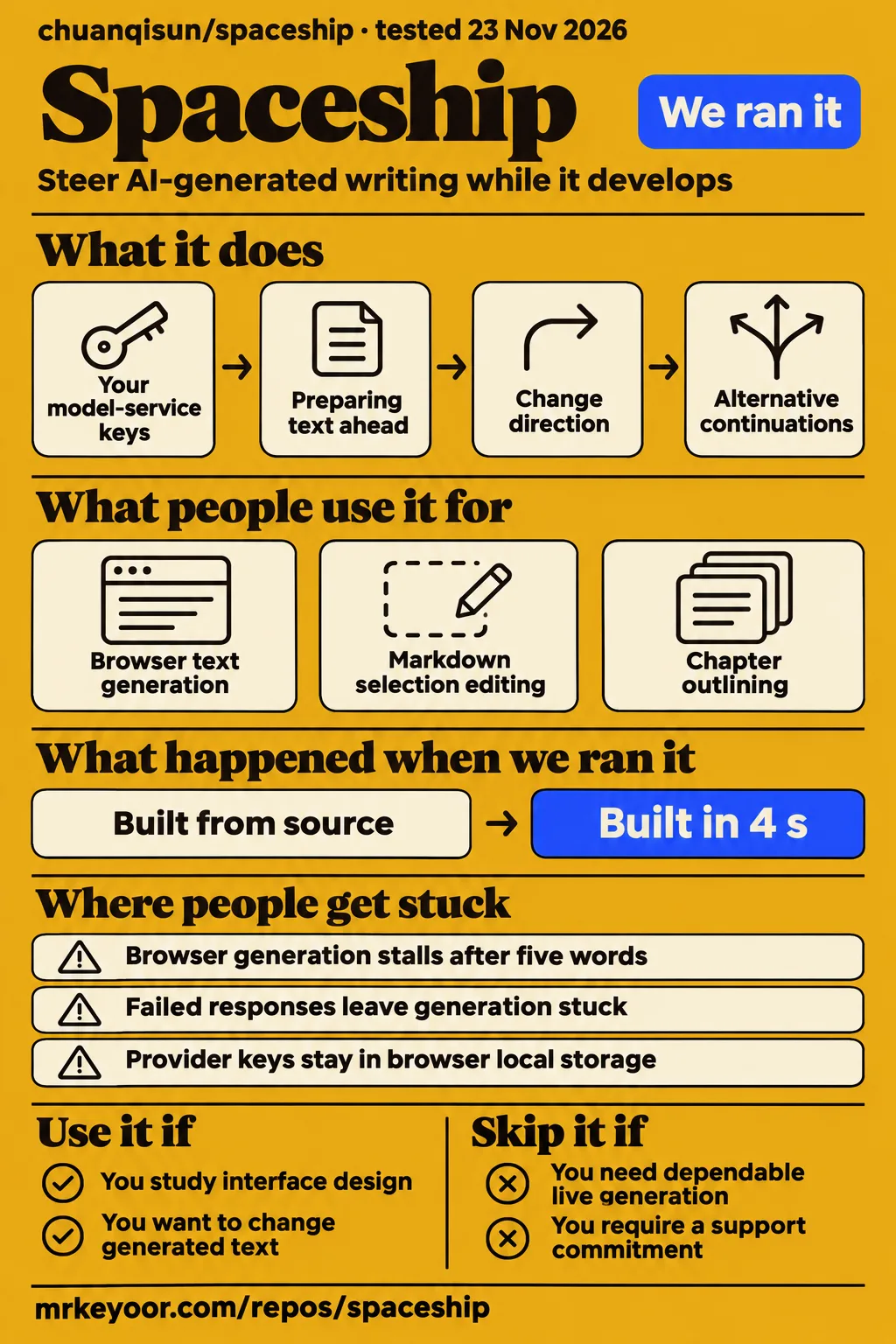
Our sandbox installed Spaceship in 4 seconds and built it in 4 seconds, while the separate live-deployment attempt stopped at the lab's Compose-file requirement. This review concerns chuanqisun/spaceship, Chuanqi Sun's experimental AI writing interface. Use it if you're designing ways to steer generated text and want a concrete interface to study. Skip it if you need a dependable daily writing application: the clearest browser user report describes stalled generation, and our run supplies no successful live-writing session.
The useful distinction is between trying a control scheme and trusting a manuscript to a workflow. The original README offers a simulator and a live mode using your Cerebras and Gemini keys. Spaceship Writer takes the steering idea into VS Code, but it has a different owner, configuration and release history. Decide which of those experiences you want before entering credentials or following an extension tutorial.
What people use spaceship for
The clearest reported uses are a browser generation attempt, a Markdown editing adaptation and experiments with the steering design. They show what you can investigate without turning someone else's demo into a claim about finished writing.
| Who used it | What they did | What happened |
|---|---|---|
| The reporter of issue #1 | Entered API keys into the hosted browser demo | Reported five initial words, then stalled generation and CORS errors. |
| brentlee-personal | Adapted steering to a selected Markdown paragraph | Reported testing the file and selection workflow on macOS, using native editor undo and save. |
| brentlee-personal | Recorded the independent extension in VS Code on Linux | Showed steering controls, an outline, a missing-prerequisite check and Markdown export using a synthetic manuscript, without running a model. |
| The contributor to issue #4 | Built the separate Heedle browser proof of concept | Shared an interface inspired by Spaceship; its agent-written description discusses tiny models and replayable exports. |
The paragraph-selection workflow is the most immediately useful adaptation for someone who already writes in Markdown. You choose where a continuation belongs, adjust its direction in a side panel and apply the result to that selection. brentlee-personal says VS Code handles undo and save because the operation is a native text edit. That gives you a familiar way to reverse an unwanted edit rather than managing a separate document history inside a browser experiment.
The Linux screencast answers a different question. Its chapter check flags a missing declared prerequisite, then the demonstration fixes the outline and exports it. That is a structural editing demonstration, with a synthetic manuscript. It should be evaluated for whether the outline operation helps you, independently of how well any model writes the next paragraph.
What happened when we ran it
Our November 23, 2026 hands-on attempt failed its safety step because the lab required a Compose file and found none. The specific check lists compose.yaml, compose.yml, docker-compose.yaml and docker-compose.yml as absent. That stopped this route before a writing task could produce an answer.
The run header describes an intended Compose deployment with ports bound to 127.0.0.1, but its claim that deployment happened conflicts with the failed safety step. We treat the explicit failure as the outcome, rather than reporting a running service. The teardown step reported ok. The word unsafe in the check is the harness's label for failing its Compose rule, not a security finding about Spaceship's source.
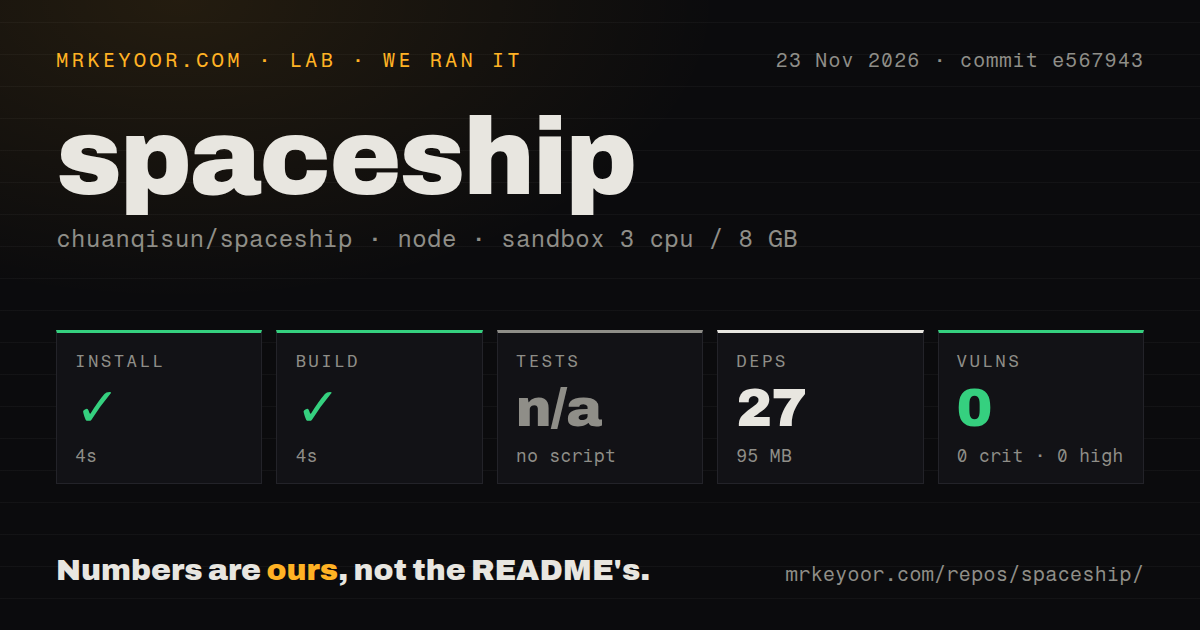
Separately, our source checks at commit e567943 completed installation and compilation:
| Source check in our sandbox | Recorded result |
|---|---|
| npm installation | Succeeded in 4 seconds |
| Dependencies | 27 recorded; 95 MB on disk |
| Build | Succeeded in 4 seconds |
| Tests | No test script or target; skipped |
| npm audit | 0 known vulnerabilities: 0 critical, 0 high, 0 moderate, 0 low |
| Repository scan | 102 files, approximately 5,076 source lines, 25.8 MB checked out |
| Automation and packaging signals | 1 CI workflow file; no Dockerfile; no tests directory |
The source-check sandbox configuration was 3 CPUs, 8 GB RAM and image label lab-node:22. That label doesn't identify the actual runtime or operating-system version. The 4-second build is useful if you want to inspect or change this small application, but it measures compilation rather than the delay between moving a control and receiving generated text. The skipped test step means there was no passing test result to report.
Where people get stuck: browser generation can stop after five words
Issue #1's reporter entered API keys, saw the page reload and got five words before generation stopped. The console showed a missing Access-Control-Allow-Origin header on a Cerebras request, followed by TypeError: Failed to fetch. CORS is the browser mechanism that controls whether a page can read a response from another origin.
The maintainer replied that an invalid Cerebras API key usually causes this error and that Cerebras supports CORS. That makes checking the key a reasonable first response. It doesn't justify changing browser security settings or promising that a localhost installation will cure it. The reporter mentioned localhost as something they hadn't tried. Although the issue is closed, the conversation contains no successful retry by that reporter.
| Symptom or obstacle | What the discussion actually recommends or changes | Resolution boundary |
|---|---|---|
| Browser generation stalls with CORS errors | Chuanqi Sun points to an invalid Cerebras key as the usual cause | Closed thread; no reported successful retry |
| Failed or empty responses leave generation looking stuck | brentlee-personal reports pausing automatic requests, keeping the manuscript and showing retry guidance | Change in the independent extension, explicitly separate from the browser failure |
| Unclear destination for extension bugs | brentlee-personal directs extension-specific bugs and maintenance to the linked extension repository | Separate project ownership |
That last distinction prevents a frustrating detour. A local gateway, the extension's route for making model requests through its host, changes where failures are handled. The extension contributor explicitly says their change neither fixes nor reproduces the browser demo's CORS issue. If you're troubleshooting the hosted page, keep the report tied to that page and provider request.
Provider keys stay in the browser in the original demo
The original README says live mode uses your Cerebras and Gemini API keys and keeps them in browser local storage. It also warns you to use that arrangement at your own risk. You supply access to the model services yourself; downloading an open-source interface doesn't supply those accounts or their usage allowance.
For an initial look at the interaction, the simulator is the sensible starting point. It lets you decide whether the control scheme interests you before choosing a provider connection. If you move to live mode, use a browser profile you control and follow your provider's own credential-handling rules. Those are practical recommendations, rather than features Spaceship claims to enforce.
The zero findings in our npm audit refer to known dependency advisories in that run. They aren't a review of credential storage, browser extensions, network traffic or manuscript handling. A useful security decision here starts with the README's explicit storage disclosure, not a green dependency scan interpreted as a privacy guarantee.
English support depends on which project and version you mean
The original Spaceship README is in English; the Chinese-language report in issue #6 concerns the independent VS Code adaptation. brentlee-personal says version 0.1.0 localized the interface into Chinese and biased live continuations toward Chinese. That's a specific versioned report, not a reason to label the original project Chinese-only.
The same discussion describes a draft change that would default the interface to English and ask the model to follow the manuscript's language. At that point the contributor explicitly called it a draft PR rather than a new Marketplace release. The extension's current README now offers a 0.3.0 VSIX and documents live continuation in the manuscript's language unless another is requested. Use that newer documentation for its stated behavior, while retaining the earlier issue as the history of the problem.
If you write in more than one language, separate the language of the menus from the language of the continuation. The extension README says its simulation uses canned English text. That makes simulation suitable for looking at controls, while live mode is the documented route for manuscript-language continuation.
Speculative generation is the operating question for longer drafts
The author says Spaceship uses speculative generation, preparing text ahead of the writer's next action, and cancels requests and clears future text when the main control moves backward. That description of cache invalidation and cancelled requests explains why a smooth interface involves more than receiving one model response quickly.
For your evaluation, the useful task is to change direction while a continuation is being prepared and watch what happens to the document. Does the continuation follow the latest setting? Can you recover the text you wanted to keep? These are evaluation criteria, not results from our run. A fast build doesn't answer either question.
The README's 60 FPS statement appears under Conjecture and describes an expected future for model interactivity. Treat it as the premise of the design experiment. If you want this approach for a long manuscript, measure the provider work created by repeated steering changes alongside whether the resulting text is worth keeping. Installation time doesn't describe that workload.
Spaceship vs Spaceship Writer, Heedle and a prompt-and-response chatbot
Spaceship Writer is the closest documented alternative for Markdown editing, while Heedle explores the design with a different browser experiment. A conventional chatbot remains the comparison for the proposed change in writing workflow.
| Option | Why consider it | What supports the comparison |
|---|---|---|
| Original Spaceship IDE | Explore the browser steering interface and its design | The README separates simulator use from live mode with your provider keys. |
| Spaceship Writer | Apply a steered continuation to a Markdown selection with editor undo | brentlee-personal describes selection-based edits and native save and undo. |
| Heedle | Investigate another implementation inspired by the steering idea | Issue #4's contributor links the separate proof of concept; its detailed behavior is described by the agent that built it. |
| Prompt-and-response chatbot workflow | Keep asking for revisions in a conversation rather than manipulating steering controls | RealMarvelX on X contrasts paragraph rewrite prompts with influencing text as it develops. This is the commentator's proposed use. |
Choose the extension first if applying an edit to a known location is your main requirement. Choose the original simulator if you're studying the interface itself. Heedle is relevant to someone building an experiment, rather than someone seeking a recommendation for a manuscript editor.
The closed proof-of-concept issue #4 ends with Chuanqi Sun encouraging the contributor to keep experimenting. It's a contribution discussion, not a bug with a verified product fix. The closed extension discussion #6 includes the author's agreement to feature the adaptation, while extension maintenance stays in its own repository.
Search results for Spaceship often describe another product
Spaceship domain registration, spaceship vs Namecheap and Spaceship promo codes concern a different product from chuanqisun/spaceship. The autocomplete list mixes domain shopping with drawing and word-meaning searches; it doesn't measure demand for an AI writing interface.
| Search wording | Which question it belongs to |
|---|---|
| spaceship domain; spaceship promo code; spaceship domain promo code; spaceship vs namecheap | Domain registration and shopping, outside this software review |
| spaceship drawing; spaceship drawing easy; spaceship images | Visual or spacecraft content, rather than the documented writing controls |
| spaceship meaning; spaceship meaning in hindi; spaceship meaning in marathi | Dictionary or translation intent, rather than this project's identity |
| spaceship vs rocket | A spaceflight comparison, rather than an alternative writing application |
The distinction also applies to community popularity. The r/TopCharacterDesigns thread asks about favorite fictional spaceship designs. Its discussion is about vehicles. The YouTube result titled SPACESHIP - AP DHILLON is a music result, not a setup walkthrough of this repository. Neither belongs in a claim about Spaceship IDE adoption or usability.
There is relevant social commentary: RileyRalmuto proposes long-form writing as a use for the interface. That is a proposed application, whereas the extension contributor's synthetic-manuscript screencast shows particular editing operations. Keeping those descriptions separate gives you a much better basis for choosing what to try.
Questions people ask
The maintainer attributes the reported browser CORS error to an invalid Cerebras key as the usual cause, while issue #1 contains no successful retry from its reporter. The closed conversation preserves both the failure and that explanation.
Why does Spaceship's browser demo show CORS errors and stop generating after a few words?
The reporter's console shows a blocked Cerebras response and a failed fetch after five words. Chuanqi Sun says invalid keys usually cause this symptom. Start with that explanation when investigating the same provider request; the conversation isn't a diagnosis of every possible browser failure.
Can an invalid Cerebras API key cause the CORS errors shown by the demo?
Yes, according to the maintainer's reply in issue #1, which also says Cerebras supports CORS. That is the author's explanation for the symptom. The reporter doesn't return with confirmation that replacing a key restored generation.
Can I use Spaceship's steering controls inside VS Code?
Yes. brentlee-personal describes an independent VS Code adaptation, now documented as Spaceship Writer. Its source and issue tracker are separate from the original browser project, so choose the extension's instructions when configuring it.
Can I steer a continuation for a selected Markdown paragraph and retain editor undo?
Yes, according to brentlee-personal's description of the selection workflow. It writes back to the selected text through a native edit, leaving VS Code responsible for undo and save. The contributor reports trying the file and selection workflow on macOS.
Does the community extension continue writing in the manuscript's language?
The current Spaceship Writer README says Live mode follows the manuscript's language unless you request another in Direction. The earlier issue #6 clarification described that behavior in a draft PR; use the current documentation rather than treating the historical draft as a release announcement.
Can I try the simulator without model credentials?
Yes. The extension contributor explicitly says its simulator works without model credentials. The current extension README describes simulation as canned English text. That mode lets you inspect the controls without interpreting its text as a live model response.
How do the steering knobs feel when used inside an editor?
brentlee-personal asks for feedback on how the knobs feel and reports testing the selection workflow on macOS. That's an invitation to evaluate the controls, rather than a comparative usability result. The Linux screencast offers a concrete look at their placement and the outline workflow.
What happens when AI can respond to our decisions as quickly as we make them?
Spaceship explores steering during generation and scrubbing through alternative continuations. RealMarvelX poses that question while describing the project as an experimental prototype. The question motivates the interface; it isn't a latency result or a demonstrated improvement in an author's finished work.
What we have not tested yet
Our source checks establish a successful install and build at e567943, not successful live writing. We have not tested an authenticated Cerebras or Gemini session, writing quality, request latency, provider cost, extended steering sessions, recovery of a real manuscript, or a comparison against a chatbot on the same writing task. The Compose-based hands-on attempt stopped at its safety check. It supplies no screenshots or known-answer task results.
The extension's current language behavior, local gateway and failure handling need their own runtime evaluation. Its contributor reports and synthetic demonstration aren't our tests of a released extension. Heedle's detailed description came from its building agent; we haven't independently checked its model behavior or replay claims.
Maintenance also needs a narrower conclusion than a closed issue count. The GitHub API reported a last push on November 23, 2026, while Chuanqi Sun told the extension contributor that thesis work would take priority until graduation. Those facts show recent repository activity and a stated availability constraint, not a support commitment. The API's latest-release endpoint returned 404, which doesn't by itself demonstrate abandonment. Star counts, social reactions and unrelated search results supply no adoption or reliability measurement.
For the next useful trial, keep a disposable Markdown passage, record the exact application version and provider, and compare the continuation before and after a steering change. Save the original text and check undo. A result showing that sequence would answer the question our successful build leaves open.