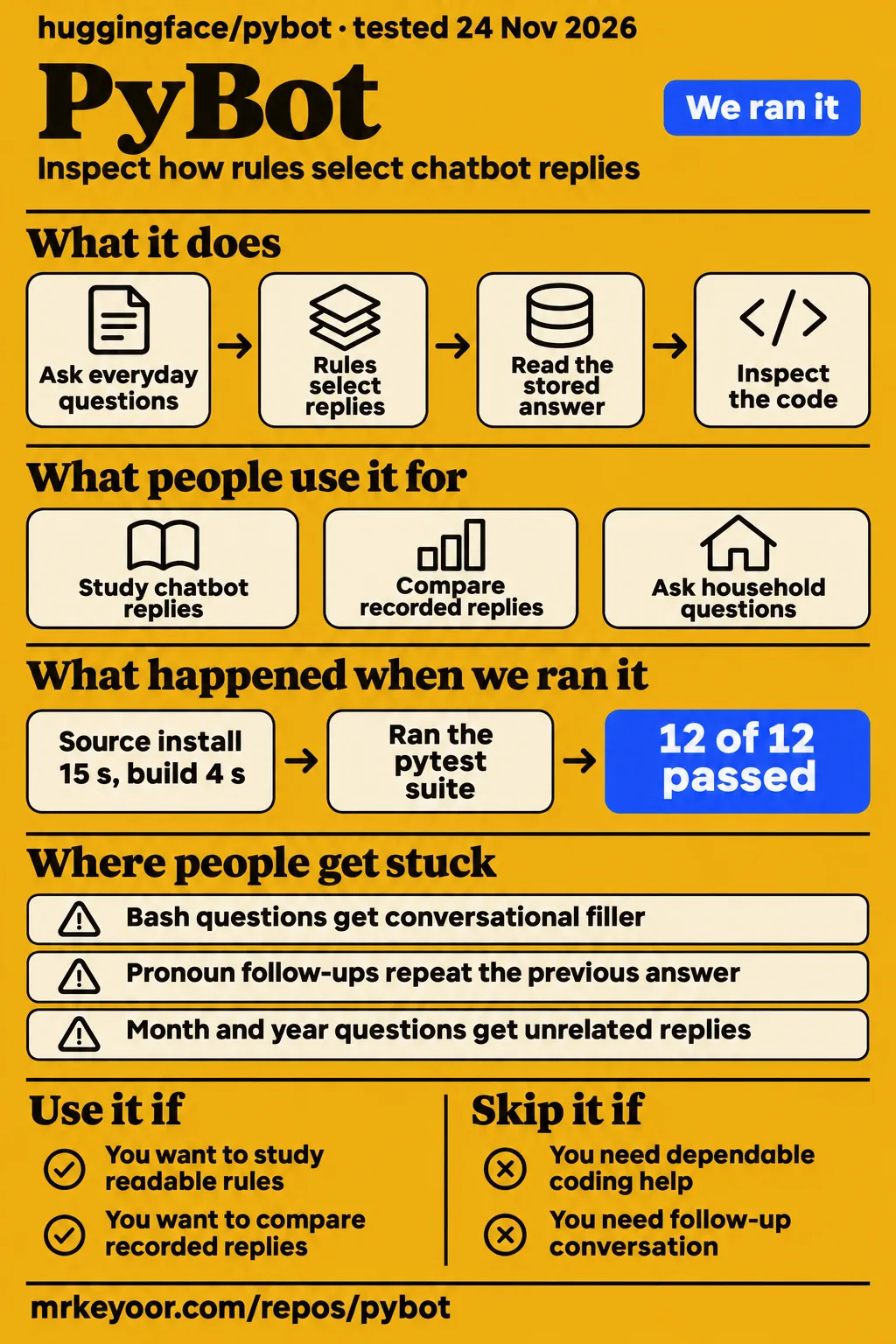
Our run installed PyBot in 15 seconds, built it in 4 seconds and passed all 12 recorded tests in 38 seconds. Use it if you want to study how a large collection of readable rules chooses chatbot replies. Skip it if you need dependable coding help or follow-up answers: the author of issue #12 got conversational filler for a directory-listing question, and issue #16 documents lost subjects. Our sandbox results support the setup finding; issue #12 and issue #16 explain the recommendation.
What people use PyBot for
Hugging Face PyBot answers messages by choosing among Python rules and stored replies, making it useful for examining how a chatbot selects an answer. The README describes modules proposing replies and an arbiter choosing the winner. You can follow that choice into code instead of treating every response as an opaque model output. That makes the failures worth studying even when the answers themselves aren't useful.
| Who used it | What they did | What came back |
|---|---|---|
| GitHub AI repo, the demo-video reviewer | Asked everyday questions and curveballs in the official demo, then repeated the conversation in a fresh browser | Reported 17 good answers among 19 scored everyday questions, two successes among eight curveballs, and identical replies to all 28 messages on repetition. The video calls this a small, reviewer-scored sample. |
| The author of GitHub issue #12 | Asked for bash help, car information and arithmetic | Reported filler for bash questions, car-maintenance advice instead of a list of cars, and arithmetic that depended on phrasing. The issue also shows arithmetic that worked. |
| Stepfunction on r/LocalLLaMA | Asked questions after release | Reported getting greeting responses instead of useful answers. Stepfunction's comment describes their experience. |
| The rsbot author | Ported PyBot to Rust and compared recorded replies and memory against a pinned Python commit | Reported identical replies across 2,198 single-turn prompts, 9,348 conversation turns and 9,000 synthetic turns. The port documents its pinned reference and comparisons. |
The demo video gives the clearest example of the tradeoff. PyBot remembered that the reviewer's dog was called Biscuit and answered household questions successfully. Asked how many days are in a leap year, it returned advice about weekly alcohol limits. The reviewer traced that answer to a prewritten passage in a Python file. You can inspect where the words came from, but you still need to judge whether they answer the question.
What happened when we ran it
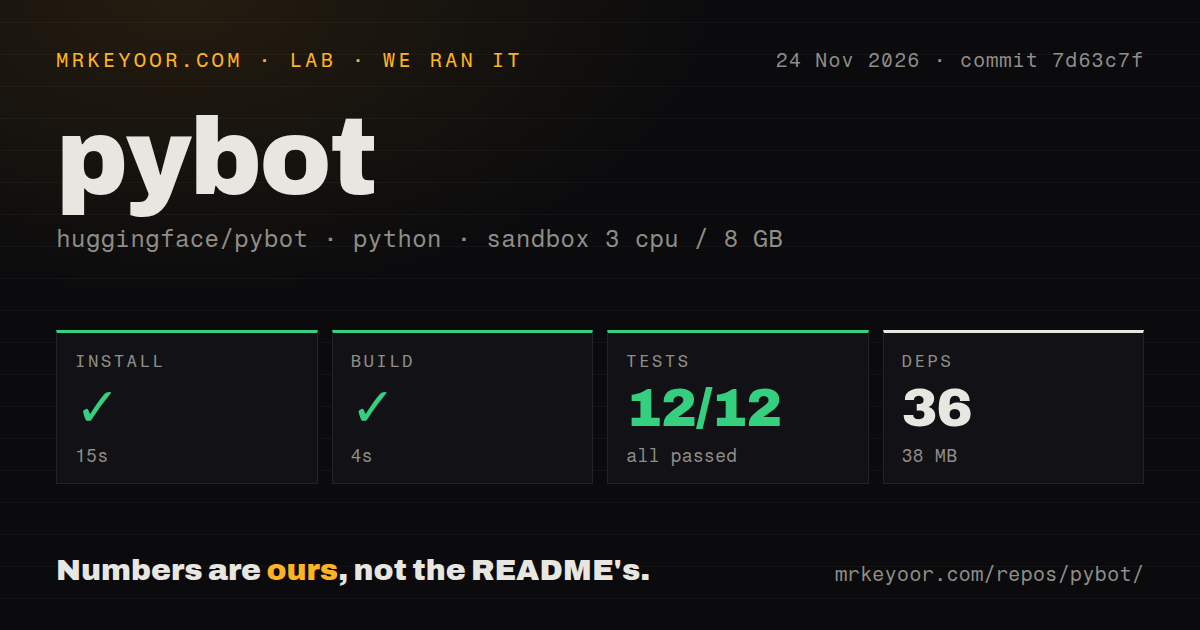
Our November 24, 2026 sandbox run at commit 7d63c7f completed installation in 15 seconds, the build in 4 seconds and pytest in 38 seconds, with 12 passed and zero failed out of 12. Those are our recorded repository checks, separate from the attempted deployment below.
| Repository check | Recorded result |
|---|---|
| Install | Succeeded in 15 seconds; 36 dependencies recorded; 38 MB on disk |
| Build | Succeeded in 4 seconds |
| Tests | Succeeded in 38 seconds; pytest: 12 passed, zero failed of 12 |
| Checkout | 537 files, approximately 637,437 source lines, 42.8 MB |
| Automation signals | Zero CI workflow files, no Dockerfile, a tests directory present |
The sandbox configuration allocated 3 CPUs and 8 GB RAM and named the image ghcr.io/astral-sh/uv:python3.12-bookworm. The actual runtime and operating-system versions require the raw toolchain logs. The measurement describes the configured sandbox, so the image name isn't a compatibility result for a particular Python release.
The separate deployment attempt stopped at its safety check. It returned unsafe repo: none of compose.yaml, compose.yml, docker-compose.yaml, docker-compose.yml exists (rule: a compose file is required). The failed step records the missing Compose file. PyBot's documented terminal route uses Python directly, so this result describes a requirement of that deployment runner, rather than a failure of the terminal chatbot.
The run summary says it deployed with its own Docker Compose and bound ports to localhost, contradicting the failed step. We treat the deployment as blocked. The teardown returned “ok”. There is no successful chat exchange to narrate from that attempt.
Where people get stuck: wording changes the selected answer
The author of issue #12 got a correct multiplication answer for “How much is 32 times 23” and a fallback for “how about 43 times 342.” The posted conversation shows both results. That distinction matters more than a generic statement that PyBot supports arithmetic. A task can fit the bot's rules in one sentence and miss them in a follow-up.
| Reported problem | What the reporter observed | Fix status in the discussion |
|---|---|---|
| Bash and factual questions | Issue #12's author got conversational filler for listing files and maintenance advice for “What cars Dacia makes” | The issue is open; a reply describes PyBot as an experiment. No completed remedy appears in the thread. |
| Pronoun follow-ups | Issue #16's author reproduced repeated answers, missing subjects and fallbacks after questions about Stonehenge, Paris and Cleopatra | Open, with no demonstrated fix or workaround in the discussion. The report pins commit 7d63c7f. |
| Month and year questions | Issue #17's author got unrelated answers for month and year while full-date questions worked | Open; the requested change is to narrow the date response to the component asked for. The report shows the actual selected modules. |
| Hidden handler errors | Issue #22 describes a safety-handler exception being caught and skipped | Draft changes cover the regex and verbose error reporting. The issue presents proposals, rather than a shipped correction. |
The Stonehenge conversation is particularly revealing. PyBot's first answer already placed the monument in Wiltshire. When the reporter asked “where is it?”, PyBot repeated the previous answer rather than extracting the place. In the Paris conversation, “how many people live there?” worked, while “where is it?” did not. Issue #16 records this uneven handling of references. Calling it a bot with “memory” leaves out the decision you need to make: whether its memory handles the kinds of follow-ups your users will actually ask.
The video reviewer found another version of this problem. A request to translate into French produced language-learning advice, and a request to spell “necessary” backwards produced a spelling tip. The same mistakes recurred in the second demo run. Repeatability helps you reproduce a defect. It doesn't make the selected answer correct.
Definition lookup can dominate a slow reply
The author of issue #13 traced a slow definition response at 7d63c7f to repeated scans of the knowledge deck. The report identifies _defines in bot/knowledge/lookup.py. This is useful engineering evidence: it names a hot path and supplies an indexing patch, rather than guessing that the whole codebase needs rewriting.
The contributor's proposed change groups candidate entries by key-phrase characteristics before applying the original checks in deck order. The report says replies stayed identical and total reply time fell roughly by half in its two workloads. It also reports a memory cost and a first-definition indexing delay. These are the patch author's measurements of a proposed change, not performance results from our sandbox or an improvement you can assume is in upstream.
For you, the practical consequence is that “no model weights” doesn't settle responsiveness. A rule engine can spend substantial work searching for the right rule. When evaluating a modified copy, preserve the original replies alongside the timing measurements: a faster lookup that chooses a different answer changes the product as well as its speed.
Safety depends on the handler actually running
Issue #22 reports that Python 3.9.6 raises re.error: multiple repeat in the safety handler, after which the runtime catches the exception and skips that handler for the turn. The report names the regex and the skipped behavior. A chatbot that starts and prints replies can therefore still be missing a handler you expected it to use.
The contributor links draft changes for the safety regex, arithmetic follow-ups, verbose import and hook errors, and lookup behavior. These are useful places to investigate a symptom, but the discussion presents them as draft contributions. Don't describe a proposed patch as a default protection already present in your checkout. For an evaluation, pin the commit and inspect the selected module using the README's documented verbose mode.
PyBot vs SmolLM, rsbot and traditional chatbots
PyBot's reported 26% SmolTalkBench win rate is a result against benchmark reference answers, not a general measure of assistant reliability. The README explains the LLM judge comparing replies with a reference. A large language model, or LLM, generates text from learned model weights. PyBot selects replies through code, patterns and stored knowledge, which gives you a different object to inspect and modify.
| Alternative | Why consider it | What the comparison actually supports |
|---|---|---|
| SmolLM-360M-Instruct | You want to evaluate a small generative model rather than edit explicit reply rules | PyBot's authors place its benchmark result alongside SmolLM. The rsbot author reproduced a 26.0% aggregate result on PyBot-equivalent replies with another judge, but did not re-measure the SmolLM baseline. The port makes that boundary explicit. |
| rsbot | You want a Rust port or a browser WebAssembly route for PyBot's behavior | The author reports reply equivalence against pinned inputs. Its speed and memory section labels the figures preliminary and describes unequal measurement conditions. Use the equivalence result without treating the timing table as a controlled race. |
| ELIZA and traditional rule-based chatbots | You want to understand pattern matching and predefined responses | PyBot's README explicitly names ELIZA and asks how far agents can expand the older approach. The project acknowledges that lineage. |
The rsbot author's equivalence work is the strongest reason to consider that port. It concerns a specific reference commit, pinned clock and random seed. It means the port reproduced the recorded behavior, including any poor answers in those conversations. The same README says the “on par with SmolLM-360M-Instruct” comparison was not re-measured. Choose between reproducing PyBot and replacing its behavior before choosing between implementation languages.
What the README gets wrong
The README's Python 3.8-or-newer requirement needs qualification because issue #22 reports a skipped safety handler on Python 3.9.6. The advertised requirement and the reported exception describe different levels of compatibility: launching the program and correctly executing a handler. The report supports correcting the unconditional support claim, without declaring every operation broken on that interpreter.
The README also describes replies taking about a second. Issue #13 reports a slowest reply of 14.7 seconds in its original workload, and the demo reviewer observed some replies taking up to 12 seconds. The profiling report and demo video make that a poor upper-bound expectation. Those observations can coexist with many replies taking about a second.
The launch language on X adds a related reading problem: lvwerra says PyBot “matches Smollm with 360M parameters.” The launch post makes that comparison, while the README places it within SmolTalkBench. Read the benchmark's comparison first. It isn't a promise that the chatbot can substitute for a small model on arbitrary coding or translation requests.
Questions people ask
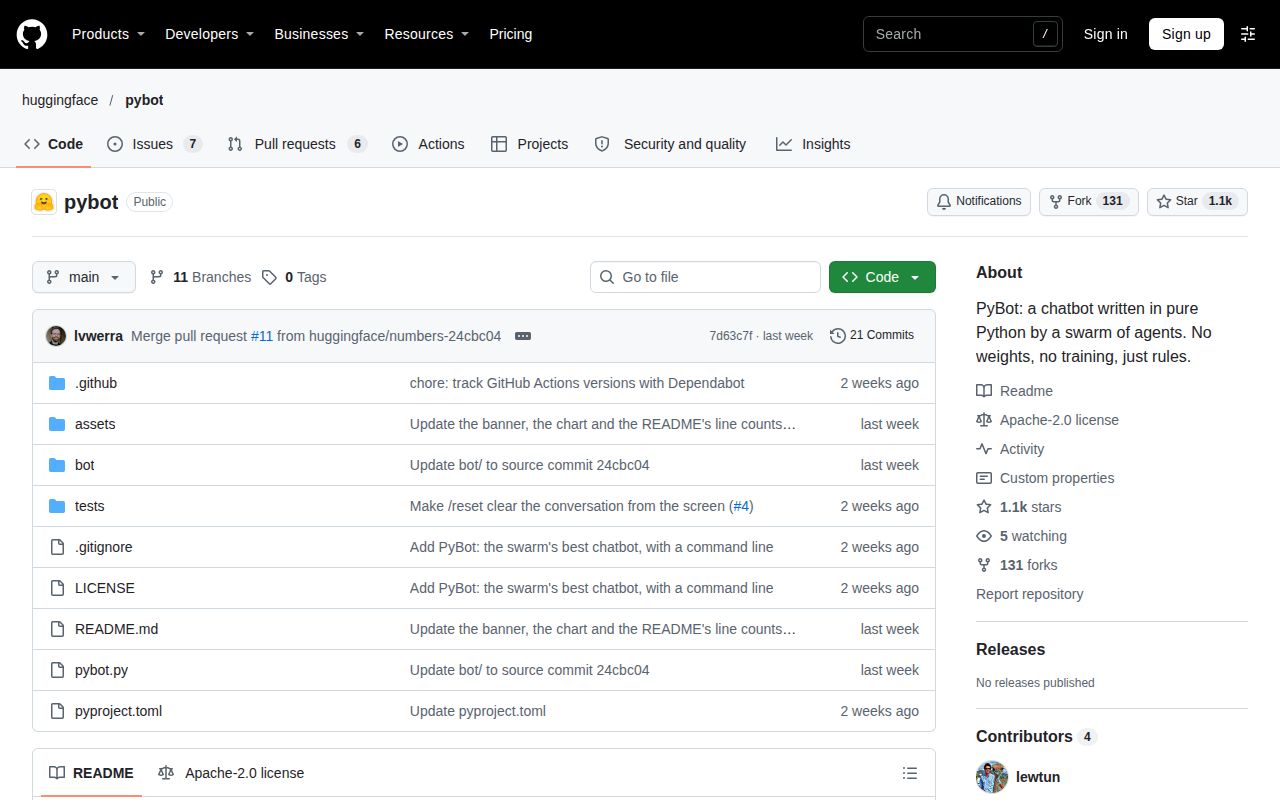
Hugging Face PyBot is a rule-based Python chatbot, and its GitHub repository is huggingface/pybot. The README identifies its mechanism and terminal entry point. Searches for “pybot ai,” “pybot robot” and “pybot meaning” mix products with different purposes, so use the owner name when looking for this chatbot.
What does PyBot mean, and which project does the name refer to?
Here PyBot means Hugging Face's Python chatbot built from explicit rules. The project calls itself “PyBot: can Python be a chatbot?”. That title isn't evidence for a universal expansion of the name. For “pybot github,” the owner-qualified repository is the useful identifier. The unrelated hlmtre/pybot describes itself as an IRC bot, and BenDol/pybot calls itself a Python scripting engine.
Is Hugging Face PyBot the same project as the PyBot SCARA robotic arm?
No: the chatbot's README describes text replies, while Evan Rust's Hackster article describes a physical SCARA arm with motors and a controller board. Searches for “pybot robotic arm” and “pybot scara robotic arm” lead to that hardware project, rather than the Hugging Face chatbot. Robot assembly instructions won't help you run this repository.
Is PyBot Labs connected to Hugging Face's chatbot?
PyBot Labs describes block coding, MicroPython and the Beaver Board; Hugging Face describes a text chatbot. The Labs site identifies its hardware and teaching workflow. Treat them as separate product identities. Neither that page nor the chatbot README documents a connection between them.
Do searches for a PyBot PIN or my ID refer to this chatbot?
The chatbot README documents terminal prompts, reset, exit, seed and verbose controls, without a PIN or “my ID” workflow. The documented interface gives you no reason to enter an account identifier to start this clone. “PyBot PIN” and “PyBot my ID” appear in search suggestions, which alone don't identify the service those searchers meant.
Can Python be a chatbot without model weights or training?
Yes: PyBot uses if-else branches, regex patterns and lookup tables to choose replies. The README describes that runtime design. “No training” refers to the chatbot's mechanism. The same README says AI agents wrote and evaluated the code, so it isn't a claim that generative models played no part in creating the project.
Why build a chatbot from hundreds of thousands of lines of rules instead of using an LLM?
The project's stated experiment is to find how far a rule-based chatbot can go when agents write the rules at scale. The README poses that question explicitly. For you, the benefit is being able to inspect the stored answer and the selection code. The demo review shows the corresponding cost when an unfamiliar request selects an unrelated answer.
What is PyBot actually useful for, and which tasks does it handle well?
The demo reviewer reported useful household and factual answers and remembered conversation details, alongside failed translation and spelling requests. The video's task results support using it to explore reply routing and familiar everyday prompts. For bash assistance, issue #12's posted directory-listing conversation is a concrete reason to choose another tool.
Why does PyBot only give greeting responses to my questions?
Stepfunction reported exactly that experience on r/LocalLLaMA, and the README describes modules competing to supply a reply. The Reddit report establishes the symptom without diagnosing that user's session. The documented -v option shows which module produced a reply, giving you a specific starting point for examining your own input.
Does PyBot work beyond the fixed examples in its demo?
The demo video includes unfamiliar requests that succeeded and others that selected the wrong response. Its small scored sample and repeated mistakes support a task-by-task answer. Neither a successful demo example nor Stepfunction's greeting-only experience describes every possible input. Keep the exact wording with each result if you compare a modified checkout.
Can PyBot help me with bash commands such as listing directory contents?
The author of issue #12 asked how to list files in a directory and received conversational filler instead of a command. The posted exchange is enough to rule it out as a dependable bash tutor on the strength of that example. The discussion's reply describes the project's purpose as exploring the limits of traditional rules.
Why does arithmetic work with one phrasing and fail with another?
Issue #12 shows arithmetic success with an explicit question and a fallback with “how about.” Separately, issue #22 links a draft arithmetic follow-up change concerning an old operand. Those reports describe wording and conversation-state problems, without proving that every arithmetic miss shares one cause. Keep the original prompts attached to the result.
Can PyBot resolve follow-up questions using it, she or there?
Issue #16 shows “there” working in a Paris population question while “it” and “she” fail in other follow-ups. The report includes the preceding answers and the follow-up replies, so you can see what context was available. Its open status and examples support treating pronoun handling as uneven rather than universally absent.
What we have not tested yet
Our successful 12-test run covers the recorded sandbox checks, not a scored conversation benchmark or a deployed chat service. We have not tested sustained load, memory during conversation, multilingual quality, safety behavior, a Python-version matrix or the proposed fixes. The blocked Compose attempt contains no known-answer questions, screenshots or chat latency measurements. The image label alone cannot confirm the actual interpreter or operating system.
The rsbot timings are author-reported preliminary comparisons under unequal conditions. We have not reproduced them, its reply-equivalence runs or its benchmark judging. The reproduced PyBot score does not establish the SmolLM baseline independently. The draft patches in issues #13 and #22 also need merge and checkout checks before anyone treats them as upstream fixes.
Anonymous GitHub API requests for repository facts and the latest release were rate-limited during research, so current stars, last-push date and release status are omitted. The PyPI page for pybot-hf returned an access challenge, leaving package ownership and metadata unresolved. Search suggestions and Bilibili app-building titles don't connect their PIN, ID or app-building products to this repository. Start an evaluation from the owner-qualified GitHub clone and keep the commit, wording and selected module with each result.