SemIf replaces generated answers with option probabilities
Most language-model branches take a long route. An application asks a question, the model writes an answer, and code tries to turn that answer back into a known choice. SemIf skips generation. It presents the state, question, and typed options to a model, reads the logits for fixed answer tokens, and converts those scores into probabilities. No answer sentence needs to be sampled or repaired.
That makes sense for work such as choosing a support queue or deciding whether evidence supports a claim. It also changes what the result means. SemIf's probability is conditional on the options in that prompt. It is not a measured chance that the action is correct. The README tells users to calibrate and validate on their own workload, which is exactly the right boundary for a model-backed if.
What happened when we ran it
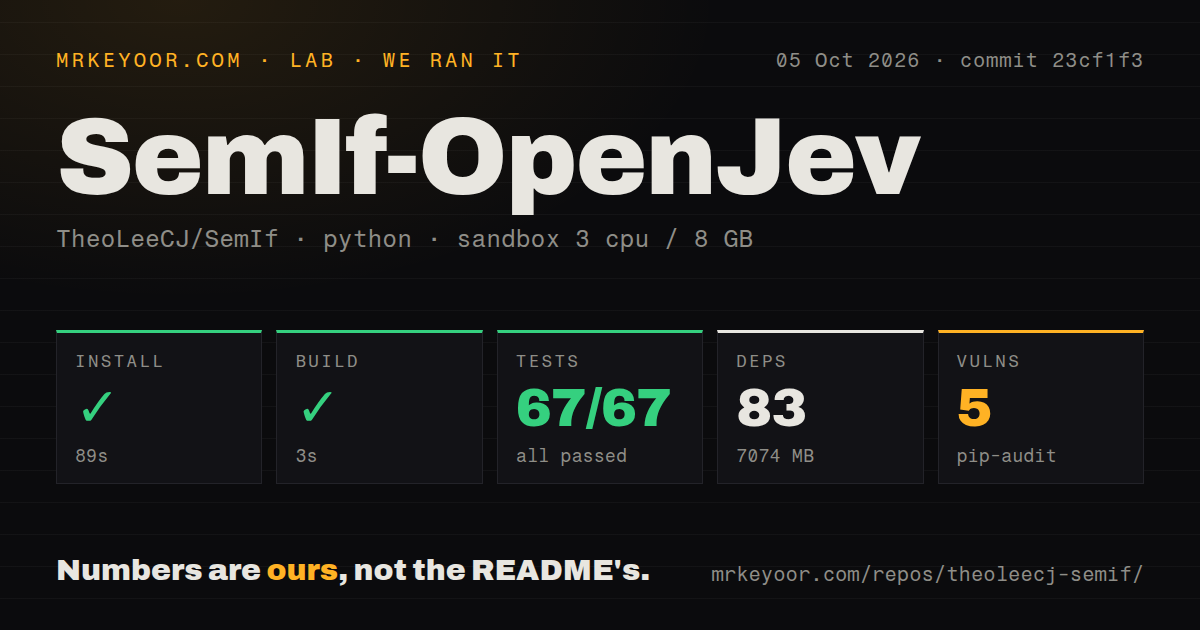
Our sandbox installed commit 23cf1f3 in 89 seconds and pulled 83 Python packages. The environment used 7,074 MB on disk before any separate model weights. Building the package took 3 seconds. We used an unprivileged Debian container with 3 CPUs, 8 GB of RAM, and no secrets; the checkout itself had 158 files, roughly 6,046 lines of source, and occupied 20.8 MB.
Pytest completed in 11 seconds with 67 passed, 0 failed, and 3 skipped. That is a good result for the code path available in our container, and the repository does have a dedicated tests directory. Pip-audit also reported 5 known vulnerabilities. The supplied audit result does not name their packages or severity, so it supports a dependency review, not a claim that SemIf is exploitable.
The repository contains no CI workflow and no Dockerfile. A clean local suite therefore does not show that upstream reruns the same checks on every pull request or publishes a standard runtime image. Reproduce our success in your target base image, then add the model and backend checks that a 3-second package build cannot cover.
A 4B model is outside the 7,074 MB environment
The default example uses Qwen3.5-4B in BF16 on a CUDA GPU. SemIf pins the model revision in its command and writes revision, prompt hash, timings, and library versions into each result. That provenance is excellent practice. You still need space for the downloaded weights, a compatible driver, and a Hugging Face cache, none of which is included in our measured 7,074 MB Python environment.
Hardware choices are broader than the main example. Apple Silicon can use PyTorch MPS or the native MLX backend. CPU users can install the llama.cpp extra and point the tool at a local GGUF. The documentation warns that direct and prefix-cached llama.cpp execution may differ slightly, so it recommends comparing decisions or probabilities with tolerance rather than expecting identical raw logits.
Prefix reuse is faster, but it can change a decision
SemIf has direct, serial, and shared modes. Direct mode scores each row fresh. Serial mode caches a repeated state across consecutive questions, while shared mode prefills one identical state and branches across criteria. The authors' 777-decision benchmark reports substantial speed gains from reuse, but also says BF16 execution changed 5 or 6 argmax choices compared with fresh scoring. That is a decision change, not harmless timing noise.
Open issue 31 finds a separate shared-state defect. The input validator accepts strings, objects, and arrays, yet some valid string and object endings produce a prefix mismatch in shared mode. The issue includes a tokenizer-only reproduction and says array states avoid the reported boundary problem. Until a fix lands, test actual production-shaped state values and keep direct mode as the reference.
Option order deserves its own regression set. The repository has an open pull request proposing order-sensitivity measurement and stabilization, while the committed method already includes reversed-option perturbations. Any system that chooses actions from a small score difference should check both orderings. If the route flips, the application needs an abstain path rather than a confident branch.
The evidence is more useful than the headline speed
The repository commits fixtures, row-level outputs, prompt hashes, source selections, raw reports, and checksum manifests. Its method document separates authored decisions, WANLI, a public TypeSafe subset, and Every artifacts instead of collapsing unlike tasks into one accuracy number. It also says the Jev comparison uses public records rather than a live Jev endpoint. These details make the published results inspectable.
The authors compare direct logits with compact generated arrays on the same frozen 4B model. They are careful to say the choices agreed on only 18 of 21 criteria, so the timing table is a systems comparison rather than proof of semantic equivalence. That qualification matters more than the speed ratio. A branch that arrives earlier but chooses differently needs its own accuracy threshold.
The repository is active and still very young
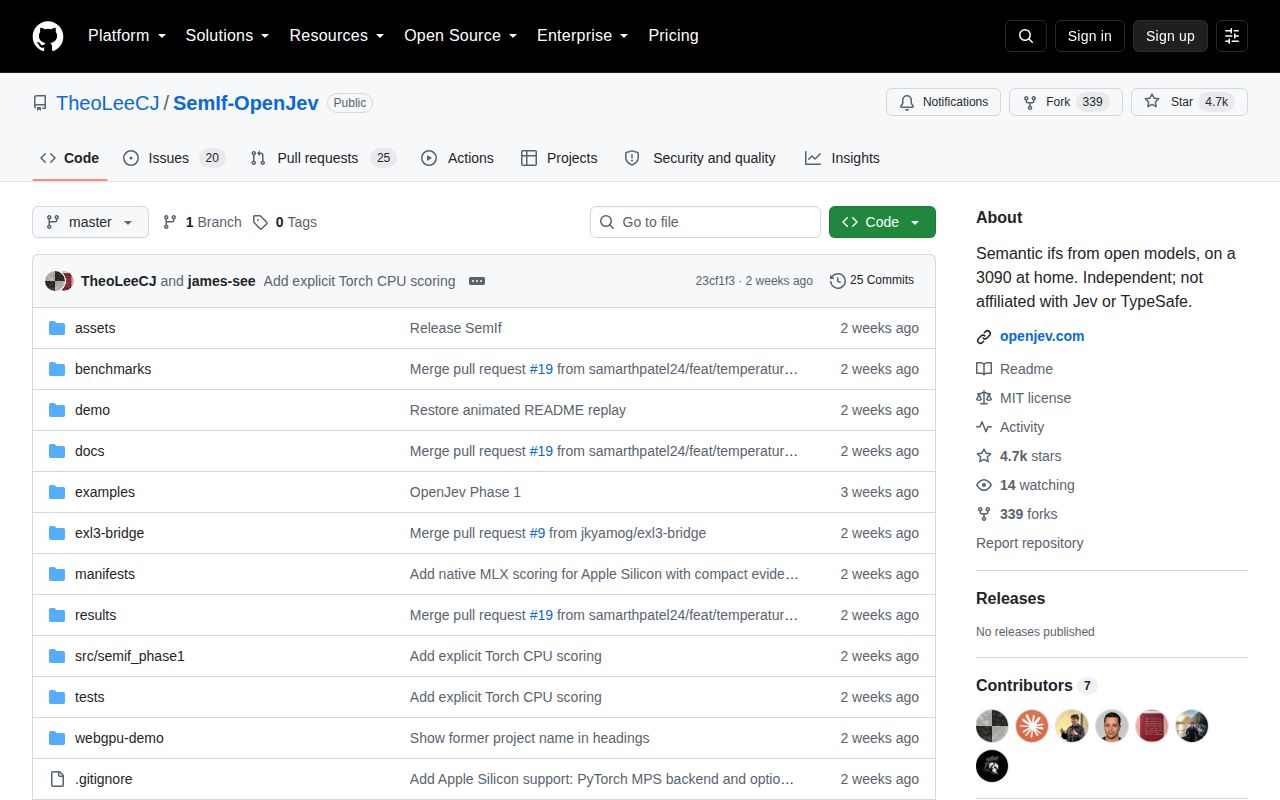
GitHub now redirects TheoLeeCJ/SemIf to TheoLeeCJ/SemIf-OpenJev. The project was created September 16, 2026, last pushed September 23, and has 4,693 stars. Tracker activity continued through October 4. Its 45 open items split into 20 issues and 25 pull requests, and there is no published GitHub release. Popularity arrived faster than release discipline.
Several open reports affect setup or correctness. Issue 49 says Jinja2 is needed for prompt rendering but is absent from the declared dependencies. Issue 39 reports an Apple Silicon test importing a symbol unavailable in the pinned mlx-lm version. Pull requests propose fixes, an HTTP server, extra backends, and calibration tools, but open work is not shipped behavior.
SemIf is worth a trial when you have labeled decisions, local model hardware, and room to abstain or fall back. Its transparent evidence is a better reason to test it than the promise of a faster if. The production question is whether the exact model and prompt remain accurate under your states, options, and backend. The included 67 passing tests cannot answer that for you.